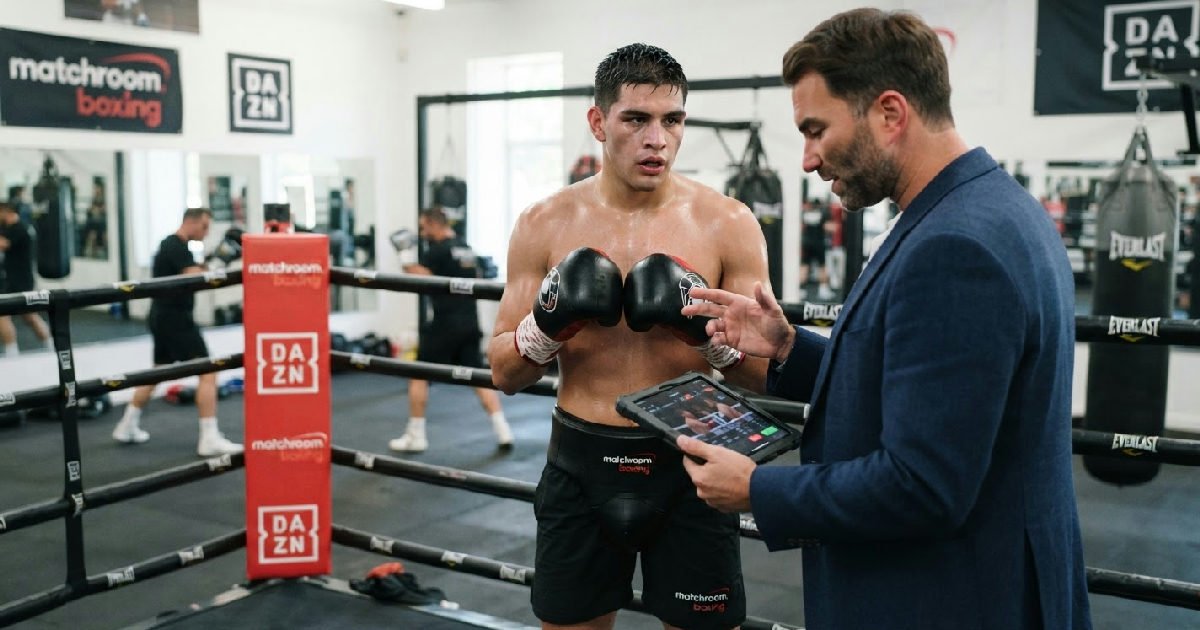
Matchroom Boxing Chairman Eddie Hearn is pumping the brakes on Diego Pacheco’s rapid ascent toward a world title shot, signaling that the undefeated super middleweight contender remains a work in progress. Despite Pacheco’s recent knockout victory and his own desire to challenge for a world title, Hearn is exercising caution following a harrowing bout last December that exposed serious defensive flaws in the 25-year-old fighter.
Pacheco, who boasts a professional record of 26-0, has been vocal about his readiness for the division’s elite, specifically targeting WBA champion Jaime Munguia. But the chilling memory of his fight with Kevin Lele Sadjo, where he was dropped and repeatedly hurt, has forced his promoter’s hand. Hearn now suggests more “seasoning” fights are in order before risking his long-term investment against a reigning champion.
The Kevin Lele Sadjo scare that changed diego pacheco’s timeline
The entire calculus around Pacheco’s future shifted on December 13, 2025. On that night, the powerful French-Cameroonian Kevin Lele Sadjo gave the 6’4” American all he could handle in Stockton, United States.
Sadjo found a home for his power shots throughout the bout, putting Pacheco on the canvas and visibly hurting him on several other occasions. It was a stark warning sign for a fighter who had largely dominated his opposition until that point.
Pacheco survived the onslaught and won a unanimous decision, but the manner of his survival drew heavy criticism from fans. He resorted to excessive clinching to smother Sadjo’s offense and buy recovery time. The holding arguably saved him from being stopped, a tactic that a less lenient referee might not have tolerated, as seen in other recent bouts.
The greater concern for Matchroom is how easily Sadjo repeatedly damaged Pacheco. The prospect, signed with Matchroom Boxing in 2018, is known for his punching power, but his upright stance leaves his head exposed for clean shots. Hearn believes that if Pacheco’s punch resistance does not match his fighting style, placing him against an aggressive champion would be a major risk.
A contender’s ambition versus a promoter’s caution
For his part, Diego Pacheco believes the time for learning is definitively over. “I’m in the second stage of my career now where the learning stage is over,” Pacheco told The Ring. “Now it’s time to go all in and really build that legacy, and I’m going to get there by finding the top names.”
He followed up his Sadjo bout with a decisive win on July 18, 2026, defeating Immanuwel Aleem by knockout at the Dignity Health Sports Park in Carson, California. That victory, his 19th by knockout, showed patience before closing the show in the 11th round. But Aleem lacked the ferocious power and pressure that Sadjo brought.
The bout with Aleem served more as a confidence-builder than a true test of whether Pacheco had fixed the issues from his previous fight. Following the win, Pacheco immediately called for a title fight with Jaime Munguia. While some fighters push for big names, others view top contenders as a challenge to be dismissed, creating a complex matchmaking calculus.
Eddie Hearn, however, sees things differently. Rather than Munguia, the names being floated by the Matchroom boss are Bruno Surace and Armando Resendiz. These opponents are seen as solid, developmental steps—fighters who can provide valuable rounds and different looks without the immediate high-stakes risk of a world title bout.
It’s a classic move designed to protect a valuable asset while keeping him active and learning on the job.
The strategic crossroads for Matchroom
Hearn and Matchroom are now at a pivotal juncture with their 25-year-old prospect, who holds a 73.08% knockout rate across his 26 wins. Continuing to match him against developmental opposition risks stagnation and diminishes his market value over time. But throwing him in too deep, too soon could derail the entire project and the years of investment.
The challenge for Hearn is that Pacheco is approaching his athletic prime, and with 26 professional fights, he’s far from a raw novice. Ingrained habits, like his upright defense and tendency to clinch when hurt, may be difficult to unlearn in simple training camps. At some point, Matchroom must put him in a sink-or-swim fight to discover if he can truly handle the elite level.
A fight with WBA champion Jaime Munguia offers a belt, a significant payday, and a chance for Pacheco to build his brand in Southern California, potentially setting up a future mega-fight with Canelo Alvarez. Another option is a clash with IBF champion Osleys Iglesias.
That fight might be easier to secure due to Iglesias’s lower commercial profile, but sources suggest it would be a far more difficult technical challenge to win.
Defensive liabilities exposed against the aggressive pressure
The key takeaway from the Sadjo fight was the stark realization of Pacheco’s defensive liabilities against aggressive, high-pressure opponents. Despite his lanky 6’4” frame and 79-inch reach—attributes that should allow him to control distance—Pacheco struggled when Sadjo closed the gap and launched sustained attacks. When hurt, Pacheco’s dependence on clinching was evident.
This tactic raises questions about his ring intelligence and stamina under fire, as clinching is a temporary fix that can lead to point deductions or exhaustion. For the Matchroom Chairman, this tactical flaw is compounded by the structural weakness of Pacheco’s upright posture, which invites hard counter shots from seasoned professionals.
For Pacheco, who won eight amateur National championships before turning pro, the fight against Sadjo was his first major brush with true professional adversity. The results were concerning enough to give his experienced promoter pause. The reality is that a single defensive flaw can be the great equalizer, neutralizing every other advantage a boxer possesses.
Evaluating the crowded super middleweight division
Diego Pacheco’s journey isn’t happening in a vacuum; the 168-pound division is currently one of boxing’s deepest. It is ruled by undisputed champion Canelo Alvarez and features other proven champions like Jaime Munguia and Osleys Iglesias. For Pacheco to truly ascend, he must prove he belongs in that top tier, a step he hasn’t definitively taken yet.
The performance against Sadjo suggests he may not be ready for that championship level just yet. It highlights the vast chasm between being a talented, undefeated prospect and being a hardened, proven world champion. Champions like Munguia have been tested under the brightest lights, whereas Pacheco’s vulnerability was alarming.
Hearn’s strategy with Pacheco can be contrasted with his general philosophy. The Matchroom Chairman has often stated that his approach is to “upset people quickly” to build interest, suggesting a willingness to put fighters in “risky match ups.”
That he is being so publicly cautious with Pacheco speaks volumes about the specific concerns raised in the Sadjo fight and is a departure from his usual plans for other rising stars. The decision reflects a tailored approach, acknowledging that not all prospects develop at the same speed.
The calculated future for diego pacheco
The immediate future for Diego Pacheco seems clear: another fight or two before the end of the year, likely against an opponent from the list of names Hearn has mentioned, such as Bruno Surace or Armando Resendiz. The goal will be to work on his defensive liabilities in a live-fire situation without the career-altering risk of facing a champion right now.
Pacheco’s physical gifts are undeniable, including his formidable size and power. He is undefeated in 26 contests and has shown the ability to finish opponents late, as he did against Immanuwel Aleem. But the Sadjo fight was a crucial lesson in the reality of championship boxing.
Ultimately, the final decision rests with Eddie Hearn, Matchroom Boxing’s Chairman. While Pacheco is eager to prove his worth, his career is in the hands of a promoter who is paid to see the big picture and maximize long-term return. For now, the picture is one of managed, careful progression.
The message is clear: Diego Pacheco is a future star, but that future will have to wait just a little bit longer.