
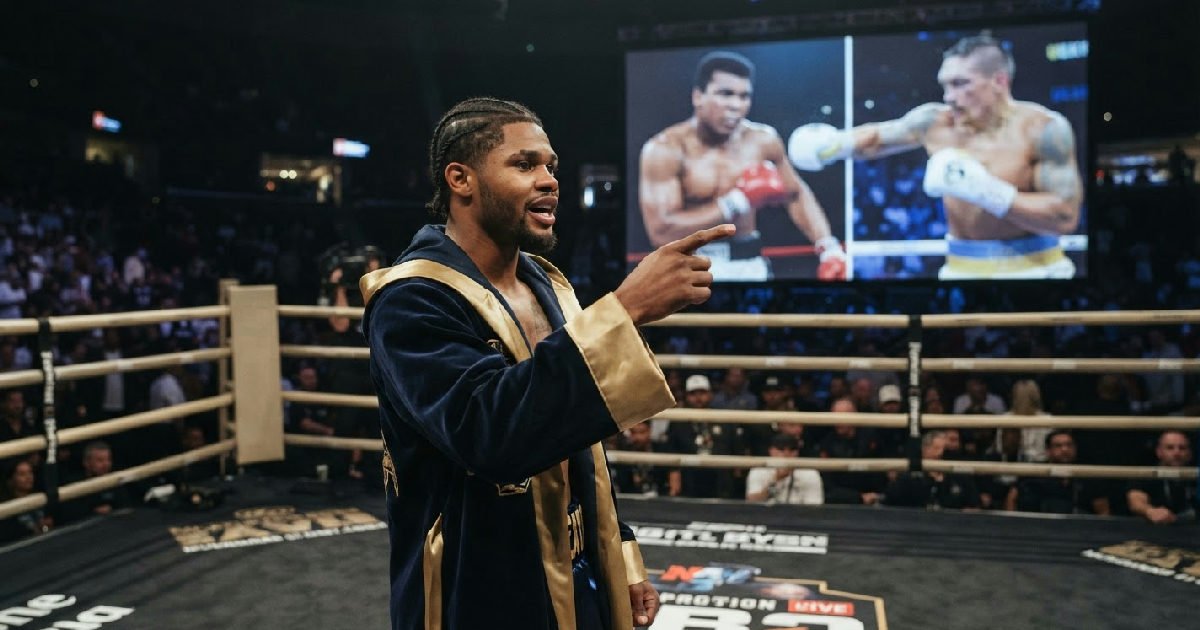
Shakur Stevenson picks Ali as the only American heavyweight who would have defeated current unified champion Oleksandr Oleksandrovych Usyk in a hypothetical matchup. Stevenson’s strong endorsement of “The Greatest” comes as Usyk, 39, appears to be nearing the end of his illustrious career.
Stevenson, a four-division world champion himself, acknowledged both fighters’ exceptional skills but ultimately sided with Ali. His comments, made to Daily Mail Boxing, highlight the perennial fascination with comparing boxing legends across different eras.
Why Shakur Stevenson picks Ali: skill vs. skill in heavyweight fantasy
Ash-Shakur Stevenson didn’t hesitate when asked to pick a winner in a dream fight between Muhammad Ali and Oleksandr Usyk. He admitted it was an incredibly tough call due to the supreme skill sets of both men.
Ultimately, Stevenson chose Ali, emphasizing the legendary American’s unparalleled blend of speed, footwork, and tactical genius. His perspective underscores a common sentiment among boxing purists who often look to Ali as the benchmark for heavyweight greatness.
Oleksandr Usyk’s dominant heavyweight reign
Oleksandr Usyk has cemented his status as one of boxing’s pound-for-pound elite, reigning as a two-division undisputed champion. The Ukrainian’s journey through the cruiserweight and heavyweight divisions has been marked by technical mastery and unwavering resolve.
His impressive heavyweight resume includes significant victories over Anthony Joshua, whom he defeated twice, and Tyson Fury, whom he also conquered twice to achieve undisputed status. Usyk’s precise boxing and strategic approach have dismantled bigger, stronger opponents.
Even a recent controversial stoppage win against Rico Verhoeven in May 2026, which Stevenson himself commented on, did little to tarnish Usyk’s overall standing. He proved capable of finishing the fight despite a perceived subpar performance. Usyk is now reportedly planning his final professional fight before retirement.
Muhammad Ali: The undisputed standard of heavyweight boxing
Muhammad Ali remains, for many, the gold standard of heavyweight boxing. His career spanned one of the division’s most competitive eras, featuring a murderers’ row of Hall of Fame talent. Ali’s unique combination of athleticism, charisma, and resilience captivated the world.
Ali’s list of vanquished foes reads like a who’s who of boxing history: Joe Frazier, George Foreman, Sonny Liston, and Ken Norton, among others. These rivalries produced some of the sport’s most iconic and brutal contests, solidifying Ali’s legacy.
His 1977 points victory over Earnie Shavers, a fighter renowned for his devastating punching power despite never holding a world title, further illustrates Ali’s willingness to face and overcome dangerous opposition. This era of heavyweights presented a constant stream of top-tier challenges.
Comparing boxing eras and stylistic clashes
The hypothetical clash between Muhammad Ali and Oleksandr Usyk invites endless discussion about how different eras of boxing would stack up. Ali fought in a time often characterized by powerful, aggressive heavyweights, against whom his movement and counter-punching were revolutionary.
Usyk, on the other hand, operates in an era where technical boxing and movement at heavyweight are increasingly valued. His southpaw stance, exceptional footwork, and relentless work rate present a unique puzzle for any opponent.
A fight between a prime Ali and Usyk would pit two masters of movement and ring generalship against each other. It’s a fascinating study of boxing’s evolution, where each fighter represents the pinnacle of their respective generations.
Stevenson’s own path to boxing prominence
Ash-Shakur Stevenson, at 29 years old, has rapidly ascended to the top ranks of professional boxing. He has already secured world championships in four different weight classes, from featherweight up to junior welterweight. This achievement places him among an elite group of multi-division champions.
In January 2026, Stevenson defeated Teofimo Lopez by unanimous decision, adding the World Boxing Organization (WBO) and Ring magazine junior welterweight titles to his collection. His undefeated professional record of 25 wins with 11 knockouts speaks to his dominant presence in the sport.
Stevenson’s technical prowess and defensive skills have drawn comparisons to some of boxing’s all-time greats. His ongoing career suggests he may one day enter conversations similar to the Ali-Usyk debate. Stevenson’s own journey, which has included intense challenges like those he might face from Emiliano Vargas, shows he understands the pressure of elite competition.
Usyk’s acknowledged skill, Ali’s unmatched opposition
While Oleksandr Usyk is widely regarded for his exceptional skill, some argue that the overall depth of opposition he has faced at heavyweight doesn’t quite match the gauntlet Muhammad Ali ran. Ali consistently battled multiple Hall of Famers at their peak.
Usyk’s wins over Tyson Fury and Anthony Joshua are undoubtedly significant. However, the heavyweight division during Ali’s time featured a greater number of consistently dominant and historically significant fighters. This perspective often fuels arguments in favor of past generations.
Stevenson’s choice reflects this sentiment, acknowledging Usyk’s technical brilliance but perhaps nudging Ali ahead due to the sheer force of his era. It’s a testament to Ali’s enduring impact that even in 2026, he remains the benchmark for ultimate success.
The enduring appeal of cross-era boxing debates
Discussions about fantasy matchups between boxing legends are a cornerstone of the sport’s culture. They allow fans and experts alike to dissect fighters’ strengths, weaknesses, and historical contexts. These debates bridge generations, keeping the legacies of past champions alive and relevant.
Shakur Stevenson’s recent comments are a prime example of this phenomenon, igniting conversations among fans about how Oleksandr Usyk’s unique style would fare against Muhammad Ali’s legendary speed and footwork. Such hypotheticals enrich the sport’s narrative.
These conversations also serve to contextualize current champions within the broader history of boxing. When Oleksandr Usyk is discussed in the same breath as Ali, it highlights the Ukrainian’s extraordinary achievements, even if he’s ultimately deemed second-best in a fantasy scenario.
Boxing legends like James Toney have also weighed in on who they consider the best. Such opinions from current and former fighters always carry significant weight.
What’s next for Usyk and the heavyweight landscape
As Oleksandr Usyk contemplates his final professional fight, the heavyweight division is poised for a new chapter. His departure will leave a significant void, with contenders vying for the titles he vacates. The landscape will shift dramatically without the undisputed king.
For Usyk, his legacy is secure, marked by historic undisputed reigns in two weight classes. His final fight will be a momentous occasion, regardless of the opponent. The boxing world will watch closely as one of its most skilled practitioners makes his exit.
Stevenson’s contribution to the great debate only adds to Usyk’s storied career, placing him in direct comparison with the sport’s ultimate icon. It’s a testament to the Ukrainian’s greatness that such a discussion is even plausible, even if he’s picked to fall short against “The Greatest.”
Stevenson’s perspective on skill and all-time great status
Shakur Stevenson’s decision to back Muhammad Ali over Oleksandr Usyk underscores his deep understanding of boxing fundamentals. Stevenson himself is known for his exceptional defensive skills and technical precision, qualities he clearly values in others. His respect for Usyk’s abilities is evident, calling him one of the most “skilful” heavyweights ever.
Yet, Ali’s historical dominance and the sheer quality of his opposition likely tipped the scales for Stevenson. It’s a recognition that true all-time great status often requires not just talent, but also a career forged against the very best of an era. Ali’s victories over Joe Frazier and George Foreman stand as monumental achievements that are hard to parallel.
This kind of analysis from a current pound-for-pound contender like Stevenson offers valuable insight. It shows how modern fighters view the giants of the past and what criteria they use to judge ultimate greatness. Stevenson’s own climb through divisions, including his win over Teofimo Lopez, gives him unique authority.
Ultimately, such fantasy matchups serve as more than just pub talk; they are a way to measure the enduring impact of boxing legends. Stevenson’s pick reaffirms Muhammad Ali’s almost mythical status while acknowledging Oleksandr Usyk’s place among the modern elite.