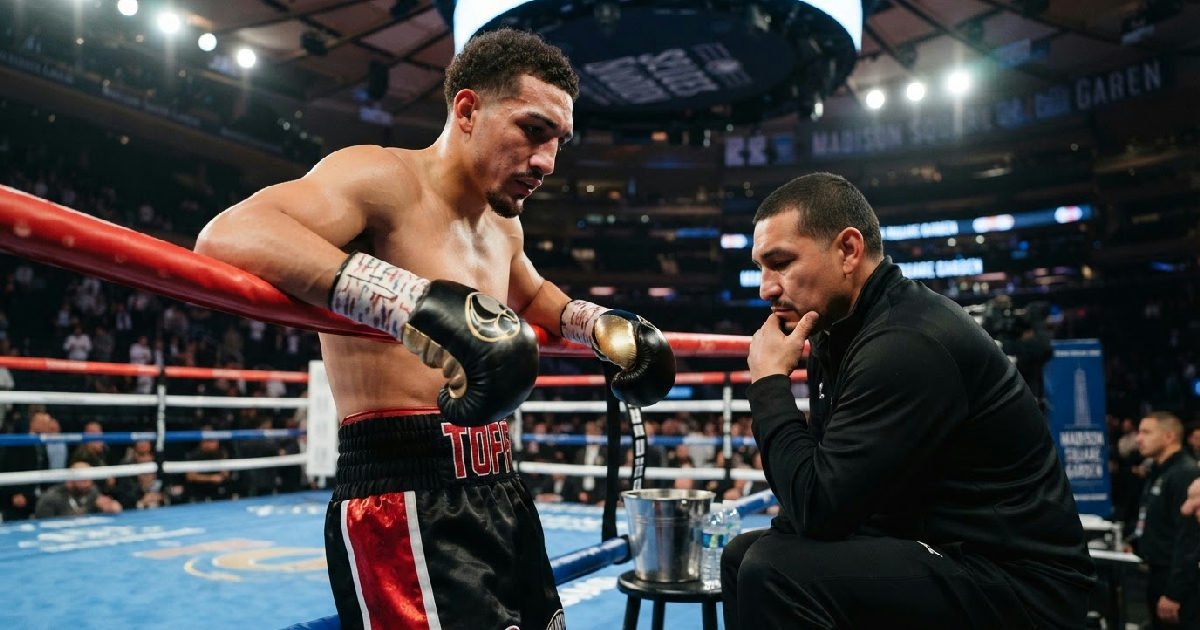
Teofimo Lopez Sr. faces Teofimo Lopez father blame for the former junior welterweight champion’s January loss to Shakur Stevenson. , the former junior welterweight champion, has publicly attributed his January loss to Shakur Stevenson primarily to his father and trainer, Teofimo Lopez Sr.
This blame game, unfolding in recent interviews around August 14-15, 2026, highlights a tense disagreement between the father-son duo over the reasons for the Madison Square Garden defeat.
The public airing of grievances raises significant questions about Lopez Jr.’s mindset as he prepares for a crucial welterweight title challenge against Rolando “Rolly” Romero later this August.
Lopez Jr. points finger at his corner after Stevenson defeat
During a candid conversation on the Mr. Verzace podcast, Lopez Jr. complained about the instructions he received while Shakur Stevenson controlled the fight. His father, Teofimo Lopez Sr., recognized the implied criticism, telling his son, ‘You’re blaming me for it,’ even as Lopez Sr. eventually accepted much of the blame himself. This uncomfortable exchange underscores lingering tension within the Lopez camp.
The genesis of this public dispute lies in Teofimo Lopez Jr.’s January defeat to Shakur Stevenson, a fight where Lopez Jr. landed just 72 punches compared to Stevenson’s 165. Lopez Jr.
vividly recalled his corner’s performance, stating, “When you’re bleeding, when they’re allowing Shakur to do all these extra things, and you’re in there and you’ve broken the record for most attendance in Madison Square Garden, your trainer is not giving you instructions, they’re just talking you down.”
He specifically cited his father questioning his power during critical moments of the fight.
This candid recollection suggests a breakdown in communication and trust at a pivotal moment. Lopez Jr. felt a distinct lack of strategic guidance, instead hearing demoralizing questions about his performance. While he acknowledged his own responsibility, saying, “Sometimes you just got to take it for what it is.
I got to take [responsibility] for my actions when I’m wrong,” the sentiment clearly leaned towards his corner’s perceived failings.
“That wasn’t my son” — Lopez Sr.’s counter-narrative
Teofimo Lopez Sr., a constant presence in his son’s boxing life since age six, offered a different perspective on the Stevenson fight. He stated bluntly, “that wasn’t my son” in the ring, suggesting a fighter he didn’t recognize. Lopez Sr. claimed the game plan was sound but his son failed to execute it, particularly regarding rhythm.
He further posited that external factors played a significant role, telling reporters around February 1, 2026, “I think probably the networks and everybody, the media, everything leading up to this fight… I think that probably got to him.” Lopez Sr.
believes outside forces actively tried to “mess with him mentally,” leading to his son’s uncharacteristic performance. He has since quit social media, perhaps as a response to this perceived mental interference.
A fighter’s tactical limitations against Shakur Stevenson
Beyond the finger-pointing, boxing analysts suggest that a fundamental mismatch in fighting styles and Teofimo Lopez Jr.’s inherent limitations played a major role in the Stevenson loss. Stevenson, known for his elite jab, timing, and movement, effectively negated Lopez Jr.’s primary weapon: power. Lopez Jr.
has historically been a boxer who relies on loading up single, powerful shots before retreating, rather than a high-volume pressure fighter.
A different tactical approach was likely needed against Stevenson, one focused on staying close, throwing constantly, and attacking the body. This strategy aims to deny an opponent like Stevenson the space to reset, but it requires exceptional conditioning. Asking Lopez Jr. to suddenly adopt such a relentless, high-contact style would mean rebuilding a fighting style honed over fifteen years.
He simply isn’t built for that kind of non-stop pressure, which demands a willingness to absorb significant punishment. His past reactions to taking clean punches suggest that turning a bout into a high-contact battle isn’t a realistic solution for him.
The challenge of adapting a fifteen-year style
Teofimo Lopez Sr. has guided his son for virtually his entire career and is intimately aware of his limitations. Transforming Lopez Jr. into a pressure fighter in a single training camp was an unrealistic expectation. His reactions to taking clean punches in previous fights, particularly against George Kambosos Jr. and Sandor Martin, showed he struggles with sustained, close-quarters combat.
Fighting from a distance offered little hope either, as Lopez Jr. lacked the reach advantage to control Stevenson with a jab. With both fighters essentially even in that department, attempting to outbox Stevenson, whose defensive prowess is widely recognized, was an improbable strategy. Ultimately, Lopez Sr.
likely felt compelled to rely on the power shots his son knew best, even if they proved ineffective against Stevenson’s elusive style.
Career trajectory and weight class struggles
Teofimo Lopez Jr.’s struggles extend beyond his relationship with his father and the Stevenson fight; they reflect a broader trend since he left the lightweight division.
At 135 pounds, his size, youth, speed, and power provided distinct physical advantages, culminating in his career-defining victory over the naturally smaller and late-prime Vasiliy Lomachenko on October 17, 2020, unifying several lightweight titles. Lopez Jr. was just 23 years old when he achieved this feat.
However, the move to 140 pounds, and now an anticipated move to 147 pounds for his fight against Rolando Romero, has seen these advantages diminish considerably. He hasn’t consistently showcased the destructive power and presence that defined his lightweight tenure. This shift has raised questions about his long-term viability in higher weight classes where opponents often match or exceed his physical attributes.
Composure issues resurface
Another persistent concern for Lopez Jr. is his composure under pressure. While he performs exceptionally well when a fight is going his way, his tactical discipline often wavers once an opponent starts gaining momentum. He described his night against Stevenson as a “full blur,” recalling a point where he believed his father was not right and Shakur was already winning.
This mirrors past instances where he was dropped by George Kambosos Jr. in 2021 and frustrated by Sandor Martin on December 10, a performance described as ‘just as bad’ as his Kambosos loss. When punches land and the crowd reacts, Lopez Jr.
can become desperate for a dramatic finish rather than calmly addressing the tactical problem at hand. Readers can find more details on this upcoming bout in Lopez’s title aspirations.
Industry figures weigh in on Teofimo’s mental state
The public spat and Lopez Jr.’s perceived struggles have not gone unnoticed by prominent figures in the boxing world. Promoter Bob Arum told Sky Sports News that Lopez Jr. is “Mentally, he is collapsing. Mentally, he’s not there for me.” This assessment from a veteran promoter like Arum highlights the seriousness of the situation within the sport’s elite circles.
WBA light welterweight champion Regis Prograis also weighed in, suggesting Lopez Jr. is “mentally crumbling” at this stage of his career.
Prograis, while expressing admiration for Lopez Jr., also issued a warning: “I love Teo, I don’t want to say anything bad about him, but if he fights me, I will to hurt him well it is necessary.” These comments underscore a growing perception among his peers that Lopez Jr.’s mental fortitude is a significant vulnerability.
The looming Rolando Romero challenge and future implications
As Teofimo Lopez Jr. prepares for his welterweight title challenge against Rolando Romero, the narrative surrounding his father and his past performances casts a long shadow. A new trainer might initially appear to be a solution, especially if matched against an opponent who offers countering opportunities and allows for power shots.
However, the core issues of adapting his fighting style and managing his composure under duress would likely persist against elite opposition. For information on potential mandatory challengers, see Jack Catterall’s title push.
Lopez Sr.’s performance against Stevenson does provide his son with a public justification for making a change. But the challenge lies deeper than just the corner. A new corner can’t magically transform Lopez Jr. into a fighter he’s never been, nor could his father.
The tactical model to trouble Stevenson existed, but the Lopez camp simply didn’t have the fighter with the necessary attributes to execute it. This upcoming fight against Romero will be a critical test, not just of his boxing skills, but of his mental resilience and his ability to move past the lingering blame game.