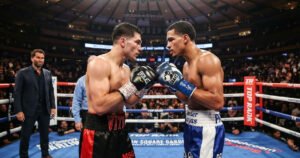
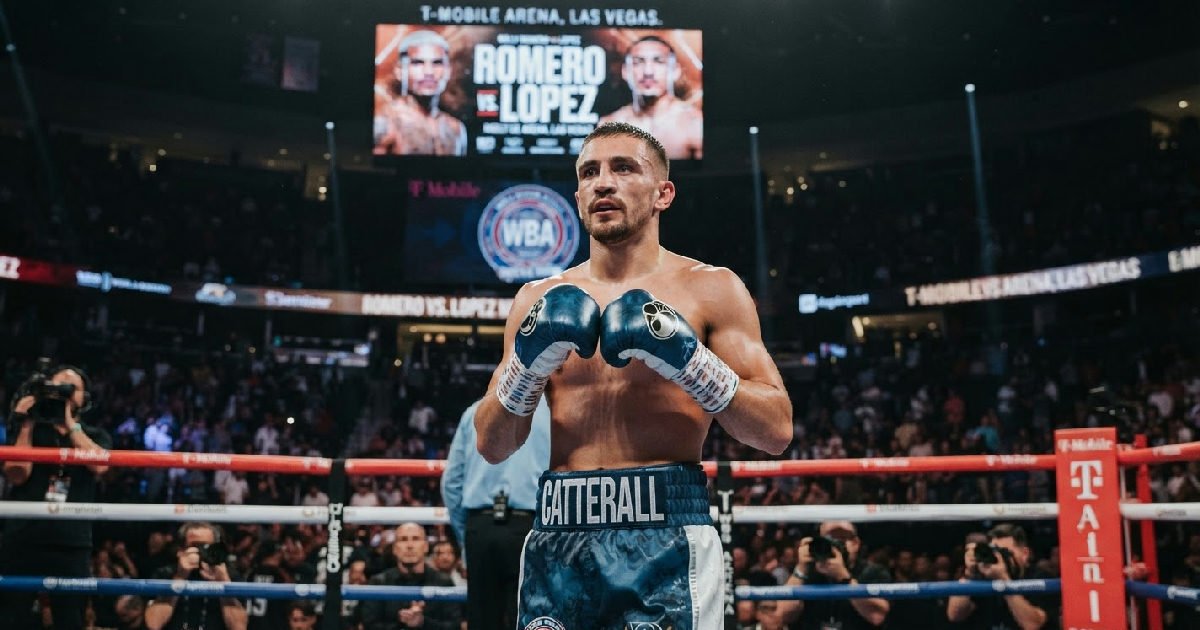
British boxer Jack Catterall stands ready to enforce his contractual right to challenge the winner of the upcoming Rolando “Rolly” Romero vs. Teofimo Lopez bout. Catterall holds a WBA mandatory challenger position, a claim that could significantly disrupt lucrative plans for either fighter following their August 22 showdown for Romero’s WBA Welterweight Title at the T-Mobile Arena in Las Vegas.
The Chorley southpaw has a deadline of November 19, 2026, for the victorious fighter to agree to terms, a situation that puts the WBA champion in a tricky position as other high-profile, bigger-money fights loom.
Catterall’s contractual claim to welterweight title shot
Jack Catterall, boasting a 33-2 record with 14 knockouts, isn’t just vying for an opportunity; he believes his contract guarantees him a shot. After his unanimous decision win over Shakhram Giyasov in May 2026, Catterall became the WBA Regular welterweight champion.
This position then placed him as the mandatory challenger for the WBA Super Welterweight Championship, currently held by Romero. The WBA elevated Rolando Romero to “Super” Champion and subsequently mandated that the winner of the Giyasov vs.
Catterall fight — Catterall, in this case — must face Romero or his successor within 180 days for the Super Championship. This specific clause is now dictating the timeline for the division.
The November 19 deadline for a mandatory defense
Catterall plans to be ringside for the Romero-Lopez clash, keenly aware of the contractual obligation. He confirmed to Ring Magazine that the winner has until November 19, 2026, to finalize a deal for the mandatory defense.
This date isn’t arbitrary; it’s directly tied to the 180-day window stipulated by the WBA after his victory in Egypt. It means the new champion will have just under three months to navigate their next steps.
Romero vs. Lopez: the looming welterweight clash
The fight at the center of this controversy pits two prominent names against each other for the WBA Welterweight Title. Rolando “Rolly” Romero, with a record of 17-2 (13 KOs), will defend his belt against the ambitious Teofimo Lopez, who enters with a 22-2 record (13 KOs).
This August 22 event at the T-Mobile Arena in Las Vegas marks a significant moment, as it’s the inaugural PBC world title fight for the new DAZN era, also available on Prime Video. The main event ringwalks are yet to be confirmed, but the action starts at 8 p.m. ET / 5 p.m. PT.
Fighters’ backgrounds and recent form
Romero, a 30-year-old from Las Vegas, hasn’t fought since May 2025 when he defeated Ryan Garcia by unanimous decision to claim the vacant WBA “regular” welterweight title. He was then elevated to full champion status in August 2025 after Jaron “Boots” Ennis moved up to 154 pounds.
Teofimo Lopez, 28, from Brooklyn, is making his welterweight debut. He’s looking to become a three-division world champion, a notable ambition for Teofimo Lopez’s title challenge in a new weight class. His last fight was a unanimous decision loss to Shakur Stevenson in January 2026, costing him his WBO junior welterweight belt.
Criticisms and promotional aspects
Lopez’s immediate WBA title shot at welterweight has drawn scrutiny from some in the boxing world. Critics question why he didn’t face a ranked contender in the division first, and why WBA No. 1-ranked Raul Curiel wasn’t next in line for a title shot. Both Lopez and Romero were previously sparring partners, adding an interesting dynamic to their upcoming bout.
Romero, for his part, has a history of “ruffling a few feathers” by reportedly sidestepping mandatory challengers, including Shakhram Giyasov and Jack Catterall. This pattern suggests a preference for more commercially viable matchups over immediate mandatory defenses.
Jack Catterall blocks bigger fights: money talks
Catterall’s mandatory status creates a significant roadblock for the Romero-Lopez winner. While the contract guarantees Catterall a shot, the reality is that other fights could generate far more revenue and prestige for the champion.
This isn’t just about a belt; it’s about the business of boxing. Champions often seek out the biggest paydays and unification bouts, which Catterall’s challenge temporarily obstructs.
The allure of Haney, Garcia, and Benn
The welterweight division currently offers highly enticing alternatives for the winner of Romero vs. Lopez. Devin Haney and the victor of the Ryan Garcia vs. Conor Benn fight represent significantly larger commercial opportunities.
These bouts could potentially happen back-to-back, generating substantial revenue that a defense against Catterall might not match. The prospect of these major clashes highlights the competitive nature of the welterweight division, with Devin Haney frequently mentioned for high-profile matchups.
Mandatory hurdles in boxing
Mandatory challenges are a double-edged sword in boxing. They ensure champions face top contenders but can also derail plans for massive fights or unify titles. For a champion, a mandatory defense against a skilled opponent like Catterall, who brings enough ability to win, could ruin their grander financial aspirations.
It’s a classic dilemma: fulfill an obligation for potentially less money, or try to navigate an exit route to pursue more lucrative options.
Precedents and the waiting game
This isn’t the first time a fighter has found themselves in Catterall’s position, nor is it the first for a champion to face such a dilemma. The boxing world is replete with examples of mandatory challengers facing a prolonged waiting game.
This creates a tense situation, as Catterall’s legitimate claim clashes directly with the commercial interests of the champion and their promoters.
Shakhram Giyasov’s experience
Shakhram Giyasov knows this process well. He spent years pursuing his WBA opportunity, often without getting Romero in the ring. Giyasov eventually faced Catterall for an interim title, a fight Catterall won. This history illustrates how champions can “stiff-arm” mandatory challengers through various means, pushing them into interim bouts.
Catterall himself could easily find himself in a similar holding pattern, despite his clear contractual standing, if the winner of Romero-Lopez decides to prioritize other fights.
Hamzah Sheeraz’s WBO dilemma
Another contemporary example mirrors Catterall’s situation: Janibek Alimkhanuly and Hamzah Sheeraz at super middleweight. Alimkhanuly was ordered as Sheeraz’s WBO mandatory, yet taking that fight puts significantly richer opportunities at risk for Sheeraz. This parallel highlights a common problem in the sport.
The Rolly vs. Teofimo winner faces the exact same type of roadblock with Catterall. They’ll have to weigh the risk and reward of fulfilling their mandatory against pursuing other, more financially appealing opponents.
Outlook: Catterall’s confidence vs. champion’s incentives
Despite the potential for the Romero-Lopez winner to seek alternative bouts, Jack Catterall remains confident in his position. He has the backing of his team, including manager Sam Jones and promoter Eddie Hearn, who have reiterated the contractual guarantee.
“I’ve spoke to Sam, I’ve spoke to Eddie and they’ve reiterated it more than once, and it’s in me contract. So, I’m confident the winner will have to fight us,” Catterall told Ring Magazine. This unwavering belief stems from the clear terms of his agreement.
But confidence alone doesn’t guarantee the fight. Rolando Romero has already hinted at his priorities, stating, “There is the [sanctioning body] process, and there are big fights. What’s better for boxing? What will make the sport of boxing bigger, truthfully?” This suggests a champion focused on legacy and financial gain, rather than strictly adhering to mandatory requirements.
Romero also controversially stated, “I am fighting Lopez, who beat both Josh Taylor and Arnold Barboza, the two dudes who beat Catterall.” This rhetoric attempts to undermine Catterall’s standing, though the available records don’t explicitly confirm Lopez’s win over Barboza. Furthermore, Catterall’s professional record shows two losses, one of which was to Taylor.
The larger paydays offered by fights with Devin Haney or the winner of Ryan Garcia vs. Conor Benn will give the next WBA champion strong incentives to find an “exit route” from the Catterall mandatory. This could involve negotiating a step-aside deal or even vacating the title, though the latter is less likely for a reigning champion.
As November 19 approaches, the boxing world will watch to see if Catterall’s contractual claim holds firm, or if the commercial pull of bigger fights will force another twist in the welterweight division’s complex landscape. For now, Jack Catterall remains a significant factor in the immediate future of the WBA welterweight title.