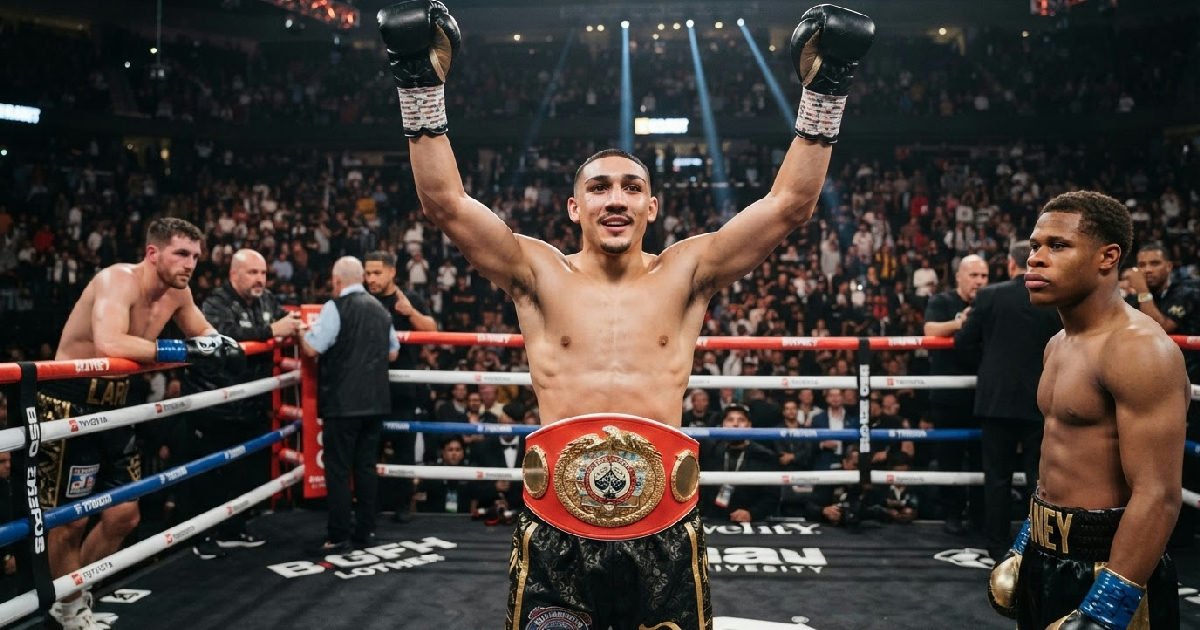
Fresh off securing his World Boxing Association (WBA) welterweight title on August 22, 2026, Teofimo Lopez has unveiled an ambitious plan. The newly crowned champion, known as “The Takeover,” aims to pursue three consecutive Teofimo Lopez unifications.
His strategy involves challenging Liam Paro, the victor of the upcoming Ryan Garcia versus Conor Benn fight, and then ultimately Devin Haney. Crucially, Lopez expects to achieve these Teofimo Lopez unifications without having to fulfill any mandatory title defenses along the way.
Teofimo Lopez unifications: welterweight strategy
Teofimo Lopez made his intentions clear during a post-fight press conference following his victory over Rolando “Rolly” Romero at the T-Mobile Arena in Las Vegas. He views his new DAZN contract as a direct pathway to undisputed status within the welterweight division.
“I got three fights with DAZN, and all of them are the road to undisputed. We’re going right to every world title. We’re not taking no title defense, no nothing. Whoever’s next, we’re going for him,” Lopez stated.
This aggressive schedule would see Lopez move from one championship fight to the next, provided his promotional and sanctioning bodies agree. Each of these high-stakes matchups requires extensive negotiations and recovery periods, which could span well over a year.
The first step in Lopez’s plan hinges on the outcome of the Ryan Garcia versus Conor Benn fight, scheduled for September 12, 2026. After that, he’d look to face the winner before moving on to Liam Paro or Devin Haney, aiming to consolidate multiple belts.
Navigating boxing’s mandatory defense rules
Boxing’s four major sanctioning bodies, including the WBA, typically require champions to face mandatory challengers periodically. These rules ensure that top-ranked contenders get a shot at a world title, maintaining the sport’s competitive integrity.
WBA “regular” champions usually need to defend their titles every nine months. “Super” champions get a longer window, up to 18 months, but mandatory defenses are still a fundamental part of the championship structure. This is where Lopez’s plan presents a significant deviation.
While unification bouts can supersede mandatory defenses, they generally require approval from the relevant sanctioning bodies. Lopez’s aspiration for three straight unifications without a single mandatory defense is an unusual request that tests the boundaries of these regulations.
If granted, this would mean top contenders, who have often fought eliminator bouts to earn their mandatory status, would remain on the sidelines. They’d be forced to wait, potentially 12 to 18 months, or take additional fights to protect their rankings.
The role of DAZN and financial incentives
Lopez’s strategy is intrinsically linked to his exclusive multi-fight agreement with DAZN, signed in July 2026 and reportedly valued at $20 million. This deal gives him greater control and access to opponents across various promotional partners, fostering a path toward lucrative bouts.
Unification fights are highly attractive for broadcasters and promoters. They generate significant revenue and fan interest by reducing the number of champions in a given division. This financial pull often gives them priority over less glamorous mandatory defenses.
But the repeated use of this priority could be seen as bending the rules for a financially appealing fighter. Such a scenario highlights the tension between boxing’s commercial interests and its established competitive framework. For Lopez, it’s about maximizing his earning potential and legacy.
Lopez’s previous career trajectory also shows a pattern of high-stakes matchups. He became a unified lightweight champion in 2020 and a light-welterweight champion in 2023, demonstrating his willingness to face elite competition. This new DAZN deal provides the platform for his welterweight ambitions.
Potential impact on challengers and the WBA
Should the WBA and other sanctioning bodies approve Lopez’s plan, it would create a significant bottleneck for other contenders. Fighters like Rolando “Rolly” Romero, whom Lopez recently defeated, or other rising talents, could face prolonged delays in their title pursuits.
The concern among many boxing observers is that this approach could set a precedent. It might allow other high-profile champions to consistently bypass mandatory obligations, further frustrating the careers of deserving, but less commercially viable, challengers. This isn’t just about Teofimo Lopez, it’s about how the entire system operates.
The WBA, in particular, will face scrutiny for its decision-making. Their rules are designed to ensure fair play, but they also have discretion to grant exceptions for “special circumstances,” like unifications. Allowing three consecutive exceptions, however, pushes the definition of “special.”
This situation underscores a recurring debate in boxing: the balance between major, fan-demanded fights and the systematic progression of contenders. The WBA’s ruling will send a clear message about its priorities. It could either uphold the competitive ladder or lean into the commercial draw of star power.
Outlook: a high-stakes gamble for “The Takeover”
Teofimo Lopez’s vision for his welterweight reign is bold, but it comes with considerable risks. A single loss during this ambitious run would transfer the collected titles, potentially restarting the entire process for waiting challengers under a new champion. Boxing is a sport where one punch can change everything, and unification bouts are notoriously tough.
Executing this plan also requires navigating complex negotiations between multiple promoters, networks, and boxing organizations. Even with DAZN’s backing, securing agreements for three such high-profile fights in a relatively short timeframe is a monumental task.
Lopez himself sustained a cut over his right eyebrow in the Romero fight, which might force a delay in his return. Such setbacks are common in boxing and can easily disrupt carefully laid plans, making the proposed 12-18 month timeline even more challenging to meet.
Ultimately, Teofimo Lopez is betting on himself to rewrite the script for championship reigns. If he succeeds, he’ll solidify his legacy as one of boxing’s true modern greats, unifying an entire division without the traditional detours. If not, the welterweight landscape could become even more convoluted.