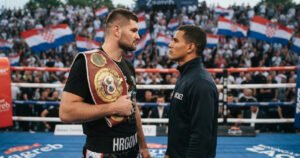
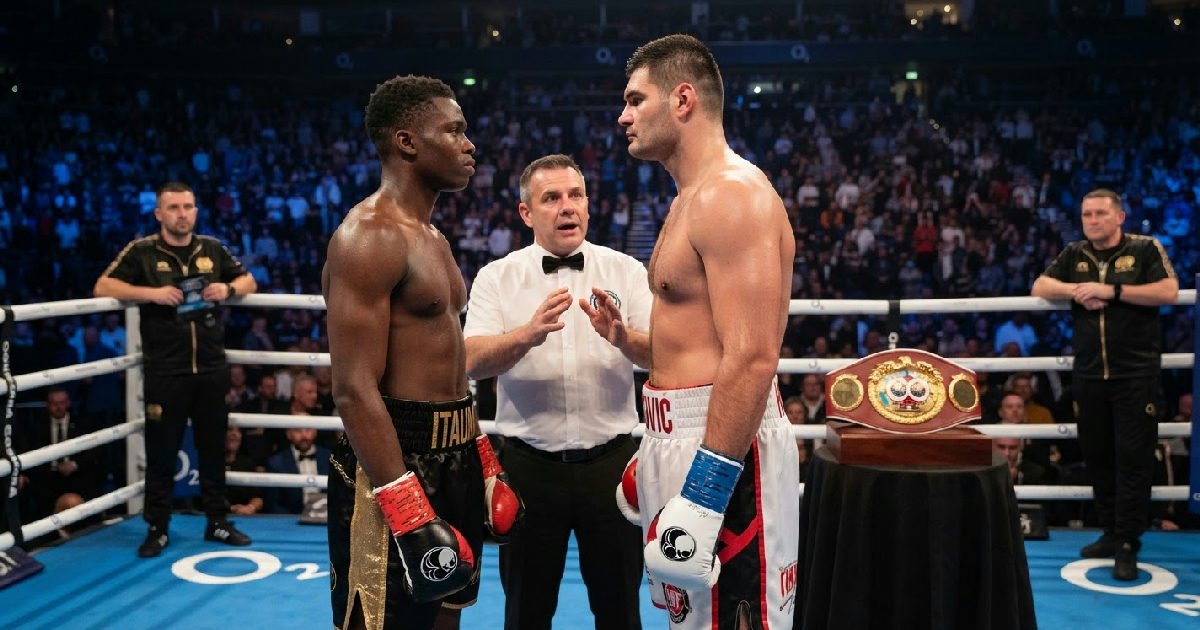
British heavyweight prospect Moses Itauma is set to challenge Filip Hrgovic for the vacant IBF Heavyweight Championship of the World on Saturday, August 29, 2026, at the O2 Arena in London. This Moses Itauma Hrgovic PPV event is being heavily promoted around Itauma’s potential to become the second-youngest heavyweight champion in boxing history.
However, industry observers are questioning whether this statistical milestone will truly translate into robust pay-per-view sales for DAZN.
Moses Itauma Hrgovic PPV Marketing Strategy
Despite Itauma’s undefeated professional record and impressive knockout ratio, critics suggest his fighting style and reserved public persona aren’t generating the kind of must-watch excitement typically needed to anchor a high-profile pay-per-view. The strategy relies heavily on a historical narrative rather than dynamic in-ring action or engaging promotional banter.
Queensberry Promotions and DAZN are banking on the allure of a potential record-breaking achievement to draw in viewers for the fight. If Itauma, who is 21 years old and was born on December 27, 2004, defeats Hrgovic, he’ll capture the IBF belt at 21 years, eight months, and one day old.
This would place him just behind Mike Tyson, who became champion at 20 years, four months, and 22 days.
This pursuit would also put Itauma ahead of Floyd Patterson, who claimed a vacant heavyweight title at a slightly older age. But simply moving up a list doesn’t necessarily guarantee fan engagement or PPV buys. Fans tend to pay for compelling narratives or explosive action, not just statistics.
The emphasis on Itauma’s age and the record chase highlights a promotional challenge. DAZN is reportedly leaning on this angle because Itauma may not possess an inherently “engaging personality” or a fighting style that makes fans feel compelled to watch him perform.
Contrasting styles with Mike Tyson’s appeal
Comparing Moses Itauma to Mike Tyson, while relevant for the age record, inadvertently underscores the current promotional hurdles. Tyson was already a massive draw before he stopped Trevor Berbick for the WBC belt in 1986. His destructive approach and aggressive ring presence made him “must-see television.”
Tyson pressed forward relentlessly, stayed in the pocket, and overwhelmed opponents with powerful combinations. His fights promised aggression and violence, guaranteeing excitement for his audience. Itauma’s southpaw style, however, is a different proposition.
He often fights from the outside, picking his shots rather than engaging in continuous close-quarters combat. When opponents apply pressure, he tends to retreat to reset. This tactical and effective approach is less likely to generate the raw, visceral excitement that drives DAZN paywall criticism.
Some analysts have likened Itauma’s fighting style to a larger version of Shakur Stevenson. This comparison, while acknowledging its effectiveness, also points to a more cerebral, less explosive ring generalship. It’s a style that prioritises victory but doesn’t always translate to explosive pay-per-view numbers.
Personality lacks pay-per-view sparkle
Beyond the ring, Itauma’s public persona isn’t helping to boost the fight’s commercial appeal. He often appears low-energy during interviews, giving off a reserved vibe rather than a hungry young heavyweight eager to conquer the division. This calm demeanor, while possibly authentic, doesn’t create the buzz required for a major PPV event.
Authenticity can be a double-edged sword in boxing promotion. While fans appreciate genuineness, the high-stakes world of pay-per-view often demands larger-than-life personalities. Itauma’s understated approach presents a stark contrast to the promotional fireworks associated with historical heavyweight attractions.
Hrgovic questions Itauma’s path to contention
Filip Hrgovic, the Croatian opponent, has openly dismissed the hype surrounding Itauma. He highlighted their differing career trajectories, suggesting Itauma has had an easier route to a world title shot. Hrgovic pointed out his own “10 times harder path” through the World Series of Boxing (WSB).
Hrgovic fought elite amateurs from Cuba, Russia, and other top boxing nations, enduring a grueling journey to the professional ranks. He also won a bronze medal at the 2016 Rio Olympics in the super-heavyweight category, a significant amateur achievement. He believes that coming from a “small country” required immense toughness.
He contrasted this with Itauma, suggesting the British fighter “got everything on the plate” due to the support structure in UK boxing. Hrgovic himself was a youth world champion, but felt “no one cared” about his journey as he climbed through the amateur and professional ranks without the same spotlight.
This perspective from Hrgovic offers a compelling counter-narrative to Queensberry’s promotional efforts. It paints Itauma as perhaps less tested, despite his impressive professional record. Such comments could add a layer of genuine rivalry to the upcoming boxing schedule, but it also underscores the challenges of selling Itauma purely on his own merits.
Itauma’s meteoric rise to world title shot
Despite the criticisms regarding his marketability, Moses Itauma’s professional journey has been nothing short of exceptional. The Slovak-Brit, who moved to the UK at age four, holds an undefeated record of 14 wins, no losses, and no draws. An astonishing 12 of those victories have come by knockout, boasting an 86% KO ratio.
He has rarely been extended, having boxed a mere 31 rounds across his 14 professional fights, averaging just 2.2 rounds per outing. His professional debut in January 2023 saw him secure a knockout in only 23 seconds against Marcel Bode at Wembley Arena. Itauma is also a southpaw, which can present challenges for opponents.
His amateur career was similarly dominant, with 24 undefeated wins, including 11 knockouts. He clinched gold medals at the Schools, Juniors, Youth European, and Heavyweight Youth World Championships, showcasing his pedigree from a young age. This solid foundation set him up for a swift professional ascent.
Key knockout victories on the road to IBF contention
Itauma’s rapid progression is underlined by a series of high-profile stoppage victories against seasoned opponents. In March 2026, he delivered Jermaine Franklin his first career knockout loss in the fifth round at Co-op Live Arena in Manchester. This win demonstrated his power against a durable contender.
Prior to that, in August 2025, a 20-year-old Itauma stopped veteran Dillian Whyte in the first round, just 119 seconds into the fight, at the ANB Arena in Riyadh, Saudi Arabia. He also secured a second-round TKO against Mike Balogun in May 2025 and a first-round TKO over Demsey McKean in December 2024 on the undercard of Oleksandr Usyk vs. Tyson Fury II.
He also retained his WBO Intercontinental title in July 2024, stopping Mariusz Wach in the second round at the O2 Arena. His victory over Ilja Mezencev in May 2024 for the vacant WBO Intercontinental belt on the Usyk-Fury undercard further solidified his status. These fights underscore his genuine talent and devastating power, even if his personality doesn’t match the typical pay-per-view star.
Filip Hrgovic: A decorated amateur with pro resilience
Filip Hrgovic, born on June 4, 1992, in Zagreb, Croatia, brings a significant pedigree to this title fight. Standing 6 feet 6 inches tall with an 82-inch reach, “Hrga” or “El Animal” has a professional record of 20 wins and only one loss, with 15 knockouts, giving him a 75% KO ratio.
His amateur career was highly decorated, including a gold medal at the 2010 AIBA Youth World Boxing Championships.
His bronze medal at the 2016 Rio Olympics in the super-heavyweight division is a testament to his elite amateur standing. Hrgovic turned professional in September 2017, quickly establishing himself as a force in the heavyweight division. He notably defeated Joe Joyce by unanimous decision in April 2025 and David Adeleye by unanimous decision in August 2025, showcasing his ability against top contenders.
His sole professional loss came in June 2024, a technical knockout in the eighth round against Daniel Dubois for the IBF Interim World Heavyweight championship. This loss has only fueled his determination, making him a formidable and experienced opponent for the younger Itauma. Hrgovic’s journey has been one of hard-fought battles, a stark contrast to the perceived easier path of Itauma.
DAZN’s strategy: Balancing subscriptions with PPV
The Itauma-Hrgovic fight also highlights DAZN’s evolving business model. The British streaming platform, which began as a subscription-first service, has increasingly re-introduced pay-per-view for select boxing events. This fight is available on both DAZN PPV and the DAZN Ultimate Tier.
US customers can access the Ultimate Tier for $49.99 per month, while UK customers pay £24.99 monthly. The Ultimate Tier guarantees subscribers a minimum of 12 PPVs annually. This hybrid model aims to capture both dedicated boxing fans and those willing to pay a premium for specific, high-stakes events.
However, the critique that Itauma’s record chase “cannot sell PPV” is a direct challenge to this strategy. If compelling narratives and charismatic fighters are not at the forefront, even a significant historical milestone may not persuade casual fans to part with their money. DAZN needs more than just statistics to justify its premium offerings.
The future of heavyweight attractions
The challenge facing promoters like Queensberry and broadcasters like DAZN is cultivating the next generation of pay-per-view stars. Moses Itauma undoubtedly possesses immense talent and a devastating knockout punch. But the current promotional focus on a statistical record rather than his in-ring magnetism or personality indicates a gap in his marketability.
For the heavyweight division to thrive commercially, it needs compelling rivalries and larger-than-life characters who command attention beyond hardcore fans. While Itauma’s style may be effective, it doesn’t always translate to the explosive, fan-friendly spectacles that generate significant pay-per-view buys. This is where comparisons to Shakur Stevenson’s style come into play.
The August 29 showdown against Filip Hrgovic at the O2 Arena is more than just a title fight; it’s a test of promotional strategy. Can raw talent and a historical record alone drive the commercial success of a major boxing event in today’s competitive sports entertainment landscape?
The answer will have significant implications for Itauma’s future and for how boxing events are marketed to a broader audience.