Heavyweight icon George Foreman has named Ron Lyle as the toughest fighter he ever encountered, a surprising declaration that bypasses his legendary rival, Muhammad Ali. The revelation offers a new perspective on Foreman’s storied career, highlighting a brutal 1976 clash for the vacant NABF heavyweight title.
Foreman, a two-time world heavyweight champion, cited Lyle’s sheer power and resilience as unparalleled. His candid reflections provide a deeper understanding of the physical and mental tests faced by toughest opponents faced by boxing greats.
George Foreman Ron Lyle: A Different Fight
George Foreman, a titan of heavyweight boxing, recently declared that Ron Lyle presented the ultimate challenge of his illustrious career. This statement, shared across various interviews over the years, stands out because it sidelines his more famous adversaries, including Joe Frazier, Evander Holyfield, and most notably, Muhammad Ali.
Foreman’s reasoning is direct and grounded in the raw experience of the fight. “I have to say Lyle because he gave me the toughest fight of my career,” Foreman stated in The Ring Magazine. “He hit me so hard, knocked me down, got knocked down and picked himself up. That was the hardest fight I ever had in my life.”
Contrasting Ali and Lyle Encounters
The distinction Foreman draws between Lyle and Muhammad Ali offers crucial insight into his perspective. Reflecting on their iconic 1974 “Rumble in the Jungle” bout, Foreman felt he “could do whatever I wanted” initially. He believed he only succumbed to exhaustion.
But against Lyle, there was no room for error. “If I had been more respectful of Ali I could have coasted at stages in that fight, and preserved energy, but I couldn’t coast with Ron Lyle because he would have killed me,” Foreman explained. He vividly recalled Lyle’s devastating power, reiterating, “Ron Lyle – never had I been hit so hard; and he did again.”
Foreman further emphasized Lyle’s impact, claiming, “This guy hit me so hard that it didn’t even hurt, I would just find myself on the canvas, knocked down, face first.”
He added that he “kept getting up, he knocked me down again, I think that he beat me up so bad that finally he gave out and I won the boxing match.” These are extraordinary admissions from a fighter of Foreman’s calibre.
He concluded that “Ron Lyle was the strongest man I ever faced in any fight,” a sentiment he has expressed multiple times. These powerful testimonials underscore the unique challenge Lyle posed, transcending even the magnitude of a title fight against Ali.
The Ring Magazine’s Pivotal Role
Foreman’s enduring views on Lyle have surfaced in multiple forums over the years. His interview with RingTV, where he discussed Lyle, was first featured in the March 2016 issue of Ring Magazine. He has consistently maintained this stance.
Further cementing his position, Foreman replied to a fan on Twitter in 2022, once again naming Ron Lyle as the hardest hitter he ever faced. Comments from an interview with BlackTreeTV also referenced similar sentiments in May 2023, showcasing the consistency of his perspective.
Most recently, Foreman reflected on Lyle in another interview with The Ring Magazine, referenced in July 2025. This recurring theme in his public statements highlights the deep-seated respect and memory of their brutal encounter, cementing Lyle’s place in Foreman’s personal boxing hierarchy.
The Epic Foreman-Lyle Showdown of 1976
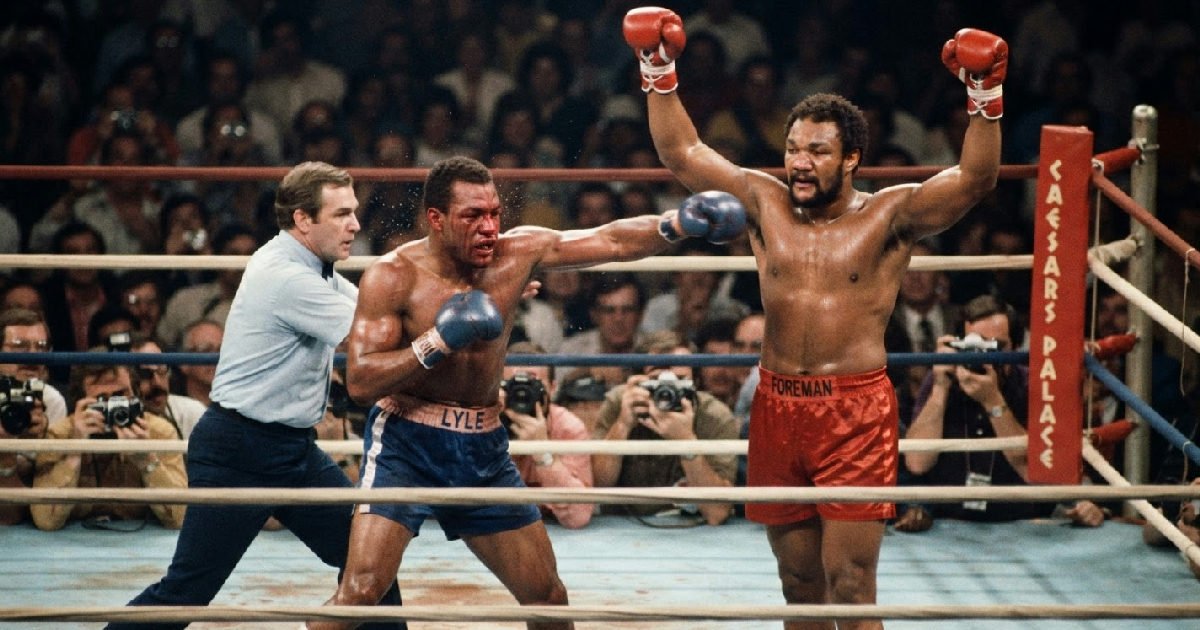
The fight George Foreman so vividly recounts took place on January 24, 1976, at Caesars Palace Sports Pavilion in Las Vegas, Nevada. This highly anticipated bout served as Foreman’s professional comeback after his devastating loss to Muhammad Ali in the “Rumble in the Jungle” back on October 30, 1974.
Foreman, who had been inactive professionally for over a year, aimed to re-establish his dominance in the heavyweight boxing division. He entered the ring with a 40-1 record, having suffered his only defeat to Ali. Lyle, with a record of 31-3-1 (22 KOs), was then ranked as the number-five heavyweight globally by The Ring magazine in March 1976.
The contest itself was a relentless slugfest, living up to its billing as an “all-time great heavyweight war.” Foreman was a 5 to 1 favourite heading into the fight, but Lyle proved to be a formidable and dangerous opponent. Each fighter landed devastating blows throughout the contest.
For their efforts, Foreman received a purse of $250,000, while Lyle earned $140,000. These significant figures underscore the magnitude of the matchup, drawing considerable attention in the boxing world eager to see Foreman’s return to form.
A Fourth Round for the Ages
The fourth round of the Foreman-Lyle clash remains etched in boxing history. It featured an extraordinary exchange of power, with both men hitting the canvas. Lyle managed to knock Foreman down twice, a testament to his raw punching power and resilience.
However, Foreman, known for his own immense power and ability to withstand punishment, retaliated. He sent Lyle to the canvas in the very same round, showcasing the incredible back-and-forth nature of the contest. It was a round of pure, unadulterated heavyweight action.
Ultimately, Foreman secured a victory by knockout at 2:28 in round five of the scheduled 12-round contest. With this win, he claimed the vacant NABF heavyweight title. This brutal encounter was justly named The Ring magazine’s “Fight of the Year” for 1976, a high honour in itself.
The fourth round, in particular, was recognized for its intensity, named the 6th most exciting round in boxing history by The Ring in 2001. Foreman himself considered this victory one of the “finest moments” he ever had in boxing, viewing it as “redemption” after his loss to Ali.
Ron Lyle: The Powerhouse Heavyweight Who Never Won Gold
Ronald David Lyle, born on February 12, 1941, in Dayton, Ohio, developed a fearsome reputation as one of the hardest-hitting heavyweights of his era. His path to professional boxing was certainly unconventional, marked by a challenging youth.
After a troubled start that included incarceration, Lyle discovered boxing while in prison in 1964. He credited the prison’s athletic director, Lt. Cliff Mattax, for fostering his interest and guiding him towards the sport. Lyle turned professional at the age of 30 in 1971.
Throughout his career, Lyle was celebrated for his thunderous punching power and aggressive, crowd-pleasing style. He amassed an impressive professional record of 43 wins, 7 losses, and 1 draw, with a remarkable 31 of his victories coming by knockout. His power was undeniable.
Despite his formidable abilities and memorable performances, Lyle is often regarded as one of the greatest heavyweights never to secure a world title. His most notable world title challenge came against Muhammad Ali on May 16, 1975, in Las Vegas. Lyle was ahead on two of the three scorecards going into the 11th round before Ali rallied to win by TKO.
Lyle’s Unforgettable Power
Lyle’s ability to deliver powerful blows was legendary. Foreman’s vivid recollections are just one testament to this fact. He possessed the kind of knockout power that could turn the tide of any fight, even against the sport’s most dominant figures.
His impressive 31 knockout victories throughout his professional career speak volumes about his devastating impact in the ring. Lyle’s legacy is not just about wins and losses, but about the sheer force and excitement he brought to every contest.
Foreman’s Enduring Respect for Boxing Greats
While Ron Lyle holds a unique place in George Foreman’s personal ranking of toughest opponents, it doesn’t diminish his respect for other boxing legends. Foreman has expressed nuanced opinions on several other prominent figures within the sport, reflecting his deep understanding of boxing history and various fighting styles.
For instance, Foreman has consistently lauded Joe Louis, stating that Louis was the “best boxer” he ever saw. He further proclaimed Louis as the “greatest heavyweight champion of all time,” asserting that “no one is in second place” to the “Brown Bomber.” Foreman praised Louis’s conditioning, skill, and punching power, unequivocally calling him the “hardest puncher.”
Even Muhammad Ali, despite being a fighter Foreman claims he “could do whatever I wanted” against early in their fight, still garners immense respect. Foreman has acknowledged Ali as “the greatest man ever to fight,” though he qualifies this by adding, “but not the greatest boxer.” This distinction highlights Foreman’s appreciation for Ali’s cultural impact and overall greatness, separate from pure boxing technique.
Foreman also holds high regard for Evander Holyfield, another formidable opponent. He has stated that Holyfield “could have competed in any era,” a testament to Holyfield’s versatility, toughness, and enduring skill across different periods of boxing. These comments collectively paint a picture of a thoughtful analyst, not just a powerful puncher.
The Enduring Impact of a Brutal Bout
The 1976 Foreman-Lyle clash continues to resonate with boxing fans and historians, offering a visceral reminder of the sport’s brutal beauty. It wasn’t just a fight; it was a pivotal moment for George Foreman, providing crucial redemption after his defeat to Muhammad Ali.
This encounter underscores that a fighter’s greatest test isn’t always measured by championship belts or global headlines. Sometimes, it’s the sheer, unyielding will and power of an opponent like Ron Lyle that truly defines a legendary career and secures a hardest puncher faced legacy.
The consistent revisiting of this fight by Foreman, decades after it occurred, speaks volumes. It highlights how certain battles transcend mere results to become benchmarks of personal fortitude and professional challenge. The Foreman-Lyle bout remains a testament to both men’s indomitable spirit.