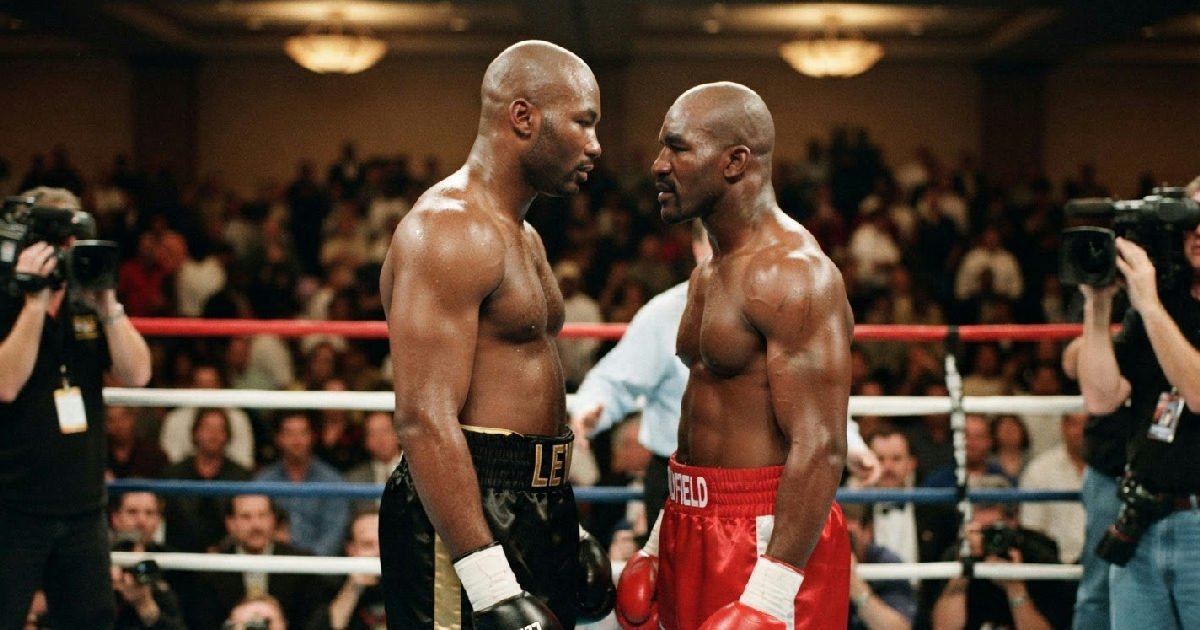
Legendary heavyweight boxer Lennox Lewis has definitively named Evander Holyfield as the strongest opponent he faced throughout his illustrious professional career. The revelation came during an interview on the popular “Joe Rogan Experience” podcast, episode #2020, which aired on 2023-08-23, providing a fresh perspective on one of boxing’s most enduring rivalries.
Lewis, a three-time world heavyweight champion known as ‘The Lion’, squared off against Holyfield twice in pivotal unification bouts at the close of the last millennium. His candid assessment on the podcast sheds new light on the immense challenge Holyfield presented, both physically and mentally, in the ring.
Lewis’s candid assessment of Evander Holyfield’s strength
During the discussion with Joe Rogan, Lennox Lewis didn’t mince words about the unique qualities that set Evander Holyfield apart. “I fought Evander Holyfield twice, and he was the strongest guy I fought,” Lewis stated directly, highlighting a level of resilience that few others could match.
He elaborated further, painting a vivid picture of Holyfield’s durability. “He was like a piece of granite, you hit him and nothing happens,” Lewis explained. This description underscores Holyfield’s legendary chin and his ability to absorb punishment, a trait that frustrated many opponents.
But it wasn’t just physical fortitude that impressed Lewis. He also made sure to point out that Holyfield was “mentally strong” as well as “physically strong.” This combination of unwavering spirit and formidable conditioning made Holyfield an exceptionally tough competitor, forcing Lewis to dig deep in both of their encounters.
The unforgettable Lewis versus Holyfield encounters
The two heavyweight titans first met on March 13, 1999, at Madison Square Garden in New York City. This highly anticipated bout was a unification fight for the WBC, WBA, and IBF heavyweight titles. The fight, however, ended in a controversial split draw, a decision that baffled many observers who felt Lewis had clearly done enough to win.
Punch statistics from that first fight heavily favored Lewis, who landed an impressive 348 punches compared to Holyfield’s 130. The outcome sparked widespread debate and immediately set the stage for a rematch, driven by public demand and the desire for a conclusive end to their rivalry.
The second clash took place on November 13, 1999, at the Thomas & Mack Center in Paradise, Nevada. Lewis emerged victorious in this encounter, securing a unanimous decision win (115–113, 116–112, 117–111) to become the undisputed heavyweight champion. This victory solidified his place at the top of the division, avenging the contentious result of their first meeting and silencing any lingering doubts about his supremacy.
A storied career and formidable opponents
Lennox Lewis’s professional record stands at an impressive 41 wins, 2 losses, and 1 draw, with 32 knockouts. His career was defined by sharing the ring with, and defeating, some of the most fearsome heavyweights of his era, including Mike Tyson and Vitali Klitschko. Yet, his recent comments suggest a particular reverence for Holyfield’s unique brand of toughness.
It’s worth noting that Lewis has, at different times, highlighted various opponents for their specific challenges. While Holyfield is now cited as the strongest, Lewis previously identified Ray Mercer as providing the “toughest fight of his career” and the first to put him on the canvas as a professional. These distinctions show Lewis’s nuanced understanding of different forms of in-ring difficulty.
Interestingly, the source article that prompted Lewis’s latest statement also made reference to Hasim Rahman, whom Lewis also spoke highly of in an older feature with The Ring Magazine, calling him the “strongest opponent he faced during his glittering tenure.”
Rahman famously stopped Lewis in the fifth round in April 2001 to capture the WBC and IBF world heavyweight titles, a defeat Lewis later avenged with a fourth-round knockout in their rematch.
This variety in Lewis’s statements over time underscores that “strongest” can mean different things, whether it’s sheer punching power, physical resilience, or overall mental fortitude. But his recent, unambiguous declaration about Holyfield provides fresh insight into his ultimate assessment.
Holyfield’s enduring legacy and Lewis’s perspective
Evander Holyfield, known as “The Real Deal,” himself boasts an incredible record of 44 wins, 10 losses, 2 draws, and 1 no-contest, with 29 knockouts. He remains the only four-time world heavyweight champion, a testament to his longevity and ability to compete at the highest level for decades. His clashes with Lewis are considered classics, showcasing the best of both fighters.
Lewis’s retrospective analysis, almost 25 years after their first bout, isn’t just a nostalgic look back; it offers a profound insight into the qualities that define a truly great opponent. The ability to endure, both physically and mentally, clearly resonates deeply with a champion like Lewis, who himself faced and overcame numerous challenges.
The impact of Lewis’s statement extends beyond a simple ranking. It reinforces the legendary status of both men and their era in heavyweight boxing. Fans continue to dissect and discuss these fights, and Lewis’s insights offer a valuable, firsthand account of the raw power and determination exhibited by heavyweight contenders at the highest level of the sport.
The enduring appeal of heavyweight rivalries
Heavyweight boxing has always captivated audiences with its larger-than-life figures and monumental clashes. Lewis and Holyfield personified this allure, delivering fights that were not just tests of skill but also of will. Lewis’s recent comments reignite conversations about the greatest rivalries and the specific attributes that made certain opponents uniquely challenging.
It’s a reminder that even for a fighter of Lewis’s caliber, who defeated virtually every top contender of his generation, some opponents leave an indelible mark. This kind of retrospective reflection from boxing legends like Lewis helps to shape the historical narrative and provides valuable context for new generations of fans and fighters.
The enduring interest in Lewis’s career and his opinions on past opponents also highlights the consistent fascination with who stands atop the heavyweight division. Boxing fans are always eager to hear direct accounts from those who were inside the ropes, particularly when discussing the sheer physical and mental demands of competing at the sport’s elite level.
As discussions about modern-day heavyweight matchups continue, such as Tyson Fury versus Anthony Joshua, Lewis’s insights serve as a benchmark for what it truly means to face a “strongest” opponent. It’s a standard set by a bygone era of champions, one that still commands respect and analysis.