
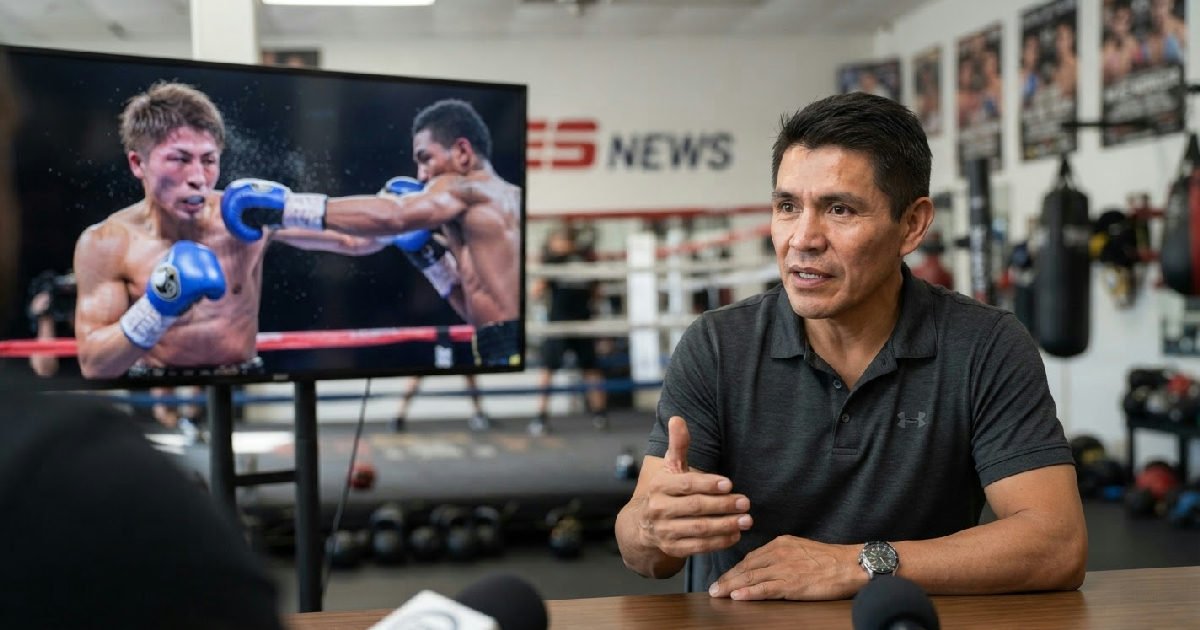
Mexican boxing icon Erik Morales, a celebrated four-division world champion, has publicly acclaimed Japan’s Naoya Inoue as the sport’s current pound-for-pound king. However, in a surprising caveat, Morales also pinpointed what he sees as critical defensive vulnerabilities in “The Monster’s” style, a detail he elaborated on in an interview with ES News on September 9, 2026.
Morales, known for his relentless aggression and storied career, suggested that while Inoue possesses unparalleled skill, his defensive lapses could leave him open to counterpunches. This nuanced assessment from a fighter of Morales’s calibre immediately sparks debate among fans and analysts alike, adding a layer of intrigue to Inoue’s seemingly invincible reign.
Morales’s Unexpected Caveat on Inoue’s Defense
Erik Morales didn’t mince words about Naoya Inoue’s defensive shortcomings. He explicitly stated that the Japanese phenom “makes too many defensive mistakes,” which, in Morales’s view, creates opportunities for opponents to land significant counterpunches. This isn’t just speculation; Morales cited specific instances to support his claim.
He pointed to fights where Ramon Cardenas and Luis Nery managed to connect with powerful shots against Inoue, even sending him to the canvas. Such moments, though rare in Inoue’s dominant career, provide concrete evidence for Morales’s argument. It highlights a fascinating dichotomy: a fighter deemed the best in the world, yet not without observable chinks in his armour.
“The Monster’s” Vulnerability Examined
Inoue’s aggressive, offense-first approach often overshadows any defensive imperfections. But Morales’s comments force a closer look at these rare instances where opponents have found success. Ramon Cardenas and Luis Nery, while ultimately defeated by Inoue, demonstrated that he isn’t entirely untouchable, even momentarily.
These brief vulnerabilities could become crucial against elite-level opponents in the future. For a fighter as accomplished as Morales, who engaged in brutal wars throughout his career, recognizing defensive gaps in even the most dominant champions is second nature. His insight here isn’t a critique of Inoue’s greatness, but rather a warning to remain vigilant.
Naoya Inoue’s Dominance and Pound-for-Pound Reign
Naoya Inoue, universally dubbed “The Monster,” has cemented his status as one of boxing’s most formidable forces. Born in Zama, Japan, on April 10, 1993, Inoue has amassed an impressive professional record of 33-0 with 27 knockouts, boasting an 81.82% knockout-to-win percentage. His destructive power and technical precision are undeniable.
Inoue has conquered four different weight classes: light flyweight, super flyweight, bantamweight, and super bantamweight. His ability to carry his power and skill up the weight divisions underscores his exceptional talent, leading many to rank him as the top pound-for-pound boxer globally, as confirmed by publications like The Ring, TBRB, ESPN, and BoxRec.
The Undisputed Double Champion
A crowning achievement for Naoya Inoue has been his undisputed championship status in two different weight classes. He first unified all four major belts—the WBA, WBC, IBF, and WBO—at bantamweight in December 2022. This historic feat made him the first Japanese and Asian boxer to achieve undisputed status in the modern “four-belt era.”
He then replicated this monumental accomplishment at super bantamweight in December 2023, showcasing an unprecedented level of dominance. Inoue is one of only three male boxers in the four-belt era, alongside Terence Crawford and Oleksandr Usyk, to hold undisputed titles in two divisions. This extraordinary track record justifies why a legend like Erik Morales would name him the best fighter in the world.
The Legacy of Erik Morales: A Mexican Icon
Erik Isaac Morales Elvira, born on September 1, 1976, in Tijuana, Baja California, is much more than just a boxing commentator; he’s a bonafide legend. Competing from 1993 to 2012, Morales etched his name in history as the first Mexico-born boxer to win world championships in four distinct weight classes: super bantamweight, featherweight, super featherweight, and light welterweight.
His career was defined by thrilling, all-action bouts and fierce rivalries. Morales famously defeated 15 world champions, but it was his epic trilogies against fellow Mexican great Marco Antonio Barrera and Filipino icon Manny Pacquiao that captivated audiences. These wars cemented his reputation as one of boxing’s most exciting and resilient champions.
A Hall of Fame Career Defined by Grit
Morales’s induction into the International Boxing Hall of Fame in June 2018 was a well-deserved honor, recognizing a career built on skill, courage, and an unwavering will to win. His early career saw him win his first 41 professional contests, securing WBC and WBO super-bantamweight titles, and the WBC featherweight crown.
Even after tough losses to Barrera and Pacquiao, Morales demonstrated incredible resilience, returning after a three-year hiatus to capture the WBC super-lightweight world title in 2011. This comeback made him Mexican history once more, illustrating the enduring spirit that characterizes his legacy and lends significant weight to his current pronouncements on the sport’s elite.
The “Pound-for-Pound” Debate and Future Challenges
The “pound-for-pound” (P4P) concept in boxing attempts to answer a hypothetical question: who is the best fighter regardless of weight? It’s a subjective ranking that evaluates skill, dominance, and achievements across different weight classes. Criteria often include footwork, defense, accuracy, ring IQ, multiple world titles, and undefeated streaks.
Morales’s naming of Inoue as the P4P king aligns with the consensus among most major boxing publications. But his concurrent highlighting of defensive lapses ensures the debate remains vibrant. It serves as a reminder that even the most dominant fighters have areas for improvement, and perfect boxers simply don’t exist.
Jesse ‘Bam’ Rodriguez: A Rising Threat
Looking ahead, one of boxing’s most anticipated matchups could see Naoya Inoue collide with American professional boxer Jesse James Rodriguez Franco, known as “Bam.” Rodriguez, born January 20, 2000, is a rising star who has already held world championships in three weight classes. His professional record stands at an impressive 24-0 with 17 knockouts.
Rodriguez became the youngest world champion in boxing in February 2022, capturing the WBC super flyweight title. He has since unified the WBO and IBF flyweight titles and recently moved up to bantamweight. A potential clash between Inoue and Rodriguez, reportedly slated for spring 2027, is already being heralded as a high-demand encounter between two of the sport’s premier talents.
Implications for the Super Bantamweight Division
Morales’s comments about Inoue’s defensive vulnerabilities could subtly shift the strategic approach for future opponents in the super bantamweight division. While “The Monster” remains a terrifying force, any perceived chinks in his armor might empower rivals to focus on exploiting those moments of openness, rather than solely trying to withstand his offensive onslaught.
It’s unlikely to deter potential challengers, given the prestige of facing a fighter of Inoue’s caliber. But the psychological impact of a legendary figure identifying a pathway, however slim, could be significant. It transforms the challenge from insurmountable to merely incredibly difficult, perhaps inspiring new tactical approaches.
What Comes Next for Naoya Inoue
Naoya Inoue is currently expected to remain on the sidelines until spring 2027, presumably to prepare for future mega-fights, potentially against someone like Jesse ‘Bam’ Rodriguez. These periods away from the ring are crucial for recovery, refinement, and strategic planning, especially when facing increasing scrutiny from legends like Morales.
Inoue has also hinted that his illustrious career might conclude around 2027. This potential timeline adds an extra layer of urgency and anticipation to his upcoming bouts. Each fight becomes not just another title defense, but a step closer to cementing his final legacy in boxing history, with every performance weighed against the highest standards.
The Enduring Prowess of Pound-for-Pound Kings
The debate over boxing’s pound-for-pound king is a perennial one, fueled by differing opinions and the ever-evolving landscape of the sport. Erik Morales’s recent declaration, while unequivocal in naming Naoya Inoue, also injects a fascinating dimension of critical analysis, moving beyond mere adulation.
It reflects the rigorous standards applied to those at the pinnacle of boxing. For Inoue, the challenge now lies not just in winning, but in demonstrating an evolving mastery that silences even the most astute critics, proving his defensive capabilities are as unassailable as his offensive power. Future high-profile matchups will undoubtedly test this.