
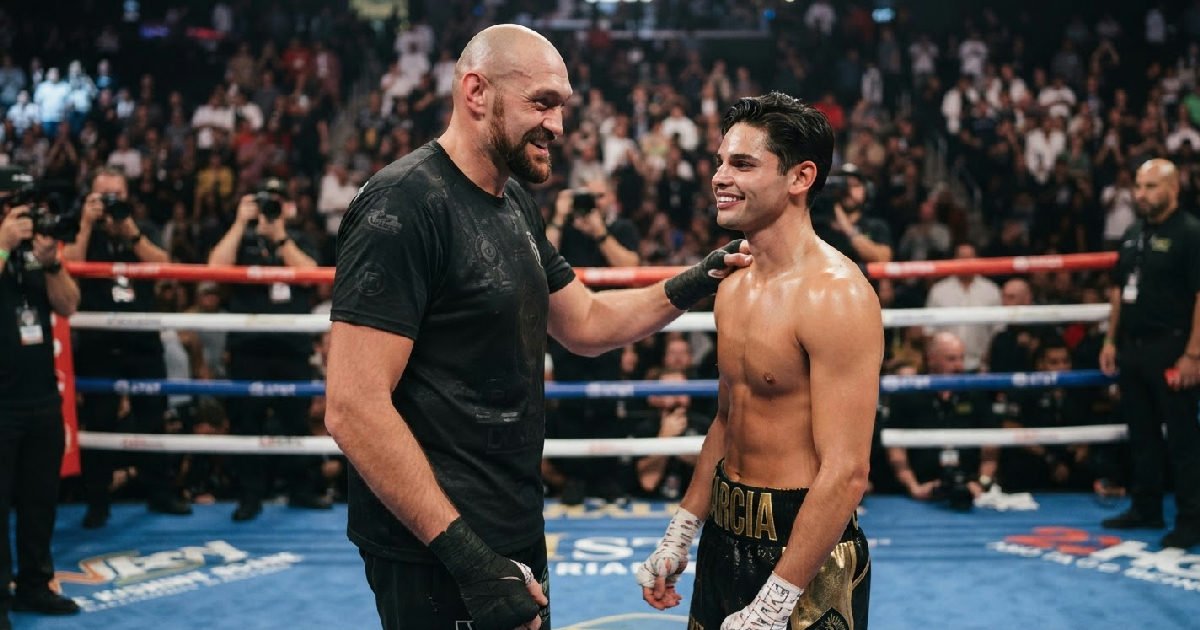
Heavyweight champion Tyson Fury asserted on April 29, 2024, that Ryan Garcia is positioned to become American boxing’s top attraction. He believes Garcia will take over after Canelo Alvarez eventually departs the sport. Fury attributed this potential to Garcia’s unique charisma and flair for generating headlines, emphasizing drawing power over pure technical prowess.
His remarks, made during an appearance on “Behind the Mic,” spotlight a critical debate within the sport. This perspective from a figure like Fury, a multi-time heavyweight world champion, offers a candid look into the commercial realities of modern boxing. It suggests that contemporary success increasingly hinges on a fighter’s ability to transcend the traditional “hardcore boxing bubble.”
Tyson Fury’s high praise for Ryan Garcia’s appeal
Fury cast his vote clearly for Ryan Garcia among a field of talented fighters such as Devin Haney and Shakur Stevenson. He highlighted Garcia’s magnetic personality and entertaining presence as key differentiators. “He’s got a personality. He talks. He’s entertaining. He’s charismatic,” Fury stated.
Fury further drew parallels between himself and Garcia, agreeing that he sees reflections of his own showmanship in the younger fighter. He acknowledged that other boxers might possess superior fundamental skills in the ring. However, Fury insisted these technical wizards often cannot generate the same level of revenue or public interest as Garcia does. It’s a pragmatic view of boxing’s commercial landscape.
The mainstream challenge for technical boxing champions
Fury expressed skepticism about the mainstream presence of other highly-rated contenders. He noted that while figures like Devin Haney and Shakur Stevenson are well-known within devoted boxing circles, their recognition rarely extends beyond that sphere. “Inside of boxing people know who they are. Outside of boxing, you go and ask 50 people… they don’t know who they are,” Fury said.
These fighters have built impressive professional resumes, often boasting undefeated records and multiple world titles. Yet, Fury argued that respect from the sport’s purists only carries an athlete so far. Becoming a marquee figure who prompts general sports fans to clear their weekend calendars demands a much larger public profile and engagement.
Devin Haney, for example, holds a professional record of 33 wins, 0 losses, and 1 no-contest, with 15 KOs, and has held world championships in three weight classes. Shakur Stevenson boasts a record of 25 wins, 0 losses, with 11 KOs, and has won titles in four weight classes. Their in-ring achievements are undeniable, but Fury believes they lack a certain spark for broader appeal.
Commercial realities: Garcia’s unparalleled drawing power
Ryan Garcia’s recent fight history strongly illustrates Fury’s point about drawing power. His April 2023 bout against Gervonta Davis generated an estimated 1.2 million pay-per-view (PPV) buys in the United States. This made it the first boxing match to surpass one million buys since 2021.
The fight also sold out T-Mobile Arena in Las Vegas, generating approximately $22.8 million in ticket sales. This commercial success underscores Garcia’s unique ability to captivate an audience far beyond boxing’s core. His unpredictable persona draws viewers who might not otherwise follow the sport.
By contrast, Devin Haney’s May 2023 fight against Vasiliy Lomachenko, despite being a highly anticipated technical matchup, saw approximately 150,000 PPV buys. This stark difference in commercial performance, at a lower price point, indicates a significant gap in mainstream appeal. Analysts suggested Haney and Lomachenko, while technically brilliant, lacked the flamboyant personality needed to attract casual fans.
Ryan Garcia also commands a significant social media presence, boasting millions of followers across platforms like Instagram and TikTok. He keeps the public talking even during long layoffs, leveraging his often unpredictable persona to maintain relevance. People tune in to see him, whether hoping for a victory or anticipating a knockout, both of which drive pay-per-view sales.
His recent outing against Devin Haney on April 20, 2024, though later ruled a no-contest due to a positive Ostarine test, was a high-profile event that generated immense public interest. This event alone, despite the controversy and Garcia missing weight by 3.2 pounds, cemented his status as a major draw.
For more on the specifics of this fight and its aftermath, consider Ryan Garcia’s 2024 weight miss and the financial implications.
The evolving landscape of fighter promotion
Tyson Fury also criticized modern streaming setups, questioning their effectiveness in building true mainstream excitement for fights. He lamented the shift from previous eras where extensive profile features would introduce contenders to the public long before fight night. Modern streaming formats, he suggested, often present the event without adequately engaging casual viewers in advance.
Because of this change, self-promotion has become an indispensable part of a boxer’s career strategy. Fury stressed that young talent can no longer rely solely on promoters to handle the heavy lifting of building a public profile. Instead, they must actively chase interviews, consistently produce content, and relentlessly hustle for their own spotlight.
This new paradigm rewards those with an innate understanding of media and audience engagement.
The role of social media in modern boxing careers
Shakur Stevenson, for instance, actively uses social media to promote himself and his fights. He leverages platforms like Instagram and TikTok, building a significant digital footprint with over a million followers as of October 2026. His “Killa Season” fight camp phrase and sponsorship deals indicate an understanding of self-branding in the digital age.
However, even with these efforts, Stevenson and Haney face a different kind of challenge. While their fan bases are robust within boxing, Fury’s comments suggest they haven’t yet captured the imagination of the wider sporting public in the same way Garcia has.
This underlines the unique, almost intangible, quality that separates a well-respected boxer from a global superstar. Stevenson’s impressive professional record of 25 wins and no losses, including becoming a four-division world champion, speaks volumes about his in-ring capabilities. Yet, translating this into the kind of mainstream appeal Fury described remains an ongoing challenge.
For context on Stevenson’s career and future bouts, information regarding the WBO ordering Shakur Stevenson to face Raymond Muratalla highlights his path through the divisions.
Implications for boxing’s future stars and marketability
Fury’s perspective highlights a significant trend in professional boxing: the increasing importance of personality and marketability alongside athletic prowess. While victories in the ring are fundamental, they no longer guarantee mass appeal on their own. Fighters like Ryan Garcia demonstrate that an engaging persona can sometimes overshadow a less consistent record when it comes to attracting mainstream attention and driving revenue.
This raises questions about the future development of boxing stars. Will future generations of fighters prioritize cultivating a strong public image and social media presence as much as, or even more than, perfecting their ring craft? The sport could see a greater emphasis on media training and self-promotion from a younger age.
This shift is already evident in the careers of successful social media figures turned athletes.
The upcoming welterweight unification bout between Devin Haney and Liam Paro on Saturday, December 19, will be a crucial test of Haney’s continued ascent. While it promises technical brilliance, its reach beyond the hardcore audience will be closely watched. Readers can find out more about the details surrounding this highly anticipated clash by exploring Devin Haney battles Liam Paro for unified titles.
Ultimately, Fury’s view holds firm: Ryan Garcia possesses a unique ability to hook an audience before the first bell even sounds. His peers, despite their formidable skills and titles, face a much steeper climb in proving they can match that commercial reach.
This doesn’t diminish their achievements inside the ring, but it certainly redefines the pathway to becoming a true global boxing icon in the modern era. The sport appears to be moving towards an equilibrium where both spectacular performance and a captivating personality are essential ingredients for ultimate stardom.