
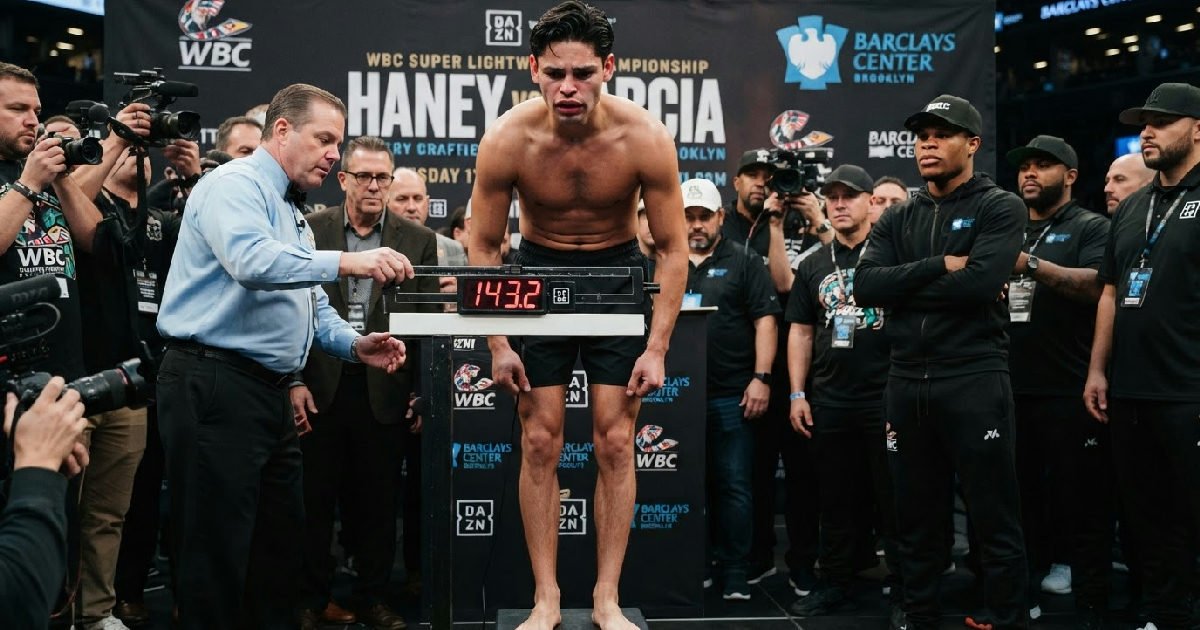
This retrospective covers the April 2024 Garcia–Haney weigh-in, not a new weigh-in in October 2026. In a dramatic turn before one of boxing’s most anticipated clashes, Ryan Garcia weighed in at 143.2 pounds for his WBC super lightweight title fight against Devin Haney.
The significant miss, 3.2 pounds over the 140-pound limit, rendered Garcia ineligible to win the championship belt and cast a shadow over the event at the Barclays Center in Brooklyn, New York, on April 19, 2024.
The Weigh-In Drama Unfolds in Brooklyn
The weigh-in fiasco prompted a substantial financial penalty, with Garcia reportedly agreeing to pay Devin Haney $500,000 for each pound he was over, totaling $1.5 million from a publicly agreed arrangement.
This incident intensified long-standing concerns about Garcia’s preparation and behavior leading into major bouts, particularly regarding his ability to consistently make weight. Despite the drama, the fight proceeded as a non-title bout for Garcia, with Haney’s WBC title still on the line. The event underscored the stringent demands of professional boxing and the consequences when those are not met.
The weigh-in, held at 11:30 a.m. ET, saw Devin Haney comfortably make the 140-pound limit, stepping onto the scales precisely at the championship weight. Ryan Garcia, however, presented a visibly larger physique, confirming pre-fight anxieties from Haney’s camp that he might struggle with the cut. When the official announcement came, confirming Garcia’s 143.2-pound mark, a palpable tension filled the arena.
Garcia’s response to the booing crowd was defiant, shouting, “Yeah, yeah, yeah! Suck my dick! At the end of the day I’m the best fighter here. I’m gonna knock him out and everybody’s gonna be cheering. Watch.”
This public display followed earlier pronouncements where he had dismissed concerns, stating on April 18, 2024, “It’s right in front of your face! How am I going to miss weight?! I am just a motherf—r on a mission. I am still here, I am strong, and I am ready to destroy him.”
Oscar De La Hoya of Golden Boy Promotions, Garcia’s promoter, downplayed the weight miss, asserting, “It’s all good, it’s all good, we’re all good. We have a fight and that’s what people want to see.” However, Devin Haney expressed frustration, telling reporters, “Now it’s time for me to shine. He’s very unprofessional.”
The reported penalty agreement saw Garcia pay Haney $600,000 from his purse and an additional 2% of any pay-per-view profits if a specific viewership threshold was met, illustrating the significant financial stakes involved.
A Pattern of Weight Challenges for Ryan Garcia
The weigh-in controversy was not an isolated event for Ryan Garcia, whose career has been punctuated by several instances of weight management issues and last-minute adjustments. His December 2023 bout against Oscar Duarte, for instance, was originally slated for 140 pounds but was subsequently adjusted to a 143-pound catchweight to accommodate Garcia.
He successfully weighed in at 143 pounds for that fight, which he won by an eighth-round knockout.
Even more notably, his high-profile April 2023 super fight against Gervonta Davis was contested at a strict 136-pound catchweight. That bout also featured a rehydration clause, limiting both fighters to 146 pounds at a second weigh-in on the morning of the fight.
While Garcia made the initial 136-pound limit, he later admitted to feeling “a little weak” in the ring due to the severe weight restrictions, though he publicly accepted the contract terms. These previous incidents highlight a recurring struggle for Garcia to meet the specified weight parameters for significant fights.
Further demonstrating this pattern, the World Boxing Council (WBC) fined Garcia $5,000 in February 2026 for submitting his mandatory 14-day weight check video late in preparation for a fight against Mario Barrios.
While he eventually complied and made weight for the official contest at 146.5 pounds, the fine served as a warning from WBC President Mauricio Sulaiman, underscoring the importance of adherence to regulatory protocols. This ongoing scrutiny of weight management indicates a consistent challenge for the fighter.
Regulatory Framework and Fighter Safety in Boxing
Boxing’s intricate system of weight classes and regulations exists primarily to ensure fighter safety and maintain fair competition. Commissions like the California State Athletic Commission (CSAC) mandate weigh-ins within a tight timeframe, typically 30 hours before a scheduled match. This regulation aims to prevent excessive weight cutting, which can severely dehydrate athletes and increase health risks during a fight.
Sanctioning bodies such as the WBC also implement their own protocols, including periodic safety weigh-ins, to monitor a fighter’s weight descent during training camps. These measures are critical for tracking an athlete’s health and discouraging dangerous weight-cutting practices that could compromise their performance and well-being. When fighters miss weight, commissions impose penalties to uphold the integrity of the sport.
Under CSAC rules, for example, fighters who fail to make weight face financial repercussions, including forfeiting a percentage of their win bonus and show money. A portion of these fines goes to the athletic commission, and another portion is often awarded to the opponent.
Additionally, fighters who miss weight may require doctor’s clearance to compete in a lower weight class in subsequent bouts, emphasizing the serious nature of these infractions.
Beyond the Scales: The Haney Fight Outcome and Aftermath
Despite the contentious weigh-in, the fight between Ryan Garcia and Devin Haney proceeded on April 20, 2024, delivering a shocking result in the ring. Ryan Garcia put on a dominant performance, knocking Devin Haney down three times across rounds seven, ten, and eleven.
The judges initially scored the bout a majority decision victory for Garcia, with scores of 114–110, 115–109, and one dissenting score of 112–112.
Punch statistics revealed Garcia’s effectiveness, as he out-landed Haney 106-87 in total punches and a significant 95-45 in power punches. Garcia also connected with 41% of his power punches, a rate considerably higher than the 25% average landed by Haney’s previous ten opponents. This offensive output suggested that despite the weight struggle, Garcia performed at an elite level during the contest itself.
However, the post-fight narrative took another dramatic turn months later. The initial majority decision victory for Ryan Garcia was subsequently overturned to a no-contest after Garcia tested positive for Ostarine, a banned performance-enhancing substance.
This development not only nullified his win but also led to a 12-month suspension from boxing and an additional $1.1 million financial penalty, further complicating the legacy of this already controversial bout. The implications for Garcia’s career path are significant after such a high-profile turn of events.
Implications for Boxing’s Weight Management and Fighter Integrity
Ryan Garcia’s repeated issues with making weight, culminating in the Devin Haney controversy, have reignited broader discussions within boxing about the sport’s approach to weight cutting. Critics argue that the current system often encourages extreme weight loss, placing fighters at undue risk. The financial penalties and championship forfeitures, while significant, don’t always deter fighters from pushing boundaries or missing the mark.
For Garcia, this pattern also raises questions about his long-term suitability for the super lightweight division.
His December 2023 fight against Oscar Duarte at a catchweight and his February 2026 comments about being comfortable at 140 pounds without rehydration clauses, even while targeting a fight with Shakur Stevenson, indicate a persistent struggle with the demands of specific weight classes.
“To those that are worried about the 140lbs weight, I will tell you this. It was my plan to be able to also win at 140. As long as there’s no rehydration clause things will be going forward,” he stated in February 2026.
The overturned result due to the Ostarine positive test further complicates the narrative, intertwining weight management with concerns over performance-enhancing substances. This confluence of issues poses a significant challenge to the sport’s integrity and fighter credibility.
Boxing federations and commissions may need to re-evaluate enforcement mechanisms and support systems to better assist athletes in healthy weight management, rather than solely relying on punitive measures. Ensuring fair play and athlete welfare remains paramount for the sport’s future.
As the sport continues to evolve, cases like Ryan Garcia’s serve as a stark reminder of the physical and professional tightrope fighters walk. The demand for peak performance, combined with strict weight class requirements, often creates a high-stakes environment where every pound, and every decision, can have career-altering consequences.
This ongoing debate about weight cutting will undoubtedly continue to shape boxing policy and the careers of its athletes for years to come.