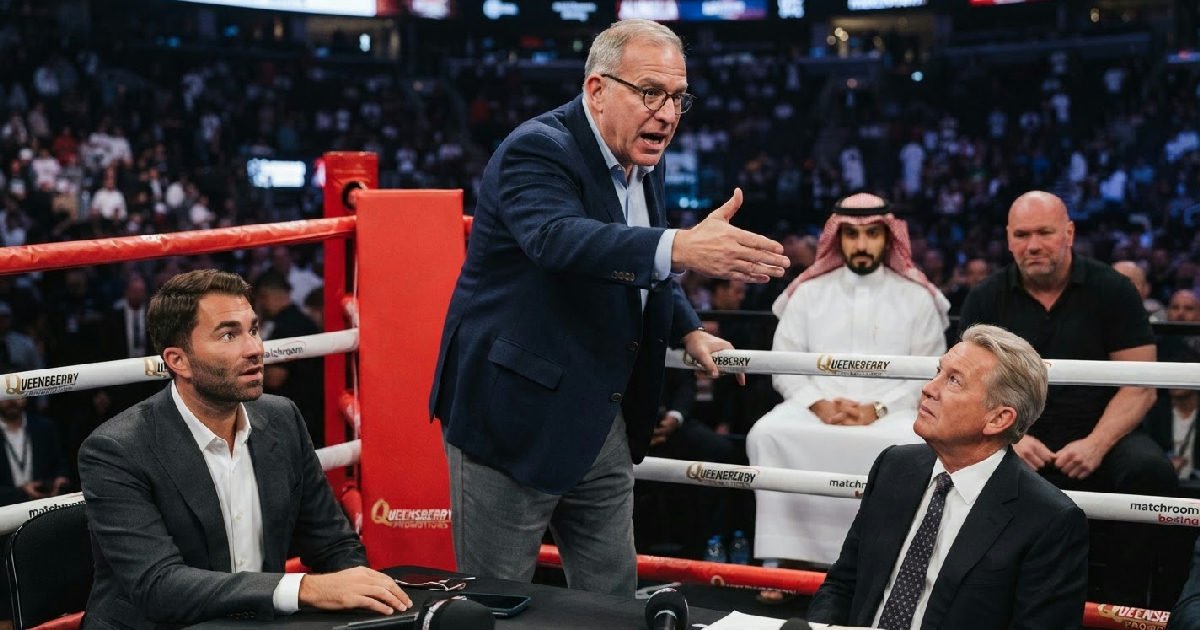
Boxing promoter Lou DiBella accused rivals Eddie Hearn and Frank Warren of causing a seismic shift by letting new entities like Saudi Arabia’s Turki Alalshikh and Zuffa Boxing into the sport.
” The Hall of Famer’s comments target their partnerships with powerful new entities, chiefly Saudi Arabia’s Turki Alalshikh and Dana White’s Zuffa Boxing, which he argues have created a “hot fucking mess” that now threatens the very promoters who welcomed them.
In a candid interview with Tris Dixon, DiBella unloaded on the state of boxing, dismissing any celebrations from the old guard over the early stumbles of Zuffa’s boxing venture. He contends that by embracing outside money and influence to stage massive events, Hearn and Warren created an independent power structure that no longer needs them, fundamentally altering the business of boxing for good.
The ‘wolf’ at the door: new money changes the game
DiBella’s “wolf” metaphor points directly at two major forces: the vast financial resources flowing from Turki Alalshikh in Saudi Arabia and the corporate muscle of TKO Group Holdings, the parent company of UFC and WWE.
This new guard, which includes Zuffa Boxing under Dana White and WWE President Nick Khan, operates on a scale that legacy boxing promoters struggle to match. They have the capital to deliver enormous purses and the political connections to secure premier broadcast deals.
For years, boxing’s fragmented nature, with its competing promoters and tangle of sanctioning bodies, made it difficult to stage the biggest possible fights. The arrival of Alalshikh, in particular, shattered that dynamic by offering purses so large they compelled rival promoters and fighters to cooperate. This resulted in a series of blockbuster events in Riyadh that were widely praised by fans for delivering long-awaited matchups.
However, DiBella’s criticism focuses on the long-term consequences of this strategy. By ceding control to an external financier, he argues, traditional promoters have made themselves expendable. The new powers can now pursue fighters and television rights directly, bypassing the very establishment that once acted as gatekeepers.
The short-term gain of participating in record-breaking cards has come at the cost of their own leverage and future security.
DiBella believes this new reality leaves the old guard in a precarious position. “They still have better political and business connections,” he said of TKO. “They still have the best TV deals in North America.” Those advantages provide a significant foundation to withstand early growing pains and ultimately dominate the market, leaving little room for those who can’t compete on that level.
A house divided: hypocrisy and instability
At the heart of DiBella’s critique is a charge of hypocrisy leveled directly at Hearn and Warren. He questions their recent complaints and victory laps over Zuffa Boxing’s reported struggles, reminding them of their own role in creating the current environment. “Who’s most responsible for letting the wolf into the hen house of boxing promotion? It’s Eddie Hearn and Frank Warren,” DiBella stated plainly.
He recalls Hearn’s own stated ambition years ago to “put everyone out of business and becoming the new UFC of boxing” in America. Now, with a more powerful and better-funded version of that vision emerging, the complaints from the old guard ring hollow. DiBella suggests they are only now reckoning with the consequences of a strategy they happily pursued when it benefited them.
This internal conflict leaves the sport in a state of chaos. DiBella points to the recent free agency of Shakur Stevenson as a prime example of the dysfunction. While rival promoters might publicly cheer Zuffa’s failure to retain him, the reality is that signing an elite free agent is an expensive headache.
Any promoter must now find the massive purse Stevenson demands, secure a worthy opponent, and book a venue, all without the centralized power of a league structure.
DiBella cuts through the noise with a series of sharp questions. “Is Eddie all of a sudden thriving? Does he have no worries? Is Oscar and Golden Boy great? Is Top Rank’s business getting better?
Is anything changing?” His point is clear: pointing fingers at a competitor’s problems does nothing to solve the systemic issues plaguing their own businesses. The fundamental economics of the sport remain challenging for everyone but the absolute top tier of power players.
From player to observer
DiBella’s perspective is colored by his own extensive history in the sport. Having served as a top executive at HBO Boxing during its heyday in the 1990s and running his own promotional company, DiBella Entertainment (DBE), since 2000, he has seen the industry from all sides. He testified before Congress about boxing’s administrative failures decades ago and feels the problems have only worsened.
He now finds more satisfaction in his role as President & Managing General Partner of the Richmond Flying Squirrels, a Minor League Baseball team.
He describes the current boxing landscape as one where it’s “every man for himself and completely uncertain.” It’s a reality that has him “sort of happy not to be earning a living” predominantly in boxing anymore, preferring to enjoy it as an observer.
This detachment gives his criticism a different weight. It’s not simply a promoter taking shots at a rival; it’s a seasoned veteran offering a dire warning about the sport’s trajectory. He sees a system where the old ways of doing business are becoming obsolete, and those who don’t adapt will be left behind.
The future of boxing promotion
The most stark part of DiBella’s assessment is his forecast for the future. He believes that without a radical change to their business models, traditional promotional companies as we know them “won’t exist in 10 years.” The influx of sovereign wealth and corporate behemoths has created a new paradigm where promoters are no longer the central figures in their own sport.
The old model relied on building a stable of fighters, securing television deals, and slowly building stars. The new model is event-driven, financed by entities with seemingly bottomless pockets who are more interested in spectacular one-offs than the long-term development of the sport’s infrastructure. While this has been great for delivering major fights, it erodes the foundation on which promotional companies were built.
DiBella acknowledges that everyone in the sport shares some blame for its fragmented condition. Years of infighting, competing television loyalties, and an inability to consistently make the best fights created a power vacuum.
In his view, promoters like himself, Bob Arum, Don King, Hearn, and Warren all “let the door wide open” for Dana White and Nick Khan to step into the void. The difficulty of making a major fight under the old system is what made the new system so appealing.
Ultimately, DiBella’s message is a sobering one. While others might be focused on the daily squabbles and taking cheap shots, he sees a fundamental and perhaps irreversible shift in power. The wolf isn’t just at the door; according to DiBella, it was invited inside for dinner, and it may end up eating everyone at the table.