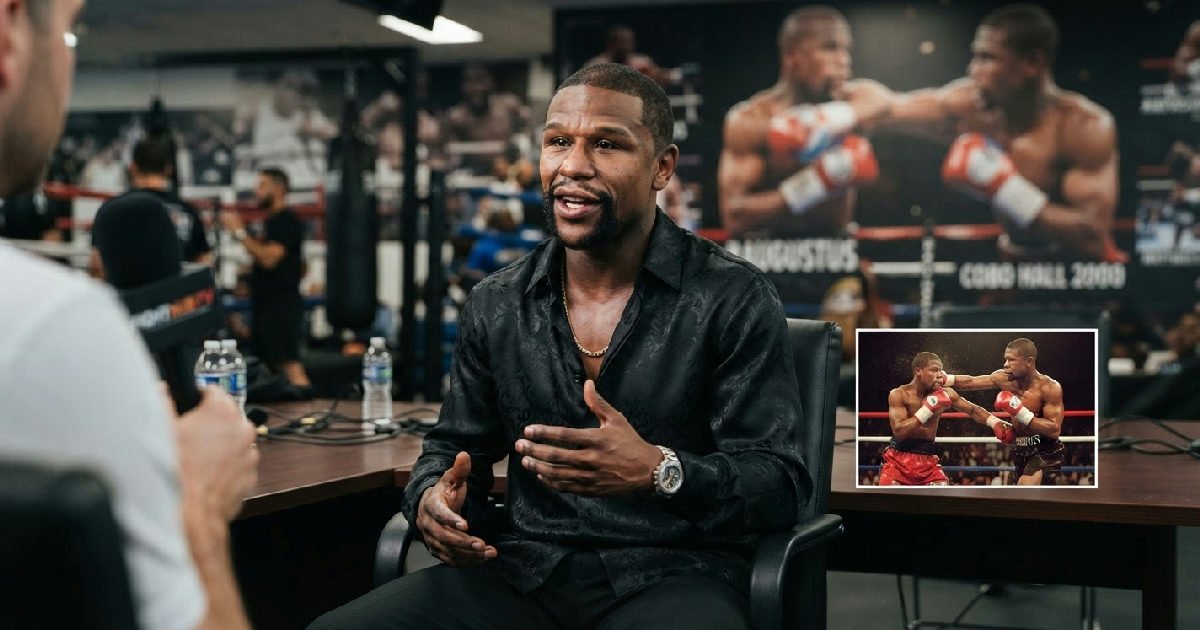
Emanuel Augustus was the toughest opponent Floyd Mayweather Jr. ever faced, according to the boxer in an April 28, 2012 interview. , widely considered one of boxing’s all-time greats, identified Emanuel Augustus (formerly Emanuel Burton) as the toughest opponent of his illustrious professional career in an interview published on April 28, 2012.
The undefeated five-division world champion offered a surprising assessment during an interview with Fight Hub TV, calling Augustus “unbelievable” despite a fight record that didn’t outwardly reflect his exceptional skill.
Floyd Mayweather’s Surprising Revelation
Mayweather’s candid statement, initially published by Fight Hub TV on April 28, 2012, offered an unexpected perspective on his storied 50-0 career.
He unequivocally named Emanuel Augustus as “absolutely” his toughest opponent “thus far,” emphasizing that Augustus’s statistical record failed to capture his true talent and formidable in-ring presence.
Mayweather later reiterated this admiration for Augustus in a separate interview with Sport Bible. He solidified his view that Augustus was a “true warrior, a true champion” whose unique approach presented an unparalleled challenge to him.
The Unforgettable Cobo Hall Showdown
The pivotal non-title bout between Floyd Mayweather Jr. and Emanuel Augustus unfolded on October 21, 2000, at Cobo Hall in Detroit, Michigan.
Mayweather, who held the WBC Super Featherweight Championship at the time after defeating Genaro Hernandez, ultimately secured a ninth-round technical knockout victory.
Despite the official outcome, the fight was a hard-fought affair. Augustus reportedly tested Mayweather’s resolve and forced him into uncharacteristic adjustments during the contest.
Mayweather himself later confessed that Augustus pushed him to fight at an unusually high intensity. It required him to adapt his strategy mid-fight to overcome the unexpected challenge. Questions about Mayweather’s involvement in other fights often arise.
Augustus’s Elusive Ring Style
Emanuel Augustus earned his enduring moniker, “The Drunken Master,” due to a boxing style that was both highly unorthodox and exceptionally unpredictable.
His repertoire included bewildering showboating, rhythmic dancing, and a series of unconventional defensive movements. These were designed to confuse and frustrate his opponents.
This distinctive approach made him a complex puzzle for anyone stepping into the ring against him. It often led to visually chaotic yet incredibly entertaining contests.
His ability to shift angles and feint unexpectedly often disrupted even the most polished offensive fighters. This made him a stylistic nightmare for many.
Emanuel Augustus: A Record That Deceived
Born Emanuel Ya’kov Burton, Augustus competed professionally from 1994 until his retirement in 2011. He concluded his career with a record of 38 wins, 34 losses, and 6 draws across 78 professional fights.
His official record, with its numerous defeats, doesn’t convey the caliber of opponent he consistently faced. He often stepped in on short notice against top-tier talent.
Remarkably, only five of his 34 losses came by stoppage. This was a testament to his extraordinary resilience and granite chin against some of boxing’s hardest hitters, including Ruslan Provodnikov and Jesus Chavez.
Beyond his memorable encounter with Mayweather, Augustus is also widely recognized for his 2001 “Fight of the Year” against Micky Ward. That was a relentless and chaotic battle that remains a fan favorite.
Many boxing purists argue that Augustus was one of the most “robbed” fighters in history. He suffered numerous controversial decision losses, particularly in fights contested outside his home turf.
Even after his professional career ended, Augustus faced a severe personal challenge on October 13, 2014. He was critically wounded in a shooting incident in Baton Rouge, Louisiana.
He survived after being placed on life support, making a remarkable recovery. He even returned to training by 2016, showcasing his incredible will to overcome adversity.
Beyond Augustus: Other Tests for ‘Money’
While Emanuel Augustus occupies a singular place in Floyd Mayweather Jr.’s personal toughest opponent ranking, “Money” encountered a formidable lineup of challengers throughout his undefeated run.
Discussions among boxing aficionados frequently highlight other significant fights where the defensive master was pushed to his absolute limits.
His first encounter with Jose Luis Castillo in 2002 stands out as perhaps the most hotly debated. Some observers, including judge Harold Letterman, scored the fight for Castillo, despite Mayweather getting the official nod.
Another strong candidate for a truly gruelling contest was his 2012 battle against Miguel Cotto. Mayweather himself famously declared Cotto “the toughest guy I ever fought” immediately after the final bell. Naming a truly difficult opponent often provides insight into a boxer’s career.
Shane Mosley delivered rare moments of peril for Mayweather in their May 1, 2010, clash. He notably buckled Mayweather’s legs twice in the second round before Mayweather regained control and secured a wide decision victory.
Marcos Maidana presented a distinctly rugged and aggressive style that truly tested Mayweather’s defensive prowess in their initial May 2014 bout. This resulted in a razor-thin majority decision that many felt could have gone either way.
The sheer quality of these opponents underscores the significance of Mayweather’s consistent praise for Augustus. It suggests a challenge that was perhaps more about style and unpredictability than raw power or championship pedigree.
The Nuance of “Toughest” Versus “Best”
The distinction between a fighter’s “toughest” opponent and their “best” or most accomplished adversary is a nuanced but critical one in boxing discourse.
For an elite pugilist like Floyd Mayweather, who systematically dismantled most top contenders, “toughest” often refers to an opponent whose unique style or sheer tenacity created unexpected difficulties.
Emanuel Augustus, with his unconventional rhythm and defensive trickery, clearly frustrated Mayweather in a way that many more celebrated champions could not.
It’s a testament to Augustus’s singular talent that he made such an indelible impression on a fighter renowned for making every opponent look ordinary.
In many ways, Augustus represented a puzzle that required more than just superior boxing skill to solve. It demanded constant adaptation and mental fortitude.
This perspective also sheds light on the challenges faced by top fighters across different eras and weight classes, where stylistic matchups can often define a struggle more than a fighter’s overall record.
The Enduring Legacy of a Shock Admission
Floyd Mayweather Jr.’s consistent and public acknowledgement of Emanuel Augustus as his toughest opponent provides valuable insight into the intricacies of professional boxing.
It re-emphasizes that statistical records, while important, rarely tell the complete story of a fighter’s true capabilities or the unique challenges they can present.
This candid revelation from one of boxing’s most dominant and defensively brilliant figures reshapes parts of the historical narrative surrounding both athletes.
It rightfully elevates the recognition of less-heralded but profoundly skilled pugilists like Augustus. Their impact often went beyond championship belts.
The admission also subtly underscores Mayweather’s own self-awareness and honesty. He openly acknowledged the profound difficulties he encountered against an opponent whose style defied conventional wisdom.
Such commentary from a revered figure like Mayweather often sparks renewed interest in past fights. It also offers contemporary fighters valuable lessons about facing unpredictable styles. Similar career setbacks can highlight the unpredictable nature of the sport.
It certainly adds another layer to the already legendary career of Floyd Mayweather Jr. It showcases that even the greatest were once tested in ways fans might not fully appreciate from scorecards alone.
Ultimately, this enduring praise for Emanuel Augustus solidifies his place not just as a cult hero, but as a true test for one of boxing’s pound-for-pound best.
It reminds us that sometimes, the toughest battles are fought not against the most decorated champions, but against those who possess an extraordinary, albeit unconventional, skillset.