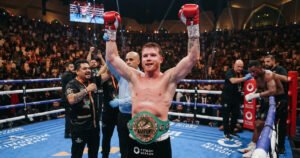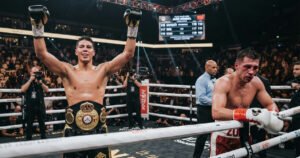
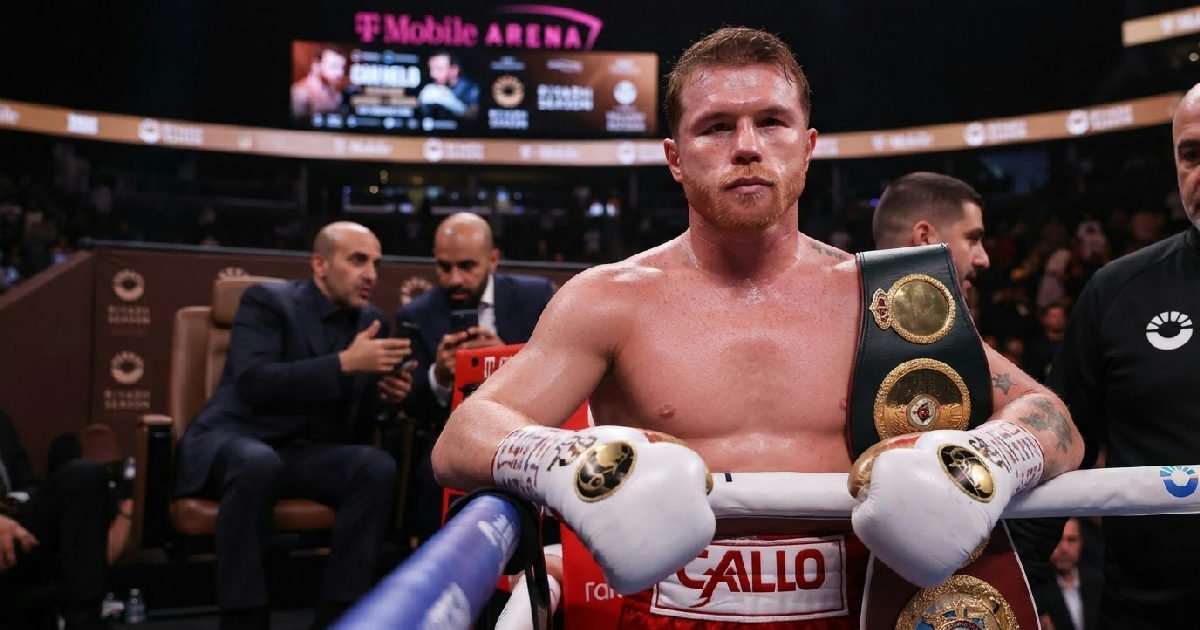
Undisputed super middleweight champion Canelo Alvarez fortified his legacy on May 4, 2024, by defeating undefeated challenger Jaime Munguia via unanimous decision. The high-stakes bout at the T-Mobile Arena in Las Vegas, Nevada, saw Alvarez successfully defend his WBA (Super), WBC, WBO, IBF, and The Ring titles, drawing an impressive 17,492 spectators.
While Alvarez delivered a commanding performance, his often-contentious relationship with influential Saudi promoter Turki Alalshikh continues to attract considerable scrutiny. This tension was recently highlighted by reports of Alalshikh’s apparent disinterest during another of Alvarez’s title fights, sparking debate within the boxing community about the dynamics between powerful promoters and elite athletes.
Canelo Alvarez dominates Munguia in Vegas title defense
Canelo Alvarez proved his dominance against Jaime Munguia, securing a decisive victory through scorecards of 117-110, 116-111, and 115-112. The Mexican star landed 234 of his 536 punches, significantly outperforming Munguia, who connected on 170 of 663 attempts. Alvarez also scored the fight’s sole knockdown in the fourth round with a powerful right uppercut.
Following the fight, Alvarez remained confident in his abilities. “I took my time. I had 12 rounds to win the fight, and I did,” he stated, adding, “He’s strong but he’s slow. I could see his punches. That’s why I’m the best. I have a lot of experience.” This victory further cemented his status atop the super middleweight division.
The May 2024 event was a major financial success. Canelo Alvarez commanded a guaranteed purse of $35 million, while Jaime Munguia earned $10 million. The fight’s robust attendance and pay-per-view sales underscored the enduring commercial appeal of boxing’s biggest stars.
Turki Alalshikh’s Ringside Behavior Fuels Speculation
The spotlight recently turned to Turki Alalshikh’s ringside conduct during Canelo Alvarez’s October 31, 2026, title defense against Christian Mbilli in Riyadh. World Boxing News reported that Alalshikh, the Chairman of Saudi Arabia’s General Entertainment Authority (GEA), spent the majority of the fight engaged in lengthy conversations with a ringside companion rather than watching the action unfold.
This extraordinary behavior quickly caught the attention of fans and media alike. Social media platforms buzzed with comments, with one viewer posting on X, “Nice to see the massive fight fan Turki Al-Sheikh having a conversation throughout the entire fight.” Other comments suggested, “Turki has completely checked out of boxing,” and “Bro Turki Alalshikh hasn’t watched a moment of this fight ….”
Many viewed Alalshikh’s repeated turning away from the ring as a direct snub to Alvarez. This was particularly striking given the magnitude of the contest, a world title fight for which Alvarez reportedly earns around $40 million as part of his lucrative Riyadh Season agreement. The perceived lack of interest from a key financier of the event raised numerous questions.
A Strained History Between Alvarez and the Saudi Promoter
The ringside incident with Christian Mbilli wasn’t an isolated event; it underscored a longer-running tension between Canelo Alvarez and Turki Alalshikh. Alvarez has previously voiced his discomfort with Alalshikh’s business approach. “I don’t need them. If they want to work with me it’ll be my way,” Alvarez declared, emphasizing his independence.
Alvarez further elaborated, stating, “I respect Turky but I don’t like the way he does business. I’m not going to be begging him for money or sucking him off like the other fighters.” This strong stance highlights a significant philosophical divide in how business negotiations are conducted in the sport’s upper echelons.
For many, this offers crucial insight into competing predictions regarding Canelo’s next opponents and strategic career choices.
Alalshikh hasn’t shied away from public criticism of Alvarez either. He has previously implied that Alvarez was hesitant to fight Terence Crawford, accusing him of “wasting our time” by demanding exorbitant sums. Alalshikh even took to X to lecture Alvarez after the fighter’s comments, intensifying their public dispute.
Rumors of a potential fight between Alvarez and Crawford have circulated for some time. Alvarez revealed that Alalshikh had texted him about a February fight against Crawford, but he declined to discuss it, preferring to focus on his September 14 title defense against Edgar Berlanga. Alalshikh reportedly believes Alvarez’s asking price for such a super-fight might be prohibitively high, further straining their negotiation prospects.
Canelo’s Financial Independence and Dealings
Canelo Alvarez’s financial standing provides him with significant leverage. He reportedly earns $40 million per fight for title defenses against opponents like Edgar Berlanga, Jaime Munguia, and John Ryder. This financial independence allows him to dictate terms more assertively than many other fighters.
In February 2025, Alvarez signed a four-fight deal with Turki Alalshikh and Riyadh Season. His first fight under this agreement was a unanimous decision victory against William Scull on May 3, 2025.
The second bout, a high-profile clash against Terence Crawford on September 13, 2025, resulted in a unanimous decision loss for Alvarez, but generated a live gate topping $47 million, making it one of modern boxing’s highest-grossing fights.
The October 31, 2026, fight against Christian Mbilli, during which Alalshikh exhibited his controversial ringside behavior, marked Alvarez’s third bout under the Riyadh Season agreement, with one more fight remaining to fulfill the deal.
The Business of Boxing: Riyadh Season’s High Stakes
The substantial financial power brought into boxing by entities like Riyadh Season, spearheaded by Turki Alalshikh, continues to reshape the sport. These significant investments have enabled numerous high-profile bouts and considerably boosted fighter purses, attracting major talent to Saudi Arabia.
World Boxing News has critiqued the broader implications of such promotional dynamics. While Alalshikh has invested heavily, his actions sometimes suggest a disconnect from the core values and passion of the sport itself. This has led to questions about the long-term impact on boxing’s integrity.
The publication questioned whether spending millions automatically translates into a deep understanding or genuine care for boxing. When key figures give the impression they neither comprehend nor value the sport, it risks undermining its credibility and appeal. This perspective suggests that the recent ringside behavior by Turki Alalshikh during a WBC title defense does little to assuage such fears among dedicated fans.
Beyond the Ropes: Implications for the Sport
Turki Alalshikh’s apparent disinterest during a major world title fight raises questions about his motivations and the future trajectory of boxing promotion. Some speculate he might have been discussing business, but choosing those precise moments, with one of boxing’s biggest stars in the ring, sends a complex message. It could imply a power play or simply a lack of genuine engagement.
His subsequent enthusiastic celebration in the ring after Alvarez’s victory against Mbilli only deepened the mystery for many observers. This contrasting behavior led to further speculation about whether Alalshikh was deliberately making a point or if his ringside preoccupation was unrelated to the fight itself.
Regardless of Alalshikh’s true intentions, his actions during such a high-profile event have implications for fighter-promoter relationships. When a key figure responsible for bankrolling multi-million dollar fights appears disengaged, it can affect perceptions of respect and commitment within the sport. This adds another layer of complexity to the super middleweight division and its top contenders.
The substantial Saudi investment in boxing, while bringing unprecedented financial opportunities, also introduces new dynamics. The ongoing public tension between Alvarez and Alalshikh suggests that financial backing alone doesn’t guarantee harmonious working relationships. This situation highlights a growing challenge: balancing commercial interests with the integrity and spirit of the sport itself, especially when personal dynamics between key players become so visible.