
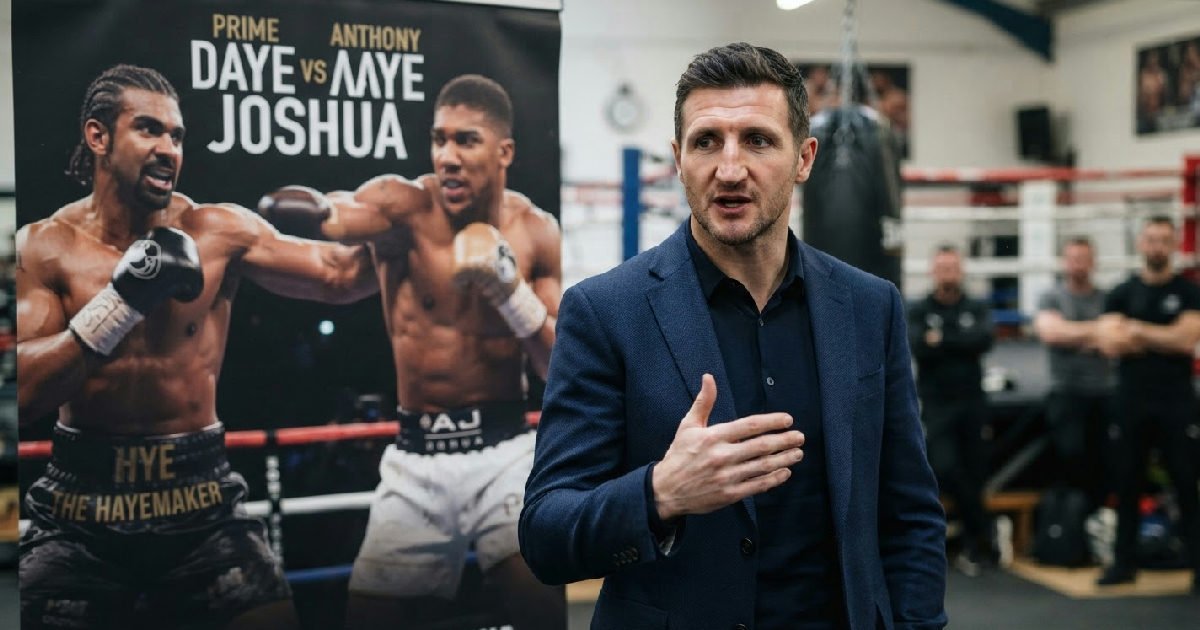
Hall of Fame boxer Carl Froch made waves in late January 2024, offering a striking prediction for a hypothetical clash between a prime David Haye and Anthony Joshua. Speaking on his “Froch on Fighting” YouTube channel, the former super-middleweight champion asserted that “The Hayemaker’s” explosive power would ultimately secure a victory against the physically larger Joshua.
This bold declaration reignited long-standing debates among boxing enthusiasts about the peak forms of both British heavyweights. Froch’s analysis delved into the nuances of their respective careers, pointing to specific fights and perceived psychological attributes to support his controversial stance.
Froch’s prime David Haye vs Anthony Joshua analysis
Froch, known for his candid commentary, didn’t mince words when envisioning the fantasy showdown between a peak David Haye and a peak Anthony Joshua. He told NewBettingSites that he “fancies Haye,” highlighting the former cruiserweight king’s speed and explosive power as decisive factors.
“He was so quick, had explosive power, and Joshua can’t take a punch,” Froch stated bluntly. This assessment challenges the commonly held belief that Joshua’s sheer size and power would overwhelm most heavyweights, even those from earlier eras.
Froch also drew a stark contrast between their ring temperaments. He suggested Joshua doesn’t truly enjoy the fight experience, saying, “I don’t think Joshua actually likes it when he’s fighting. I don’t think he enjoys it.” Conversely, he painted “The Hayemaker” as a pugilist who relished combat, keen to engage and dominate.
This psychological edge, combined with Haye’s perceived ferocity, formed a crucial part of Froch’s argument for a Haye victory. It’s a perspective that offers an interesting alternative to purely physical comparisons, suggesting mental fortitude plays a larger role than often acknowledged in major heavyweight bouts.
Re-evaluating Haye’s heavyweight prime
To fully grasp Froch’s perspective, it’s essential to consider David Haye at his most formidable. Before encountering Wladimir Klitschko, Haye had a celebrated run, unifying the WBA, WBC, and Ring magazine cruiserweight championships.
His move to heavyweight saw him defeat the 7ft giant Nikolai Valuev in 2009 to claim the WBA world title. He later put on a far more assertive display, stopping the durable Derek Chisora in five rounds, showcasing the very “explosive power” Froch referenced.
This version of “The Hayemaker” was a dynamic force, capable of quick, devastating finishes. He became one of only three boxers in history to unify cruiserweight world titles and also become a world heavyweight champion, putting him in elite company alongside Evander Holyfield and Oleksandr Usyk.
It’s this specific, dynamic version of Haye—not the one who later faced Tony Bellew in 2017—that Froch envisions squaring off against Joshua. His track record of challenging much larger opponents successfully at heavyweight, like Valuev, lends credence to the idea that he wouldn’t be intimidated by Joshua’s stature.
The Klitschko conundrum and AJ’s rise
A significant part of Froch’s reasoning involved comparing both fighters’ encounters with Ukrainian legend Wladimir Klitschko. David Haye lost a unanimous decision to Klitschko in 2011, a fight where he cited a broken toe as a contributing factor to his defeat.
Froch acknowledged this bout but offered a specific interpretation. “People will say, ‘Look at Haye against Klitschko. Klitschko was too big for him’,” Froch conceded. However, he then argued, “Klitschko was cute – holding back, staying out of the way, being tricky and horrible.”
Froch suggested Klitschko “smothered him and leaned on him,” rather than truly out-fighting him due to superior skill or power. This interpretation downplays Klitschko’s dominance in that particular fight, reframing it as a tactical masterclass exploiting size rather than a definitive statement on Haye’s abilities.
The former super-middleweight champion also pointed to Anthony Joshua’s famous 2017 victory over Klitschko, labelling it as less impressive than many believe. He highlighted Klitschko’s age and inactivity: “AJ beat a 42-year-old Klitschko who had been on the sofa for 18 months.”
While Joshua did climb off the canvas to secure an 11th-round stoppage in front of 79,000 fans at Wembley, Froch’s comments suggest he views this defining win through a different lens. He implies the victory was somewhat diminished by the circumstances of Klitschko’s career stage, a common point of contention among boxing analysts discussing Anthony Joshua’s career trajectory.
Joshua’s physical advantages in focus
Despite his firm backing of Haye, Carl Froch didn’t completely dismiss Anthony Joshua’s formidable physical attributes. He acknowledged Joshua as “a big lump,” recognizing the significant size difference between the two heavyweights.
Reports indicate Joshua holds an approximate four-inch height advantage and carries about 30 lbs more bulk than David Haye did in his prime. This considerable physical disparity is usually seen as a major asset in heavyweight boxing.
“As much as I think David Haye could iron out AJ, I just think AJ beats the Hayemaker cause he’s too big for him,” Froch ultimately concluded, presenting a slight contradiction to his initial leaning towards Haye. This acknowledgment of Joshua’s size suggests a more nuanced internal debate for Froch.
It highlights the perennial question in boxing: can speed and skill overcome sheer size and power? Froch’s conflicting statements here reflect the complexity of such hypothetical matchups, where different attributes could lead to varying outcomes depending on the exact scenario.
Contrasting career trajectories and legacies
The hypothetical nature of a prime David Haye versus Anthony Joshua fight invites reflection on their actual careers and the legacies they’ve built. Haye, as “The Hayemaker,” was renowned for his explosive, knockout power and charismatic persona.
He achieved significant success in two weight classes, a rare feat that cemented his place in boxing history. His cruiserweight dominance and WBA heavyweight title reign were marked by thrilling performances, showcasing his ability to compete at the sport’s highest levels.
Anthony Joshua, on the other hand, exploded onto the professional scene after winning Olympic Gold in 2012. He rapidly ascended to become a two-time unified WBA (Super), IBF, WBO, and IBO heavyweight champion, captivating a massive global audience.
His impressive knockout ratio and physical prowess made him one of boxing’s biggest draws. The Klitschko fight in 2017 was a defining moment, illustrating his resilience and championship mettle despite Froch’s later caveats.
The enduring appeal of fantasy matchups
These “prime versus prime” debates are a staple of boxing discourse, fueling endless speculation among fans and pundits alike. They offer a chance to reimagine history and pit legends against each other without the constraints of time or weight classes.
Analysts like Carl Froch play a crucial role in igniting these discussions. Their unique insights, drawn from years of experience in the ring, provide fresh perspectives that often challenge conventional wisdom. This keeps the sport’s historical narrative vibrant and engaging for its passionate following.
For British boxing fans, a clash between David Haye and Anthony Joshua holds particular allure. Both are iconic figures who have headlined major events and captured the national imagination. Imagining them at their absolute best creates a captivating “what if” scenario.
It allows fans to consider how different eras and fighting styles might have intersected. Such discussions celebrate the rich history of boxing while also providing context for current heavyweight dynamics.
What this prediction means for current heavyweight discourse
Carl Froch’s comments, delivered in early 2024, resonate within the broader conversation surrounding Anthony Joshua’s contemporary career. After losing his unified titles to Oleksandr Usyk in 2021 and failing to regain them in the rematch, Joshua has been on a path to rebuild his standing.
Analysts frequently scrutinize his performances, particularly concerning his perceived willingness to engage in sustained, brutal exchanges. Froch’s assertion that Joshua “doesn’t enjoy” fighting might echo sentiments from some observers who feel his post-Klitschko career has shown moments of hesitation.
This type of critique from a respected figure like Froch can influence the narrative around Joshua’s mental game. While Froch’s prediction is for a hypothetical fight, it subtly underscores ongoing questions about Joshua’s psychological resilience and aggression at the highest level of the sport today.
The challenge of comparing different eras
Comparing fighters across different eras is inherently complex. Boxing evolves, with training methods, dietary science, and tactical approaches constantly changing. A “prime” fighter from one decade might have faced different challenges and developed distinct skill sets than a “prime” fighter from another.
David Haye, for instance, operated in a heavyweight division that arguably had a different character than the one Anthony Joshua came to dominate. Haye’s approach often prioritized speed and explosive bursts, while Joshua epitomised raw power and physical conditioning.
Froch’s analysis attempts to bridge this gap by focusing on fundamental attributes like power, speed, and mental tenacity rather than purely technical comparisons. It acknowledges that while physical dimensions change, core fighting principles remain timeless in heavyweight boxing.
Ultimately, such predictions serve more as thought experiments than definitive statements. They invite fans to consider the subjective nature of greatness and how different styles stack up when stripped down to their most fundamental components. Froch’s take certainly adds another layer to the enduring “what if” discussions in boxing.