
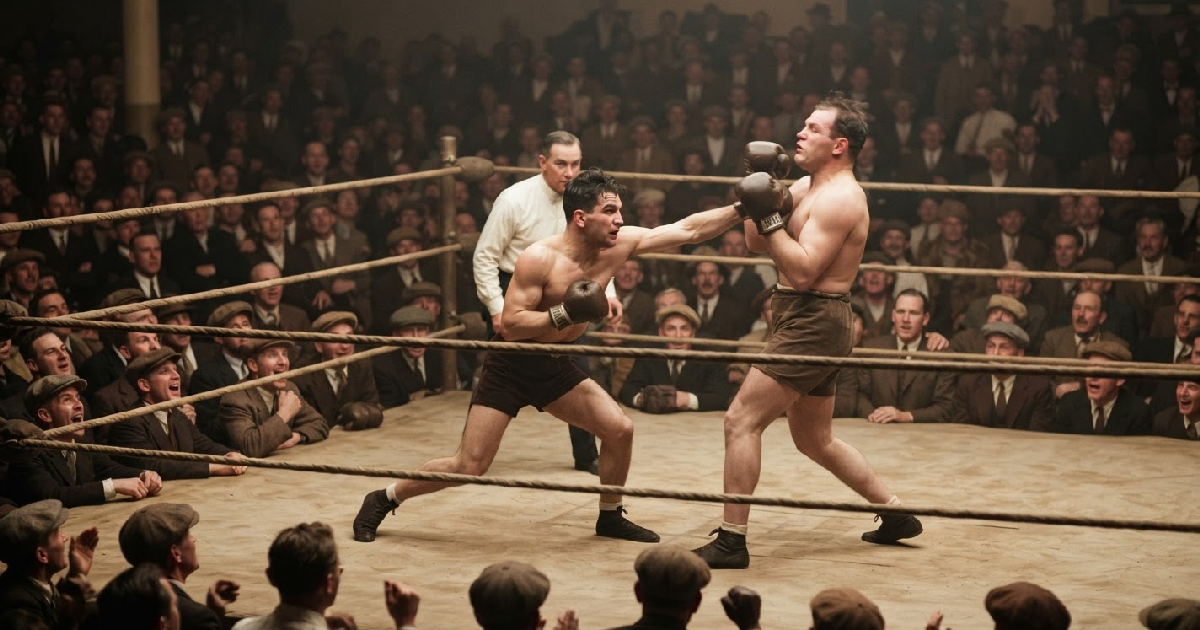
Harry Greb, the formidable middleweight known as “The Pittsburgh Windmill,” decisively defeated heavyweight contender Bill Brennan by points decision on July 4, 1919, in Tulsa, Oklahoma. Greb overcame a significant weight disadvantage of over 20 pounds in the 15-round non-championship bout. This victory underscored his fearless approach to challenging larger opponents.
The match was a crucial step in Greb’s storied career. It cemented his reputation as an elite fighter unafraid of physical mismatches. Brennan, a leading heavyweight contender, represented a significant test for the naturally smaller man.
Harry Greb’s Tulsa triumph over Brennan
Held at Convention Hall, this particular bout drew what contemporary newspaper accounts described as the largest boxing audience Tulsa had hosted up to that point. It reflected the growing popularity of professional boxing following World War I.
The event also showcased Greb’s burgeoning status as a major attraction. While contemporary reports celebrated the main event, details regarding the full undercard or additional participants for this historic July 4, 1919, event are not available.
Though no world title was on the line, the contest carried immense significance for both combatants and their careers. Greb routinely sought out and engaged much larger opponents, strategically building a formidable resume designed to challenge the sport’s biggest names.
Greb’s Masterclass in Ring Control
Despite conceding more than 20 pounds to his opponent, Greb controlled the majority of the contest. He achieved this through sheer athleticism and tactical brilliance. His relentless pace, superior footwork, and exceptional hand speed were simply too much for Bill Brennan.
The Tulsa World reporter Charles J. Brill scored the fight decisively, awarding seven rounds to Greb, just one to Brennan, and seven rounds even. This tally reflected the overwhelming consensus among ringside observers, who watched Greb force the larger man to fight at an exhausting, unsustainable tempo.
Brennan did find some success during the fourth round. He briefly used his size and heavier punches to slow Greb’s momentum. This proved to be only a temporary setback, however.
Greb quickly regained control, dictating the action with superior footwork, hand speed, and constant pressure. He forced the larger man to fight at an exhausting pace. Contemporary accounts even remarked on the surprising authority of Greb’s punches despite the significant weight difference.
A Defining Rivalry of 1919
The July 4th victory in Tulsa was not an isolated incident. It marked one of four wins Harry Greb recorded over Bill Brennan during their intense 1919 rivalry. Their first encounter took place on February 10, 1919, in Syracuse, New York, where Greb secured a newspaper decision.
Just over a month later, on March 17, 1919, Greb again triumphed over Brennan with another newspaper decision in Pittsburgh, Pennsylvania. These repeated victories highlighted Greb’s dominance and his unwavering commitment to challenging virtually anyone, regardless of weight class.
Greb sought opportunities against top-tier fighters like heavyweight champion Jack Dempsey. Modern boxing often sees strategic weight class navigation, but Greb’s approach was about sheer challenge, much like how current fighters eye IBF middleweight eliminator bouts for stepping stones to a championship.
The Fearless “Pittsburgh Windmill” Emerges
Harry Greb, whose full name was Edward Henry Greb, was born in 1894 and tragically passed away in 1926 at just 32 years old. His short but impactful career earned him nicknames like “The Pittsburgh Windmill” or “The Human Windmill.” These monikers reflected his incredibly aggressive, swarming, and non-stop punching style.
Greb was also renowned for his exceptional toughness and chaotic, sometimes “dirty fighting” tactics that unsettled opponents. His professional record is astonishing by today’s standards, with estimates ranging from 290 to 305 total fights between 1913 and 1926.
In 1919 alone, the year of his defining wins over Brennan, Greb fought an incredible 45 times. This volume speaks volumes about his desire to compete and his physical conditioning. Greb achieved significant titles, capturing the American Light Heavyweight Championship from 1922 to 1923.
He notably defeated an undefeated Gene Tunney, handing him his only professional loss. He then secured the World Middleweight Championship in 1923, holding it until his death. His ability to defeat 16 out of 17 Hall of Fame opponents he faced solidified his legend. This underscored a career built on fighting the best across multiple divisions.
Bill Brennan’s Heavyweight Challenge
Born Wilhelm Schenck in 1893, Bill Brennan was a formidable heavyweight contender of his era. He was also known as “K.O. Bill Brennan” or “Battling Bill the Bartender.” Standing 6 ft 1 in tall, Brennan possessed a powerful punch and a respectable knockout percentage.
He was a dangerous opponent for anyone in the heavyweight division. He had established himself as one of the leading contenders in the country, capable of competing with the best. Despite the four losses to Greb in 1919, Brennan’s career trajectory remained strong.
He notably received a world title opportunity against the legendary Jack Dempsey in 1920. In that bout, Brennan impressively extended the fearsome champion into the 12th round before ultimately being stopped. His resilience against Dempsey further cemented his place as a tough and respected figure in the sport.
Today, the heavyweight division still draws immense global attention with events like Oleksandr Usyk defending his WBC heavyweight title. This showcases the enduring appeal of the sport’s biggest punchers.
A Legacy of Unwavering Determination
More than a century later, the July 4, 1919, contest between Harry Greb and Bill Brennan remains a crucial piece of boxing history. With no surviving film, newspaper reports offer the primary record of Greb’s vintage performance and tactical mastery. It stands as a clear example of the fearless style that propelled him to greatness.
Greb’s repeated victories over larger, stronger opponents set him apart. He combined conditioning, speed, and relentless determination to achieve these wins. His willingness to consistently challenge heavier fighters, culminating in his middleweight and light heavyweight titles, redefined what was thought possible for a smaller man.
This occurred in an era less defined by strict weight classes. His victory over Brennan showed that skill, heart, and strategic pressure could overcome raw power and size. Such audacious challenges still captivate audiences, much like recent high-profile matchups, such as Oleksandr Usyk’s successful encounter against a kickboxing superstar, continue to push combat sports boundaries.
Greb’s career, tragically cut short at 32, left an indelible mark on boxing. His approach to fighting, incredible work rate, and ability to triumph against seemingly insurmountable odds cemented his place as one of boxing’s most celebrated all-time greats. He famously concealed blindness in one eye for years. The win over Brennan was a testament to that enduring spirit.