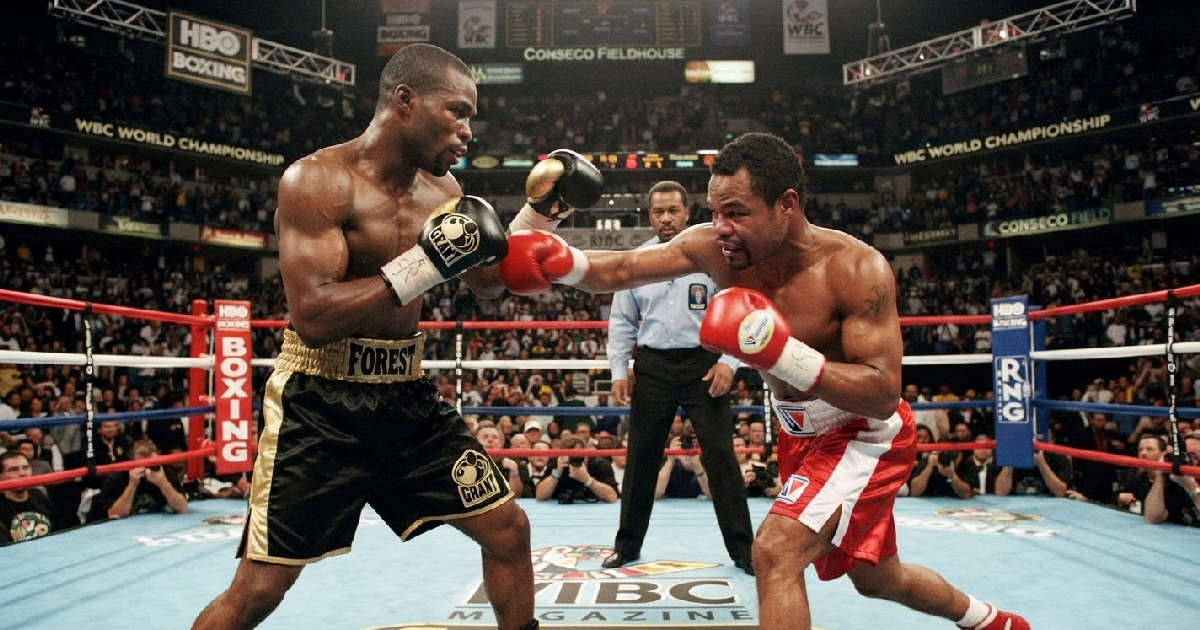
Vernon Forrest removed any lingering doubt about his first victory over Shane Mosley, decisively defending his World Boxing Council (WBC) and The Ring welterweight championships on July 20, 2002. At Conseco Fieldhouse in Indianapolis, Indiana, Forrest secured a second straight win over the former pound-for-pound king, solidifying his reign.
This highly anticipated rematch saw Forrest outmaneuver Mosley over 12 rounds, earning a unanimous decision that settled their compelling rivalry once and for all. It was a significant night for both fighters, with the outcome cementing Forrest’s status at the top of the welterweight division.
Forrest proves first victory no fluke in Vernon Forrest Shane Mosley rematch
The stakes were incredibly high for this second encounter. Six months earlier, in January 2002, Forrest had shocked the boxing world by capturing both the WBC and Ring Magazine welterweight titles from Shane Mosley.
Many in the boxing community expected Mosley, a fighter widely regarded as one of the sport’s best, to adjust his strategy and reclaim his championships. But Forrest was determined to prove his initial upset was not a one-off performance.
His prior professional win against Mosley, coupled with an amateur victory at the 1992 U.S. Olympic trials, underscored a rare mastery. This rematch was his chance to firmly establish his dominance.
A tactical masterclass in the ring
From the opening bell, Shane Mosley came out aggressively, attempting to force exchanges and erase the memory of his previous loss. However, Vernon Forrest, nicknamed “The Viper” for his sharp jab, refused to be drawn into a brawl.
Standing at 6 feet 0 inches, three inches taller than Mosley, Forrest effectively used his height and reach advantage. He consistently established his jab early, circled well, and countered Mosley’s rushes with precise shots.
Whenever Mosley closed the distance, Forrest tied him up, stifling the challenger’s offense. As the rounds progressed, Forrest steadily took control, repeatedly jabbing Mosley before initiating clinches to prevent sustained attacks.
Veteran referee Laurence Cole frequently had to separate the fighters, highlighting the intensely physical and tactical nature of the bout. The middle rounds saw some boos from the crowd due to the cautious pace, but Forrest remained committed to his game plan.
Even an altercation in the stands during the sixth round reportedly drew as much attention as the action unfolding inside the ropes. It was a clear sign the fight hadn’t quite caught fire for some in attendance.
Scorecards confirm Forrest’s dominance
Despite moments of reduced action, Forrest maintained his composure and executed his strategy flawlessly, consistently landing cleaner and more effective punches. CompuBox statistics backed up the tactical narrative of the contest.
Forrest landed 120 of 446 punches thrown, while Mosley connected on 114 of 259. Although Mosley had a slightly higher connect percentage, Forrest’s superior jab, timing, and ring control were undeniable, dictating the pace and flow of the entire fight.
Mosley did increase his pressure during the championship rounds, sparking several spirited exchanges in the tenth. But Forrest met the challenge with crisp counterpunching, finishing strongly with hard right hands late in the eleventh round and boxing confidently through the final stanza.
Ultimately, the official scorecards reflected Forrest’s clear advantage. Judge Gary Merritt scored the bout 117–111, Tony Castellano 116–112, and Jerry Roth 115–113, all in favor of Vernon Forrest. HBO unofficial scorer Harold Lederman and several media scorecards also agreed, confirming his supremacy.
Financial success and enduring legacies
Beyond the pugilistic drama, the rematch was a significant commercial success. The event drew an attendance of 15,775 fans to Conseco Fieldhouse, making it the largest boxing crowd in Indiana history at the time.
Both fighters also earned career-high paydays for their efforts. Vernon Forrest took home $3.42 million, and Shane Mosley collected $2.8 million, reflecting the substantial financial rewards at boxing’s highest level.
The championship bout received national television coverage on HBO, further amplifying its reach. The presence of HBO’s unofficial scorer, Harold Lederman, who later became an International Boxing Hall of Famer, added an extra layer of expert analysis for viewers.
Forrest continued his championship run after this victory, eventually unifying the welterweight division. Sadly, he passed away in 2009. His professional record finished at 41 wins (29 by knockout), 3 losses, and 1 no-contest, with his philanthropic work also forming a key part of his legacy.
Shane Mosley, despite the losses to Forrest, went on to capture world titles in higher weight classes, cementing his own Hall of Fame career. He won titles including the WBA (Super) and WBC welterweight titles again, alongside the WBA (Super), WBC, and The Ring light middleweight titles, showcasing remarkable resilience and skill.