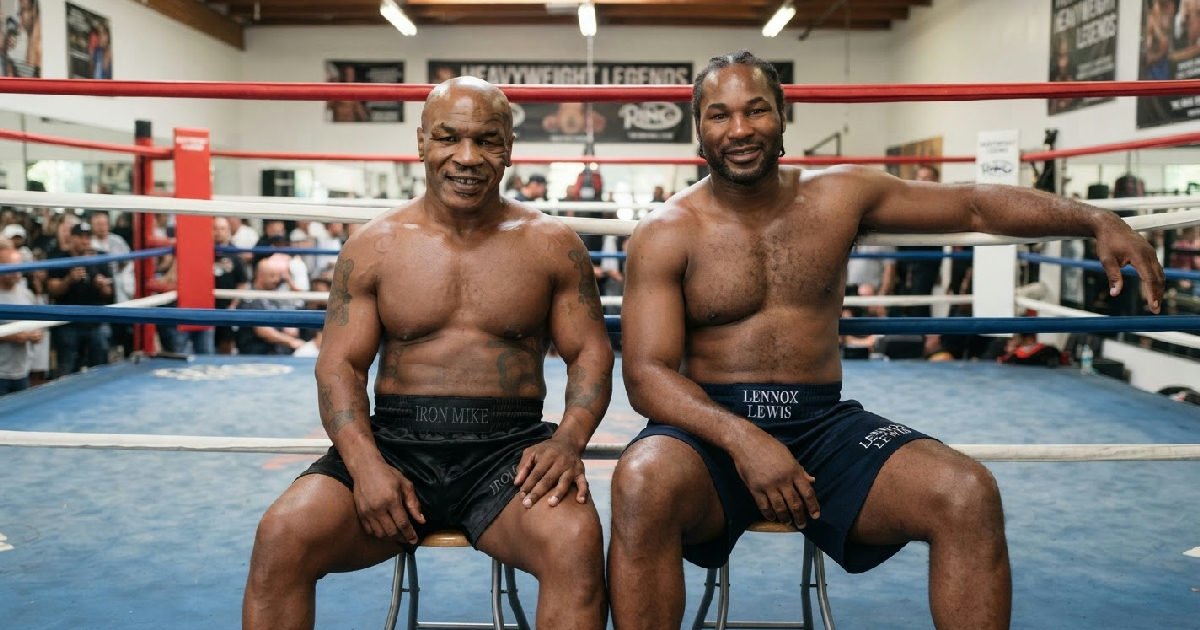
Boxing legend Mike Tyson has definitively named Lennox Lewis as the greatest opponent he ever faced, placing the former undisputed heavyweight champion above other formidable rivals, including Evander Holyfield. Tyson made his declaration on May 24, 2024, during an episode of his “Pound 4 Pound” podcast, which he co-hosts with Henry Cejudo. He stated simply, “Lennox is the best fighter I fought. He stands alone.”
This assertion from the man once dubbed “the baddest man on the planet” offers a rare and candid insight into the mind of one of boxing’s most dominant, and often controversial, figures. Even with a career spanning decades and featuring matchups against numerous Hall of Fame talents, Lewis appears to hold a singular and unmatched place in Tyson’s boxing memory.
Tyson’s definitive choice for Lennox Lewis
Mike Tyson’s recent pronouncement about Lennox Lewis wasn’t a casual remark; it was a firm declaration on a platform where he often reflects deeply on his career and the sport itself. Tyson didn’t hesitate when articulating his choice, emphasizing that he “didn’t fight nobody like that. Nobody. And they were all great fighters.
But he was just great.” This isn’t merely a compliment; it’s an acknowledgment of a profound difference in skill and challenge that Lewis presented.
The statement is particularly striking given Tyson’s two epic encounters with Evander Holyfield, a rivalry often considered his most personal and notorious. While Tyson readily acknowledges Holyfield’s exceptional qualities, calling him a “great champion” with “chin, heart, determination, work ethic, demeanour,” he maintains that Lewis presented a challenge on an entirely different level.
This distinction highlights the unique technical and strategic prowess Lewis brought to the ring, setting him apart in Tyson’s estimation as a truly unparalleled adversary.
Dissecting Lewis’s “greatness”
Lennox Lewis was known for his formidable size, powerful jab, and astute ring generalship. His approach was often calculated and clinical, contrasting sharply with Tyson’s more explosive, predatory style. Tyson’s acknowledgment of Lewis’s “greatness” points to a fighter who not only withstood Tyson’s legendary power but also outmaneuvered him strategically.
Lewis possessed an exceptional reach, strong defense, and a knockout punch of his own, making him a complex puzzle for any opponent, including “Iron Mike.”
The historic clash: Tyson vs. Lewis (2002)
The highly anticipated undisputed heavyweight championship bout between Mike Tyson and Lennox Lewis took place on June 8, 2002, at the Pyramid in Memphis, Tennessee. The boxing world buzzed with excitement and tension in the lead-up to this mega-event. It was a fight that truly captivated the sport, pitting two generational heavyweights against each other, both known for their raw power and imposing ring presence.
The build-up to the fight was as dramatic as the contest itself, filled with intense verbal exchanges and physical altercations during press conferences, which only fueled public interest and boosted pay-per-view numbers. This was more than just a fight; it was a clash of titans, and the public demanded to see who would emerge victorious.
Fans debated endlessly whether Tyson’s raw aggression could overcome Lewis’s disciplined boxing. Aggression against Anthony Joshua is a trait current heavyweights like Tyson Fury frequently discuss.
Lewis ultimately delivered a dominant performance, methodically breaking Tyson down and defeating him by knockout in the eighth round. This victory solidified Lewis’s position as the undisputed heavyweight champion and marked a definitive point in both fighters’ careers.
The fight wasn’t just a sporting spectacle; it was a massive commercial success, generating approximately $106.9 million from an impressive 1.95 million pay-per-view buys. This financial landmark underscored the enduring appeal of both fighters and the magnetic pull of a genuine super-fight in the heavyweight division.
Legacy of Iron Mike’s storied career
Mike Tyson’s journey in boxing is a saga of explosive talent, unprecedented success, and profound challenges. He burst onto the scene in the 1980s with a style characterized by ferocious speed and devastating knockout power. His early career was a whirlwind of rapid victories, as he tore through opponents with a relentless, almost primal force.
Just over 18 months into his professional career, Tyson made history, becoming the youngest world heavyweight champion at the age of 20 when he defeated Trevor Berbick in two rounds on November 22, 1986.
“Iron Mike” quickly unified the WBC, WBA, and IBF titles by August 1, 1987, achieving undisputed status and cementing his place at the pinnacle of the sport. He continued his reign of terror with impressive victories over boxing legends like Larry Holmes, Michael Spinks, Tony Tucker, and James Smith. Tyson’s aura of invincibility was palpable during this period, intimidating opponents even before the first bell.
However, his undefeated run and undisputed championship came to a shocking end in February 1990 with an upset loss to Buster Douglas, marking one of boxing’s most unexpected results.
While he did reclaim world honors by defeating Frank Bruno in 1996, further defeats to Evander Holyfield and, crucially, Lennox Lewis ultimately signaled the end of his time as a top-tier contender.
His professional record stands at 50 wins, 7 losses, and 2 no-contests, with 44 knockouts, a testament to his incredible power and fighting spirit.
Tyson’s peekaboo style dominance
Tyson’s aggressive, peekaboo boxing style became his defining characteristic. His hands were held high and tight to his cheeks, combined with continuous bobbing and weaving, which made his defense incredibly difficult to penetrate.
This unique approach, often attributed to his legendary trainer Cus D’Amato, allowed him to close distance on taller opponents, avoid incoming punches, and unleash devastating hooks and uppercuts from unexpected angles.
His explosive power and ability to overwhelm opponents rapidly secured many of his early victories within the first few rounds, solidifying his reputation as a knockout artist.
Holyfield rivalry: A different kind of challenge
While Tyson now regards Lennox Lewis as his most formidable adversary, his two fights against Evander Holyfield remain etched in boxing history for their unparalleled intensity and personal drama.
Holyfield, known as “The Real Deal” and “The Warrior,” holds a unique place in the sport as the only boxer to win the undisputed championship in two weight classes – cruiserweight and heavyweight – during the three-belt era. His career is a testament to extraordinary tenacity, versatility, and sheer will.
Their first encounter, on November 9, 1996, billed as “Finally,” saw Holyfield, then 34, pull off a major upset against the defending WBA champion Tyson. Holyfield secured a technical knockout in the 11th round, a victory many pundits and fans had considered highly unlikely at the time.
This fight, held at the MGM Grand Garden Arena in Paradise, Nevada, was so compelling and unexpected that it was named the “Fight of the Year” and “Upset of the Year” by The Ring magazine, underscoring its profound impact on the boxing landscape.
The rematch on June 28, 1997, became infamously known as “The Bite Fight.” A frustrated Tyson, claiming Holyfield was repeatedly headbutting him, bit Holyfield’s right ear and later his left. The controversial incident led to Tyson’s disqualification in the third round, with Holyfield retaining his WBA title.
The Nevada State Athletic Commission subsequently revoked Tyson’s boxing license indefinitely and fined him $3 million, a significant penalty. This dark chapter, however, doesn’t diminish Holyfield’s considerable achievements, including becoming a four-time world heavyweight champion, a feat unmatched in history.
When discussing the best fighter he faced, many boxers will often point to rivals who pushed them to their absolute limits, and Holyfield certainly did that for Tyson, albeit in a different way than Lewis.
Holyfield’s unparalleled heavyweight reigns
Holyfield’s path to multiple heavyweight titles was arduous, beginning with his dominance at cruiserweight before moving up in weight. After making the jump to heavyweight in 1988, he claimed the unified WBA, WBC, and IBF titles in 1990 by defeating James “Buster” Douglas.
His subsequent reigns included holding the WBA and IBF titles from 1993 to 1994, the WBA title for a third time from 1996 to 1999, and yet again for a fourth time from 2000 to 2001.
His fighting style, characterized by exceptional conditioning, remarkable durability, and a relentless assault of combinations often targeting the body, made him a truly formidable and enduring presence in the ring for decades.
The enduring draw of heavyweight legends
The conversation sparked by Mike Tyson’s recent comments about Lennox Lewis highlights the enduring fascination with boxing’s heavyweight division and its legendary figures. These discussions aren’t just about historical rankings; they offer fresh perspectives on rivalries and careers that continue to influence the sport.
Tyson’s willingness to re-evaluate his past opponents publicly adds another layer to his complex persona, reminding fans of the profound respect that often exists between competitors at the highest level.
Such retrospective analyses are crucial for understanding the evolution of boxing and the unique attributes that define greatness. They allow both seasoned fans and newcomers to appreciate the depth of talent that has graced the heavyweight division.
As Tyson looks towards new ventures, his reflections provide valuable context for his ongoing engagement with the sport, demonstrating that his passion for boxing remains undiminished. The legacy of these fighters, intertwined through their epic battles, continues to resonate and inspire new generations of boxers and fans.
What’s next for Iron Mike?
Even in his late 50s, Mike Tyson continues to command attention in the boxing world, proving that his star power hasn’t faded. While his career as a professional competitor officially concluded years ago, he still engages in exhibition bouts that consistently draw significant viewership and media buzz.
The latest of these is his highly anticipated showdown against social media personality and boxer Jake Paul, which is scheduled for July 20, 2025. This event will take place at AT&T Stadium in Arlington, Texas, and will be streamed live on Netflix, marking a significant foray for the streaming giant into live combat sports.
This upcoming fight, regardless of its competitive nature, underscores Tyson’s enduring appeal and his willingness to step back into the spotlight. It also highlights how figures like Tyson continue to shape the conversation around boxing, drawing new audiences and keeping the sport firmly in the cultural discourse.
The allure of seeing one of boxing’s all-time greats in action remains potent, a testament to his indelible legacy and the public’s sustained interest in his career. The continued presence of such legends only adds to the rich tapestry of boxing history, connecting past eras with current trends.
Fury stops Joshua early is a prediction many make about upcoming heavyweight clashes, showing the continued dominance of powerful fighters.