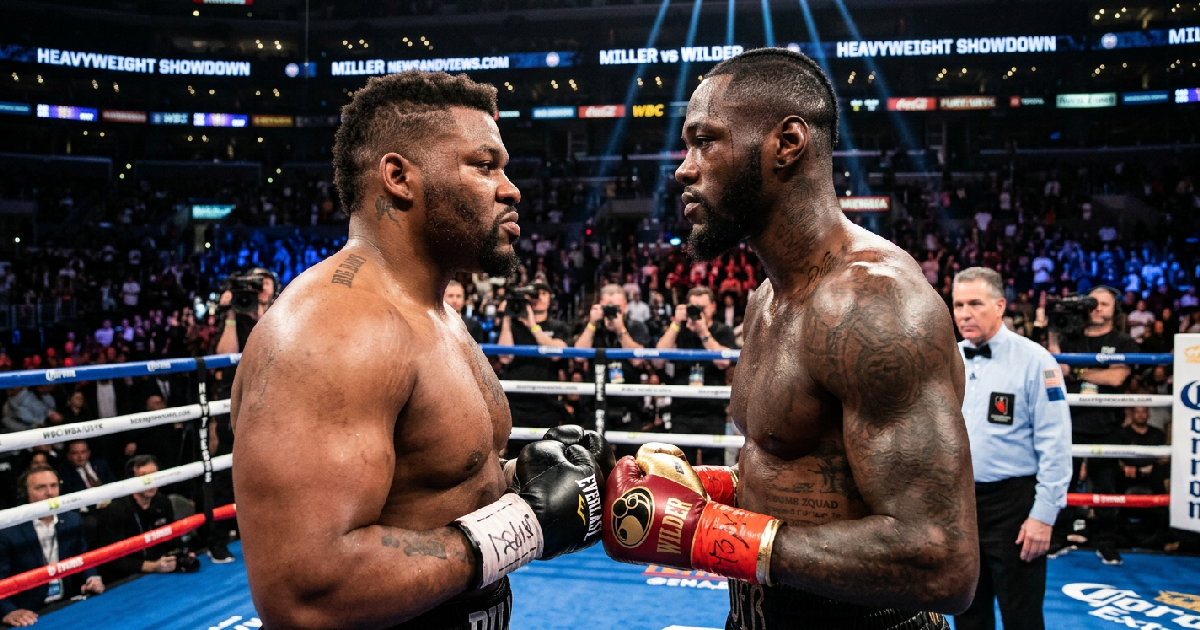
Jarrell Miller and Deontay Wilder are reportedly being discussed as potential opponents for a heavyweight clash that would see two of the division’s most recognizable figures attempt to rescue their careers. Both men have struggled to maintain momentum after recent high-profile setbacks in international marquee events, leading industry insiders and analysts to view a head-to-head matchup as a logical crossroads fight for both veterans.
Wilder, the former WBC champion known for his power, has seen his stock fall according to some observers after recent performances that left fans questioning his remaining desire for the sport. Similarly, Miller reportedly suffered a significant setback in a high-stakes encounter against Daniel Dubois, a result that slowed his climb back toward the heavyweight elite. With both fighters currently looking for a clear path to a world title shot, a meeting between them solves the immediate problem of matchmaking for two experienced contenders who still possess significant name value.
The timing for such a bout aligns with the current heavyweight climate, where high-stakes scenarios are becoming increasingly common to clear the logjam at the top of the rankings. While no official date has been set, the chatter surrounding the pairing suggests that promoters are looking for a redemption narrative to sell to broadcasters. For Wilder, it offers a chance to prove his power can still neutralize a massive, pressure-based fighter; for Miller, it is an opportunity to prove his durability and volume can break a heavy puncher. Some experts, such as David Price in his recent heavyweight evaluations, have noted how difficult it is for veterans to regain their peak form once they lose their momentum.
Heavyweight Redemptions and the Search for Relevance
The heavyweight landscape has shifted dramatically over the last year, with the emergence of new contenders and the consolidation of titles. This has left seasoned veterans like Wilder and Miller in a precarious position. Wilder’s recent outings have led to reports that he may have lost some of the predatory aggression that once made him a feared presence in the division. Both men are now at a point where a loss could effectively end their dreams of returning to the pinnacle of the sport.
Miller presents a unique stylistic challenge that could reveal exactly how much Wilder has left in the tank. Unlike the agile technicians who have frustrated Wilder in the past, Miller is a front-foot pressure fighter who relies on his enormous physical frame to wear opponents down. If Wilder cannot find an opening early, he risks being smothered by a man who typically carries a significant weight advantage into the ring. This dynamic often makes such fighters some of the most dangerous boxers in the world because of their physical persistence.
The Pressure on “The Bronze Bomber”
For Deontay Wilder, the stakes couldn’t be higher. A further loss would likely signal the end of his time as a major headline attraction. His career has been defined by spectacular results, but when those outcomes dried up, critics began to find technical deficiencies in his game. He remains a threat purely based on his reputation for one-punch power, yet power alone has not been enough to secure victory in his most recent competitive outings.
Critics argue that Wilder has looked hesitant in his last few appearances. Facing someone as vocal and physically imposing as Miller would force Wilder to either engage or be overwhelmed. This provides a narrative hook that promoters love: can the ultimate puncher find his trigger against a man who refuses to take a step backward? Miller is still looking to fully move past his previous controversies and re-establish himself as a top-tier threat.
Style Clash and Marketplace Value
Beyond the ring mechanics, the business of boxing demands matchups that can draw audiences without necessarily requiring a world title on the line. Both Miller and Wilder are experienced in pre-fight promotion. Miller’s ability to sell a fight through verbal exchanges is well-documented, and Wilder’s theatrical persona remains a draw for casual fans. In a market where undercards are often filled with unknown prospects, a Miller-Wilder main event provides a mainstream feel with proven names.
The logistics of the fight would likely see it land in one of the emerging boxing hubs in the Middle East or perhaps a major US venue where both men have established fanbases. Despite their recent losses, they remain recognizable brands. While the business side is complex, especially as the fallout from previous internal boxing power struggles continues to impact how deals are structured, the simplicity of this match makes it attractive to investors. It is a fight that doesn’t require a complex tournament structure to justify it.
Future Implications for the Heavyweight Division
The winner of this potential clash would immediately find themselves back in the conversation for high-profile fights. With a new crop of heavyweights moving toward title contention, the veteran who emerges victorious could serve as a high-level gatekeeper or even a late-career challenger for a secondary title. The loser, conversely, would likely face calls for retirement from both fans and the media, given the current strength of the division.
Moving forward, the heavyweight division needs clear results to keep the narrative moving. A decisive outcome between Miller and Wilder would provide exactly that. It separates the active contender from the former champion who is perhaps struggling to adapt to the current era. As the rankings continue to fluctuate, this fight represents one of the more efficient ways to determine who still deserves a place in the elite circle.