
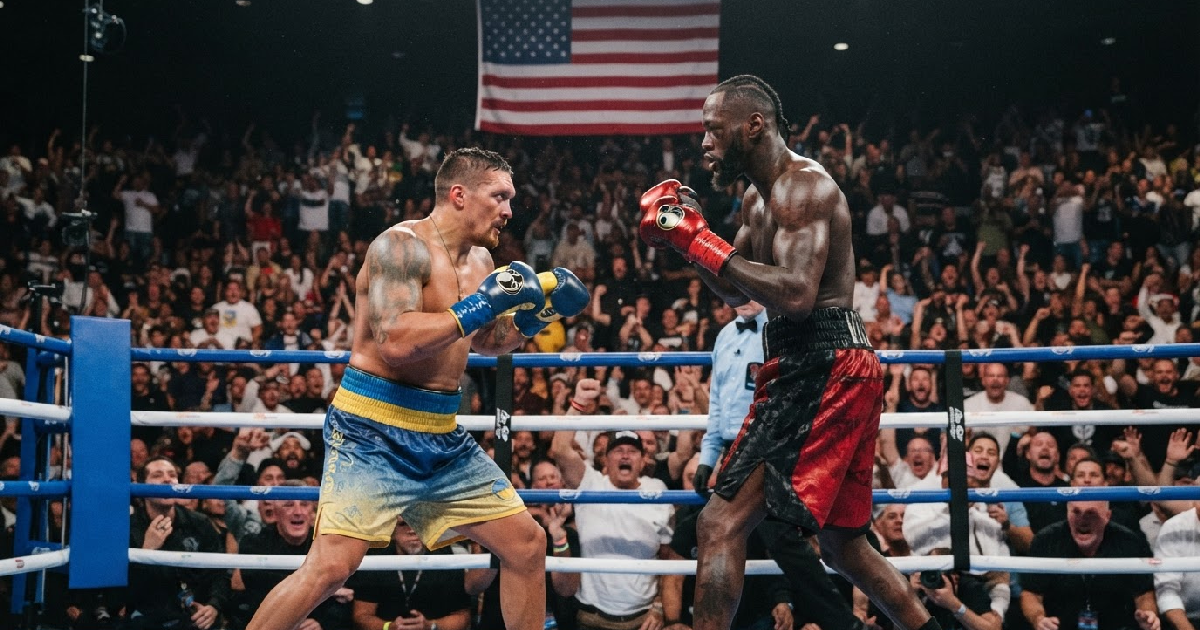
Ukrainian boxing sensation Oleksandr Usyk, the 39-year-old former two-division undisputed champion, is facing significant fan backlash after revealing his strong interest in a “last dance” farewell fight against American heavyweight Deontay Wilder.
The potential bout, reportedly eyed for the United States later this year or early next, has sparked widespread criticism from supporters who believe Usyk, with his pristine 25-0 record, should conclude his illustrious career against a more formidable opponent.
Usyk targets Wilder for “last dance” in the USA
Fans are questioning the sporting merit of facing Wilder, whose recent form has been less than stellar. Usyk, who last fought in May against kickboxer Rico Verhoeven, has openly stated his desire for a financially rewarding final bout, a decision that appears to be prioritizing business over traditional boxing legacies.
Oleksandr Usyk has made it clear his final professional appearance will be a grand event, far from a quiet exit. He told Mail Sport that his “Last Dance” is “going to be in the U.S.A., Maybe in New York, [in a] stadium,” underscoring his ambition for a high-profile, commercially successful farewell from the sport.
This pursuit has also involved specific behind-the-scenes movements. Negotiations for this proposed farewell fight are reportedly underway with Zuffa Boxing. Sources indicate that talks between the teams of Oleksandr Usyk and Deontay Wilder have recently resumed, signaling serious intent for the bout to materialize.
Money and business over legacy
Speaking to The Athletic, Usyk candidly explained his motivation for this choice. “Why not? If Deontay’s team wants it, I do it. Money, business… now we have two options, but what for me is good, we will take,” he remarked, revealing a pragmatic approach.
For a fighter who has already conquered every peak in boxing, financial considerations appear to outweigh further championship glory. His decision to vacate multiple heavyweight belts supports this interpretation, allowing him to dictate the terms of his retirement.
The allure of a big name
Even with Deontay Wilder’s recent struggles, his name still carries considerable weight, particularly in the American market. Usyk acknowledged this, telling All Out Fighting, “Listen, this is a man who, over the last ten years has been a top fighter and world champion. He’s a dangerous guy.”
The Ukrainian boxer clearly sees value in closing his career against a globally recognized figure. While the sporting challenge might be debated, the commercial pull of an Oleksandr Usyk Deontay Wilder fight is undeniable, promising a significant payday for both veterans.
Fan backlash questions sporting merit
The proposed matchup has not been well-received by a significant portion of the boxing community. Fans, many of whom have watched Usyk achieve unprecedented success, are voicing strong disapproval across social media and boxing forums, arguing his final test should be against a top-tier contender.
They believe Usyk, who boasts an unblemished 25-0 record and is considered one of the era’s pound-for-pound greats, deserves an opponent that truly challenges his extraordinary skill set. This widespread sentiment highlights a deep-seated desire among purists for legacy-defining encounters.
Wilder’s recent struggles
Critics point to Deontay Wilder’s recent string of losses as the primary reason for their apprehension. The “Bronze Bomber” has suffered two high-profile defeats to Tyson Fury, along with more recent setbacks against Joseph Parker and Zhilei Zhang.
This losing streak raises serious questions about his current standing in the heavyweight division. Wilder’s last outing, a “sloppy split-decision” win against Derek Chisora in April at London’s The O2 Arena, further fueled concerns about his diminished form and readiness for an elite opponent.
The “softer option” perception
Many fans perceive Wilder as a “softer option” for Usyk, offering a relatively safe path to retirement. They feel Usyk, having defeated elite fighters like Tyson Fury, Anthony Joshua, and Daniel Dubois (twice) to become the only two-time undisputed heavyweight champion in the four-belt era, should face a truly challenging opponent.
Names like Moses Itauma or the winner of the highly anticipated Tyson Fury vs. Anthony Joshua bout are frequently suggested alternatives. Moses Itauma has been making significant waves in the division, garnering support as a legitimate final opponent. This highlights the fan expectation for a grand finale that aligns with Usyk’s exceptional career.
Usyk’s championship relinquishment redefines his final chapter
Oleksandr Usyk’s decision to vacate his WBC, IBF, and WBA heavyweight titles has fundamentally reshaped the narrative around his “last dance.” This strategic move, while allowing him freedom, also highlights a shift in priorities from championship unification to personal financial gain.
He can now pursue fights that are commercially viable rather than strictly mandated by governing bodies. This approach isn’t unprecedented in boxing, where fighters often balance legacy and financial incentives as they near the end of their careers.
Freedom from mandatory obligations
By giving up the belts, Usyk freed himself from the pressure of mandatory defenses. For instance, defending the WBC belt would have required him to face mandatory challenger Agit Kabayel. This strategic relinquishment has allowed Usyk to cherry-pick his final opponent, unburdened by championship stipulations.
This freedom contrasts sharply with the strict regulatory landscape many champions face. WBO deadlines for title fights, for example, can often dictate a boxer’s schedule and limit their choices. Usyk has opted out of this system for his swansong, seeking a different kind of reward.
While some purists might decry the move, Usyk has already cemented his place in boxing history with multiple undisputed reigns. His decision reflects a fighter with little left to prove in terms of titles, now seeking to maximize his earnings in his final professional outing.
The fading power of the “Bronze Bomber”
A key element in the fan backlash revolves around the perceived decline of Deontay Wilder. Once celebrated for his devastating right hand, often dubbed a “bazooka,” recent performances suggest that formidable power may no longer be as potent, making a fight against Usyk seem less of a competitive challenge.
Wilder, who held the WBC heavyweight title for five years and boasts 45 wins with 43 knockouts, was once the most feared puncher in the division. His current record and recent losses paint a picture of a fighter whose dominance has significantly waned in the past few years.
Lingering questions about shoulder injury
Deontay Wilder himself has openly discussed issues with his right shoulder. This admission casts a shadow over his most potent weapon, prompting questions about how much of his once-feared power remains, especially against an elusive, technical boxer like Usyk.
An injured or diminished Wilder presents a far less imposing threat to an elite technician like Usyk than the version who terrorized the heavyweight division for years. The concern is that Usyk would be facing a version of Wilder far removed from his prime, making the encounter less compelling.
Commercial interests versus sporting legacy
The ongoing debate surrounding an Oleksandr Usyk Deontay Wilder fight encapsulates a perennial tension within professional boxing: the balance between commercial viability and sporting legacy. For Usyk, the financial rewards of a fight against a recognized name like Wilder are clearly a strong motivator for his final bout.
This isn’t just about a personal payday; it’s a reflection of the broader economics of top-tier boxing. Large venues, substantial pay-per-view numbers, and global media attention are all tied to big names, regardless of their current athletic standing.
Impact on the heavyweight landscape
Should this fight proceed, it will inevitably impact the perception of Usyk’s remarkable career. While his accomplishments as the only two-time undisputed heavyweight champion in the four-belt era are undeniable, ending against a past-his-prime opponent could leave a slightly sour note for some purists.
The heavyweight division continues to evolve, with new talent always emerging, and such a fight could be seen as a missed opportunity to pass the torch. Young prospects setting ambitious timelines for their careers often look for a definitive challenge.
Conversely, a big-money fight in the US could introduce Usyk to an even broader audience for his swan song. This choice reflects a pragmatic business decision, securing a comfortable retirement while still engaging with a recognizable figure in the sport. It’s a calculated risk, weighing fan sentiment against personal and financial goals, as Usyk prepares to step away from the ring on his own terms.