
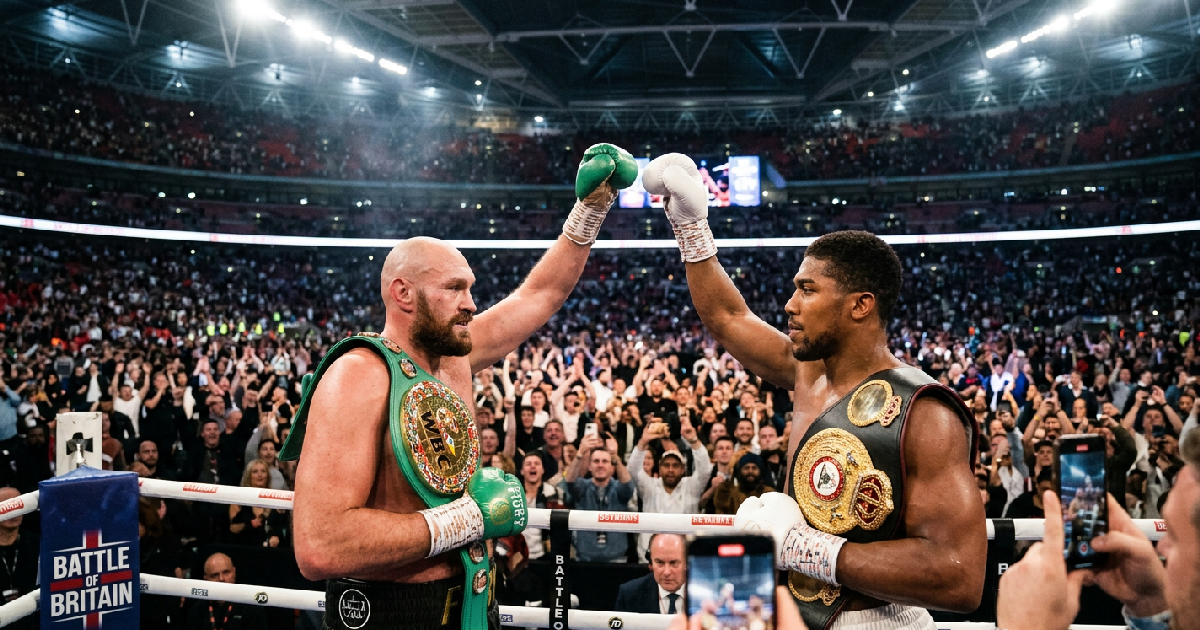
Heavyweight rivals Tyson Fury and Anthony Joshua have officially signed an agreement to meet in the ring in late 2026, ending years of public disputes and failed negotiations. The deal, confirmed on May 18, 2026, marks the first time both British superstars have committed to a firm timeline for what is widely considered the biggest fight in the history of United Kingdom boxing. Both camps have agreed to terms that will see the long-awaited showdown head towards a winter date, pending the outcome of their respective interim bouts.
The path to this moment has been littered with legal hurdles and last-minute collapses. For years, fans watched as “Battle of Britain” talks fell apart over broadcast rights, purse splits, and mandatory obligations. While the rivalry remained fierce on social media, the practical reality of making the fight often seemed impossible. This new signed agreement represents a definitive shift, moving the conversation from hypothetical matchmaking to a concrete commercial reality for 2026.
Industry insiders suggest the landscape changed following a series of high-profile heavyweight performances that shifted the leverage between the two camps. Experts such as David Price have recently evaluated Tyson Fury and his current standing, noting that the window for this legacy-defining clash was narrowing as both fighters entered the latter stages of their careers. The urgency to secure the bout became undeniable for both promotional teams.
Timeline of the Tyson Fury and Anthony Joshua rivalry
The rivalry first gained major traction in 2021 when a two-fight deal was reportedly agreed upon for matches in Saudi Arabia. However, an arbitration judge in the United States ruled that Tyson Fury was legally obligated to face Deontay Wilder for a third time, scuppering the plans. Anthony Joshua subsequently lost his world titles to Oleksandr Usyk, which further complicated the path to an undisputed or even a non-title mega-fight.
Negotiations spiked again in late 2022 after Tyson Fury stopped Derek Chisora in London. Public deadlines were set and missed, with Anthony Joshua eventually moving toward a rebuilding phase under trainer Ben Davison. During this period, the heavyweight division saw the rise of new threats, including young knockout artists like Moses Itauma who continues to climb the rankings, forcing the established veterans to finally consolidate their positions.
Commercial hurdles and broadcast challenges
Money was rarely the primary issue, as the fight is expected to generate record-breaking pay-per-view revenue. Instead, the “clash of the broadcasters” proved to be the most persistent obstacle. Tyson Fury’s long-term partnership with Top Rank and TNT Sports often sat at odds with Anthony Joshua’s career-long ties to Matchroom Boxing and DAZN.
The 2026 agreement reportedly includes a collaborative broadcast model, allowing multiple platforms to share the rights in a manner similar to recent cross-promotional superfights. This compromise was essential to satisfy the complex web of sponsors and networks attached to both athletes. Without this administrative breakthrough, the contracts would likely have remained unsigned indefinitely.
What the 2026 agreement means for the heavyweight division
The signing of the Tyson Fury vs. Anthony Joshua contract effectively freezes the top of the heavyweight division for the next 18 months. With the two biggest names tied to a late 2026 date, other contenders must now fight for secondary positions or wait for the fallout of this massive encounter. It provides a rare bit of clarity in a weight class often criticized for its slow-moving bureaucracy.
This development also impacts promotional power plays across the globe. While Matchroom Boxing has been active in expanding its roster, including a new deal for Dalton Smith to secure his long-term future, the Fury-Joshua fight remains the “North Star” for the company’s financial projections. It is the one event capable of overshadowing any other boxing cards scheduled for the 2026 calendar year.
The technical matchup and current form
By the time the fighters step into the ring in late 2026, Tyson Fury will be 38 years old, while Anthony Joshua will be 36. Although both remain elite performers, the naturally aging bodies of heavyweight giants will play a role in the betting odds. Tyson Fury continues to rely on his exceptional movement and height, while Anthony Joshua has recently rediscovered the aggressive, punch-perfect style that saw him dominate the division in the late 2010s.
Tactically, the fight is viewed as a classic “boxer versus puncher” dynamic, though both men have showed versatility in recent years. Tyson Fury has become more stationary and offensive under coach SugarHill Steward, while Anthony Joshua has shown improved defensive discipline. These evolutions mean the fight in 2026 will look vastly different than it would have if it had occurred five years earlier.
Frequently Asked Questions
Is the Tyson Fury vs. Anthony Joshua fight officially confirmed?
Yes, both fighters have officially signed a contract for a match aimed at late 2026. While dates can occasionally shift due to injury or training camp requirements, the legal agreement between the two camps and their respective promoters is now in place.
Where will the Fury vs. Joshua fight take place?
While an official venue has not been named in the initial announcement, London’s Wembley Stadium and various sites in Saudi Arabia are the primary candidates. The decision will likely depend on which location offers the highest site fee and the best logistical setup for a global broadcast.
What happens if one of them loses a fight before 2026?
The current agreement reportedly contains clauses that protect the fight even if one protagonist suffers a defeat in an interim bout. However, a loss would likely strip the fight of any remaining world title significance, turning it into a “legacy” grudge match rather than an undisputed championship clash.