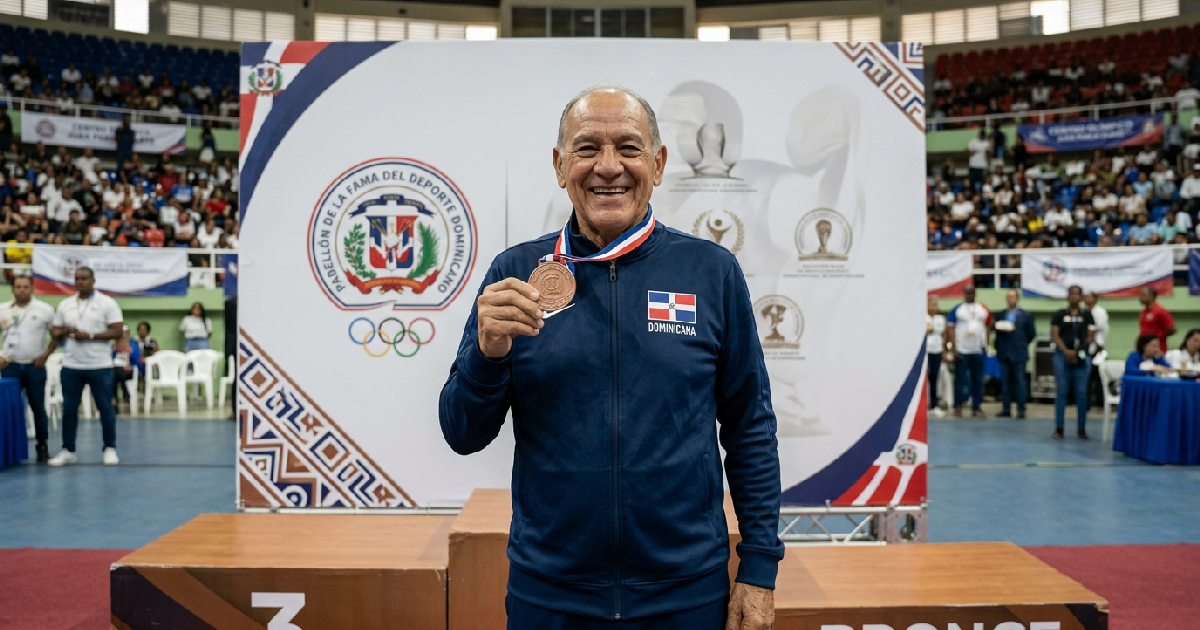
The Permanent Committee of the Pabellón de la Fama del Deporte Dominicano officially announced on Tuesday, June 30, that legendary boxing trainer Victor Pascual Linares will be inducted into the Dominican Republic Sports Hall of Fame.
The ceremony, marking the 60th edition of this prestigious event, is scheduled for the morning of Sunday, November 15, 2026, in the auditorium of the Centro Olímpico Juan Pablo Duarte in Santo Domingo.
Victor Pascual Linares: Architect of the 1984 Olympic breakthrough
Victor Pascual Linares is celebrated as the intellectual architect behind the country’s first Olympic medal, a bronze won by Pedro Julio Nolasco at the 1984 Los Angeles Games.
Pascual’s career spans over four decades dedicated to molding amateur talent and directing various national teams. His selection was unanimously approved by the Permanent Committee, recognizing a legacy that includes leading the Dominican Republic to over 100 international medals, including more than 40 gold.
He enters the hall as a “propulsor,” a specific designation for those who drive the growth and promotion of sports.
This induction makes him the 28th individual linked to boxing to enter the Hall of Fame, joining a group composed of 23 boxers and five propulsores, including Bienvenido Solano, Arturo Morales, Enrique Ripley Marín, and Carlos Lamarche Rey.
The high point of Victor Pascual Linares’ tenure remains the 1984 Los Angeles Olympics. By guiding Pedro Julio Nolasco to the bronze medal, he ended the Dominican Republic’s drought on the world stage, securing the nation’s inaugural Olympic podium finish in any sport.
This achievement catalyzed a new era for Caribbean boxing, proving that domestic fighters could compete with the world’s elite programs. The impact of this victory resonates even today as Richard Torrez Jr. anticipates demonstrating high-level amateur fundamentals in modern professional bouts.
Key details
Pascual will be enshrined alongside many of the students he personally mentored. These include Pedro Julio Nolasco (inducted in 1997), Eloncio Mercedes (1997), Jorge “Salchichón” Amparo (1999), and Manuel de Jesús Herrera (2019).
His successor as national coach, Ruddy Zapata, who was inducted in 2020, also joins him in an elite fraternity that reflects the continuity of Dominican boxing excellence over the last fifty years.
Pascual’s transition from an assistant coach at the 1975 Pan American Games in Mexico to a Hall of Fame immortal represents the pinnacle of a life spent in the gym corner.
Unprecedented dominance in regional championships
In 1981, Pascual achieved a historic milestone by leading his team to defeat the powerful Cuban delegation at the Central American and Caribbean Boxing Tournament. It was the first time the Dominican Republic had ever won that specific event, signaling a shift in the regional power dynamic.
During this era, Pascual traveled to all five continents, competing in Moscow for the 1980 Olympics and Munich for the 1982 World Championships. His ability to consistently produce winners across different environments solidified his reputation as a world-class tactician.
His results at major games were equally productive. As director of the national team at the 1978 Central American and Caribbean Games in Medellín, the Dominican squad secured three gold, two silver, and two bronze medals. At the 1979 Pan American Games in San Juan, Puerto Rico, he oversaw a five-medal haul.
These successes served as a foundation for fighters like Manuel Herrera, a junior world champion in 1983 and four-time world title challenger. Just as Roberto Duran names Ken Buchanan as a highly skilled tactical puzzle, Pascual’s students were known for the technical proficiency he instilled in them.
Mentoring world champions and elite amateur prospects
The roster of talent under Pascual’s wing included former world champions who made the successful leap from the amateur ranks to the professional stage. Eleoncio Mercedes, a 1975 Pan American silver medalist, eventually became the world flyweight champion in 1982. Similarly, Luis Santana, a Central American Games champion, ascended to a world title in 1994.
These career paths demonstrate Pascual’s capability to prepare athletes for the rigors of championship-level professional boxing while maintaining their amateur excellence.
Pascual also mentored Héctor Julio Ávila, a standout who achieved a rare feat in amateur boxing. Héctor Julio Ávila was the first Latin American boxer to win a gold medal in the prestigious Córdoba Cardín tournament in Cuba. Ávila later transitioned to the professional ranks, where he became a challenger for a world championship.
Key details
This level of development allowed the Dominican Republic to remain relevant even as women’s boxing entered its own prime in later decades, maintaining the country’s status as a combat sports hub.
Throughout his career, Pascual was present for the development of José Dolores Caba and Jorge Amparo, both of whom were part of his 1975 squad. Amparo went on to win gold in Medellín 1978 and bronze in the 1979 Pan American Games.
These achievements highlight a career that concluded its Olympic participation in 1997, leaving behind a legacy of discipline that defined the Dominican Republic’s presence in international boxing rings for more than twenty years.
The 2026 Induction Class of Immortals
The 60th edition of the induction ceremony features a wide array of sporting icons. Victor Pascual Linares will share the stage with 11 other inductees, including former Major League Baseball star Alex Rodríguez, weightlifter Yuderqui Contreras, and baseball player Darío Veras.
The class also recognizes the late journalist Domingo Saint Hilaire, further expanding the group of individuals who promoted and chronicled the growth of the nation’s athletic achievements. By placing an Olympic trainer alongside global stars, the Pabellón de la Fama acknowledges the essential role of specialized coaching.
The choice of the Juan Pablo Duarte Olympic Center for the ceremony is fitting, as it serves as the beating heart of Dominican sports. For Pascual, this induction is a homecoming to the facility where he spent decades training the next generation of bantamweights and flyweights.
As he joins the ranks of fellow propulsores Arturo Morales and Carlos Lamarche Rey, the boxing community will finally see the man who helped create the “Olympic ” culture in the Dominican Republic take his rightful place among the immortals.