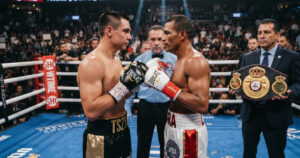
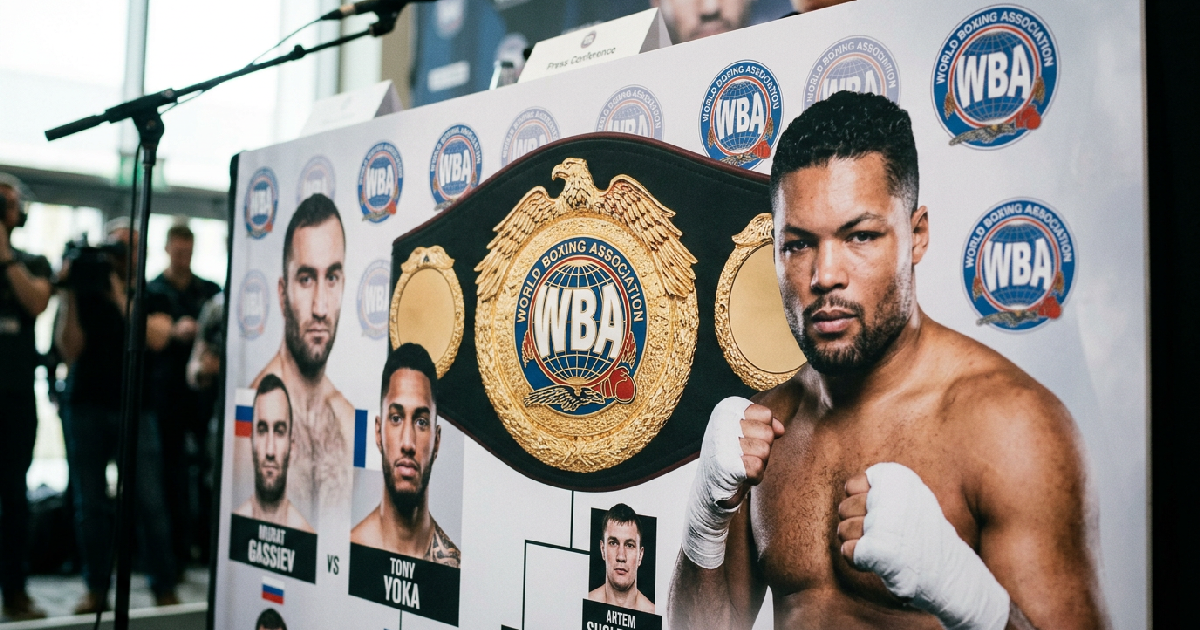
The World Boxing Association (WBA) is on the verge of making what many in boxing are calling one of its most bewildering decisions, reportedly weighing British heavyweight Joe Joyce for a full WBA heavyweight title shot against Murat Gassiev on July 11 in Moscow.
This controversial consideration comes despite the 40-year-old Joyce suffering two consecutive losses and failing to secure a win since March 2024. His potential elevation follows Frenchman Tony Yoka’s withdrawal from the main event due to a back injury, with Joyce already scheduled to fight on the card.
Joyce’s surprising path to a World Boxing Association title fight
World Boxing News (WBN) reports that Joyce is currently discussed as Yoka’s potential replacement for the upcoming bout. He was already set to face unbeaten Russian Artem Suslenkov in Moscow. However, the WBA might now ask him to step into the main event, saving the card but sparking widespread concern within the sport.
Joe Joyce finds himself in a truly extraordinary predicament, considering his recent performances in the ring. He was already slated to face unbeaten Russian Artem Suslenkov, a fighter with a perfect 14-0 record, on the very same Moscow card. But with Yoka’s sudden injury, the WBA appears to be eyeing Joyce as a direct replacement.
This potential main event change means Joyce could bypass a crucial test against Suslenkov. The original bout was viewed as vital for the 40-year-old Briton to stop his career’s downward slide. Instead, he might get a shot at the full world heavyweight championship without earning a preceding victory.
The issue for many observers, including World Boxing News, is Joyce’s stark lack of recent form. He has suffered back-to-back defeats against Derek Chisora and Filip Hrgovic. His last triumph was in March 2024, representing over two years without a professional win.
Such a long period without a victory is highly unusual for a boxer being considered for a world title bout. It raises immediate questions about the criteria consistently applied by the WBA. Typically, challengers are expected to be on an upward trajectory or holding significant recent wins.
WBA’s ongoing ranking controversies
This isn’t the first time the WBA’s methods for challenger selection have drawn fire from boxing pundits and fans alike. The organisation previously faced significant scrutiny surrounding Tony Yoka’s initial challenge to Murat Gassiev. Yoka had inexplicably spent four years completely outside the WBA’s top fifteen rankings.
Yet, he was announced as Gassiev’s opponent, creating immediate uproar. Mysteriously, Yoka then appeared at number fourteen in the subsequent rankings update, effectively “tidied up the issue” after the title fight was already in place. This pattern has led to ongoing questions about the integrity of the boxing rankings system and its transparency.
Key details
To sanction Gassiev versus Joyce for the full heavyweight championship would, in WBN’s view, effectively “render the WBA rankings almost meaningless.” This criticism is particularly sharp following the contentious process around Yoka’s sudden return to the top fifteen. Such a move risks further eroding trust in the WBA’s established evaluation standards.
The WBA already faced questions over its rationale for placing Yoka into a title fight before he was even ranked within the top 15. Replacing him with a heavyweight whose career trajectory is described as “hanging by a thread” would be even harder to justify. It sets a worrying precedent for the organisation’s future decisions.
This scenario directly jeopardises the overall heavyweight division credibility, suggesting that wins and losses might not be the primary criteria for title contention. Such a decision could open the floodgates for similar controversial selections, weakening the sport’s competitive integrity. It makes the WBA’s role as a sanctioning body seem less about meritocracy.
What this means for Joe Joyce and the WBA
From Joe Joyce’s perspective, accepting a world title opportunity, regardless of his recent form, is almost a given for any fighter. The chance to compete for a full world championship, especially in the heavyweight division, is rare and career-defining. However, the stakes are incredibly high, not just for the British boxer himself but for the sport as a whole.
The WBA’s entire reputation, particularly its ranking system, hinges on how it navigates this unique situation. Should Joyce accept the fight and then lose again, the repercussions for the WBA’s already fragile standing could be severe. It could be seen as further proof of a system prioritising convenience or commercial interests over athletic achievement.
Such an outcome would underscore fears that the organisation might be prioritising factors like simply saving a fight card. It would effectively signal that consistent performance, a cornerstone of professional boxing, might be deemed secondary to other considerations. This could deter genuinely deserving contenders from trusting the ranking system.
Key details
This situation highlights a fundamental question for boxing sanctioning bodies: how much weight should be consistently given to a fighter’s recent record and official rankings? The WBA’s choice will send a clear message to fighters, managers, and fans worldwide. It will influence how other bodies view its commitment to fair and transparent practices.
Questions about career longevity and future prospects often loom large for boxers, as seen in discussions surrounding top figures like Canelo Alvarez and Terence Crawford.
While the WBA faces scrutiny in the heavyweight division, other sectors of the sport continue to grow and evolve. Indeed, women’s boxing, for example, is currently experiencing an emerging prime and attracting significant new attention. This broader context underscores the importance of maintaining credibility across all divisions.
The ultimate responsibility for this highly controversial decision lies solely with the World Boxing Association. Their upcoming announcement will be under intense scrutiny from across the boxing world. It could set a significant precedent for how future heavyweight title challengers are selected, impacting the sport for years to come and shaping public perception of its integrity.