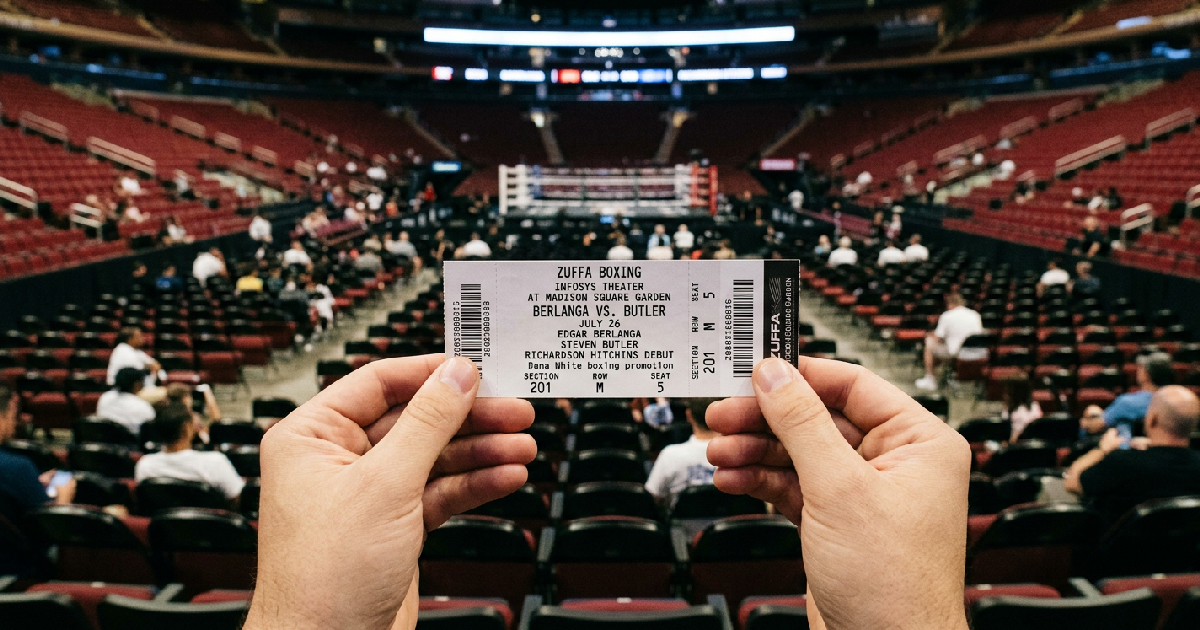
Zuffa Boxing faces a challenging New York City debut as ticket sales for the July 26 event at the Infosys Theater at Madison Square Garden reportedly remain sluggish.
As of July 6, data from BoxingTixs indicates that the promotion has sold approximately 2,713 primary tickets, generating a gate of $354,951, with substantial seating sections still unoccupied for the card headlined by super middleweight contender Edgar Berlanga and Canadian veteran Steven Butler.
Matchmaking scrutiny follows Berlanga and Butler headliner announcement
The slow movement of inventory has sparked immediate debate within the industry regarding the matchmaking strategy employed for the promotion’s first foray into the New York market.
Edgar Berlanga, who carries a record of 23-2 with 18 KOs, serves as the primary draw and hometown attraction, yet the choice of Steven Butler as his opponent has failed to ignite the level of local fervor typically associated with a “Chosen One” homecoming.
The disconnect between a high-profile venue and a low-stakes matchup appears to be reflected in the current box office figures.
The underwhelming response to the main event highlights a potential strategic error in how Zuffa Boxing positioned its debut. Edgar Berlanga is currently in a rebuilding phase after suffering a fifth-round knockout loss to Hamzah Sheeraz last July in Queens.
That defeat was particularly damaging because Edgar Berlanga had predicted a dominant victory, only to be systematically dismantled. Following that loss and a previous high-profile defeat to Canelo Alvarez, the fighter’s stock with the casual fan base has undeniably cooled.
There is valid industrial logic behind pairing a recovering contender with an opponent like Steven Butler. For the fighter and his manager, Keith Connelly, the bout offers a chance to regain confidence and re-establish the knockout power that originally made him a sensation.
However, a “get-well” fight rarely possesses the commercial gravity required to sell out a legendary venue like Madison Square Garden’s theater. Critics argue that while the fight makes sense for the athlete’s career trajectory, it makes very little sense as a standalone commercial engine for a brand-new promotion’s flagship debut.
The situation puts Dana White, the CEO of the UFC and a founding force behind Zuffa Boxing, in an uncharacteristic position. Dana White has built a career on the premise that his promotions deliver the most meaningful and competitive matchups possible.
By headlining with a fight that many perceive as a foregone conclusion, Zuffa Boxing risks contradicting the very brand identity it seeks to import from the world of mixed martial arts.
Balancing career rebuilding with commercial demands
The primary tension here lies in the conflicting goals of the athlete and the promoter. Edgar Berlanga arguably needs the breathing room provided by an opponent of Steven Butler’s level. After the physical and psychological toll of the Hamzah Sheeraz encounter, jumping back into the deep end against a world-class elite could be career suicide.
But by placing this developmental step at the top of a Madison Square Garden marquee, the promotion has asked a rebuilding project to perform the duties of a finished superstar.
Industry insiders suggest that the event would have benefited significantly from a stronger primary main event, with Edgar Berlanga appearing in a co-feature role.
In that scenario, the pressure to drive ticket sales would have rested on a high-stakes title fight or a more competitive crossroads match, allowing Edgar Berlanga to reclaim his footing without being blamed for a half-empty arena.
Instead, the Brooklyn native finds himself under the microscope, where anything short of a sellout will be viewed as a personal failure of his drawing power.
Hometown support fails to boost Zuffa Boxing ticket sales
Zuffa Boxing attempted to double down on local appeal by including former IBF light welterweight champion Richardson Hitchins on the card. Like Edgar Berlanga, Richardson Hitchins is a Brooklyn native, and his inclusion was intended to anchor a “New York vs. The World” theme.
Richardson Hitchins is set to make his promotional debut against Ricardo Salas, but his presence has seemingly done little to move the needle in the early sales period.
Marketability issues have trailed Richardson Hitchins since the cancellation of his high-profile February 21 title defense against Oscar Duarte. Richardson Hitchins withdrew from that bout citing illness, a move that triggered a wave of social media skepticism.
While no evidence emerged to suggest he was “ducking” the fight, the lingering perception of hesitation often harms a fighter’s reputation with hardcore fans. Coming off that controversy, Richardson Hitchins has yet to prove he can pull a crowd on his own, further thinning the event’s commercial foundation.
The combination of two technical fighters in non-competitive or rebuilding roles creates a “wait-and-see” attitude among ticket buyers. Even with the backing of a major platform like Paramount+, fans are increasingly savvy about the quality of matchups they are willing to pay for in person.
The days of a hometown fighter selling out a hall simply by appearing on the poster are largely over, especially in a combat sports hub as discerning as New York City.
Dana White and the UFC model in professional boxing
The struggle to fill the Infosys Theater raises broader questions about how easily the UFC model can be translated to the boxing world. Zuffa Boxing was founded in June 2025 as a joint venture between TKO Group Holdings and Sela, with the stated goal of centralizing the sport.
By controlling the rankings and the matchmaking, Dana White and his partners—including WWE President Nick Khan and Turki Al-Sheikh—hoped to bypass the often-stalled negotiations that plague traditional promoters.
We have seen how boxing match delayed by contract talks can kill the momentum of even the largest stars. Zuffa’s structure is designed to avoid these pitfalls, but it also assumes that the “Zuffa” brand itself will eventually carry enough weight to sell tickets regardless of the specific names on the card.
The early returns for the July 26 show suggest that, for now, boxing fans are still making purchasing decisions based on the perceived quality of the individual matchups rather than loyalty to a promotional banner.
The promotion’s partnership with Paramount+, which was intended to distribute 12 yearly events starting in 2026, relies heavily on these live events generating a “big fight feel.” Sluggish ticket sales at the world’s most famous arena do not provide the ideal optics for a media partner looking for a return on a long-term rights deal.
If the venue looks sparse on the broadcast, it complicates the narrative that Dana White has “solved” the problems of professional boxing.
Comparing the New York debut to previous promotional launches
When looking at how other entities have launched in major markets, the contrast is stark. Successful debuts usually feature an undeniable “must-see” fight or a deep undercard that justifies the ticket price. For example, while Gualtieri-Jones IBF Middleweight bout approaches were smaller in scale, they often targeted specific niches with high-value price points.
Zuffa Boxing appears to be trying to bridge the gap between a boutique arena show and a mainstream sporting spectacle, but the Berlanga-Butler pairing may simply be too thin for the Madison Square Garden name.
It is worth noting that some modern boxing promotions, such as those led by Eddie Hearn or Al Haymon, often report late surges in ticket sales during “fight week.” However, with primary sales sitting below 3,000 for a venue of this capacity, the steepness of the remaining climb is significant.
The promotion will likely need a heavy marketing push in the final two weeks, possibly involving steep discounts or local radio giveaways, to ensure the crowd looks respectable for the cameras.
The road ahead for Berlanga and Zuffa Boxing
Despite the current scrutiny, the July 26 event is not yet a lost cause. With roughly three weeks remaining, there is still a window for the promotion to turn the tide.
A dynamic performance from Edgar Berlanga against Steven Butler—specifically a viral, early-round knockout—could help repair the damage to his reputation and set him up for a more significant fight later in the year. If he struggles to dispatch an opponent he is supposed to beat easily, the questions about his ceiling will only grow louder.
For Zuffa Boxing, this New York debut serves as a laboratory. It is a test of whether the UFC’s “machine” can manufacture interest in a match that the public has deemed underwhelming. If the gate remains stagnant, expect to see a shift in matchmaking for the next Paramount+ broadcast.
The era of the “soft touch” headlining at Madison Square Garden may be coming to an end, forced by the harsh reality of a changing ticket market.
Ultimately, the success of this event will be measured not just in dollars, but in the momentum it provides for Zuffa’s ambitious 2026 schedule.
If the promotion wants to be the primary home for the sport’s biggest stars, it must prove it can draw a crowd even when the local hero is coming off a loss.
For now, the empty seats in the Infosys Theater suggest that Dana White and his team have a long way to go to convince the New York public that this new era of boxing is worth their hard-earned money.