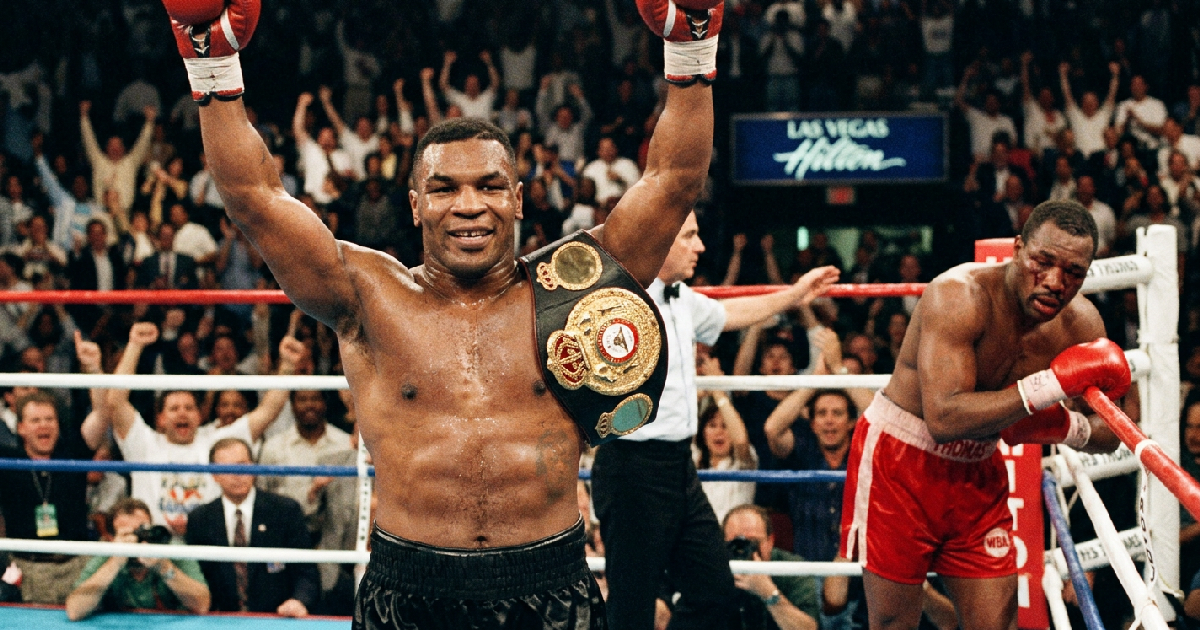
On May 30, 1987, Mike Tyson solidified his status as the most formidable force in heavyweight boxing by defeating Pinklon Thomas via a sixth-round technical knockout at the Las Vegas Hilton. The victory allowed Mike Tyson to successfully retain his WBC and WBA heavyweight titles, marking a pivotal moment in his quest to become the first undisputed champion since the belts were fractured in the late 1970s. The stoppage came after a devastating 15-punch barrage that left the normally durable Pinklon Thomas slumped against the ropes, unable to beat the count.
The fight was more than just another notch on the belt for the 20-year-old champion; it was a demonstration of clinical precision against a former champion. Pinklon Thomas had held the WBC title just years prior and was known for possessing one of the best jabs in the division. While many of Mike Tyson’s previous opponents had crumbled under the psychological pressure of his power, Pinklon Thomas managed to remain competitive during the early rounds, even landing effective counter-punches that momentarily slowed the champion’s relentless forward motion.
The atmosphere in Las Vegas reflected the growing “Tyson-mania” that had gripped the sports world. By the mid-1980s, the heavyweight division had lacked a singular, dominant figure, a void Mike Tyson filled with explosive efficiency. This victory set the stage for his final hurdle in the unification process, as he looked toward an August showdown with IBF champion Tony Tucker. Unlike some of the modern boxing match delays by contract talks that often frustrate today’s fans, the path to undisputed status in 1987 moved with a sense of inevitability and momentum.
The anatomy of the sixth-round stoppage
As the bout entered the sixth round, the physical toll of Mike Tyson’s body attack began to manifest. Pinklon Thomas, who had never been stopped in his professional career up to that point, suddenly found himself trapped in the champion’s “peek-a-boo” offensive rhythm. A sharp right hook followed by a vicious left uppercut served as the catalyst for the ending. Mike Tyson did not let up, unloading a flurry of hooks and straights that landed with terrifying accuracy.
Referee Carlos Padilla moved in to wave the fight off at the 2:00 mark of the sixth round as Pinklon Thomas hit the canvas. It was a rare sight to see a fighter of Thomas’s caliber dismantled so thoroughly. Even legendary figuress like Roberto Duran identified cerebral opponents as the toughest to crack, but Mike Tyson’s 1987 form combined raw athleticism with a technical sharpness that few could solve. Pinklon Thomas later admitted the power was unlike anything he had felt, even from other heavy hitters of the era.
This performance silenced critics who suggested Mike Tyson might struggle against a seasoned boxer with a world-class jab. By absorbing the best shots Pinklon Thomas had to offer and systematically breaking him down, the champion proved he was more than a front-runner. He was a tactician who could adjust his timing to find the chin of a slippery veteran who was fighting for his professional life.
Unification goals and the road to undisputed
The win over Pinklon Thomas was a mandatory requirement in the HBO-sponsored heavyweight world series, a tournament designed to crown one single champion. At the time, Mike Tyson held the WBC and WBA versions of the crown, while Tony Tucker held the IBF title. The dominance shown on May 30 made it clear that Mike Tyson was the betting favorite to sweep the division. His camp, led by Kevin Rooney and Bill Cayton, had transformed the young brawler into a disciplined fighting machine.
While the modern era deals with news such as Tyson Fury and Anthony Joshua fight dates being shifted by years, the 1987 schedule was remarkably consistent. Mike Tyson fought three times that year, each time elevating his profile and the sport’s revenue. The Pinklon Thomas fight proved that “Iron Mike” could draw massive television audiences, cementing his place as the biggest pay-per-view attraction the sport had ever seen to that point.
Historical impact on the heavyweight division
Looking back from 2026, the victory over Pinklon Thomas is often cited by historians as the peak of Mike Tyson’s physical prime. He was at his fastest, lightest, and most focused during this stretch of his career. The 1987 campaign essentially ended the “lost generation” of heavyweights—fighters like Thomas, Trevor Berbick, and Tony Tubbs—who had traded the belts back and forth with little fanfare before Mike Tyson arrived to seize control.
The fight also highlighted the defensive evolution Mike Tyson had undergone under the tutelage of the late Cus D’Amato. Despite Pinklon Thomas being a taller man with a longer reach, Mike Tyson’s head movement ensured that most of the challenger’s jabs whistled harmlessly over his shoulders. It was a complete performance that justified the hype and ensured that every subsequent heavyweight title bout for the next decade would be measured against the standard Mike Tyson set that night.
Frequently Asked Questions
What titles were on the line during the Mike Tyson vs Pinklon Thomas fight?
Mike Tyson defended his WBC (World Boxing Council) and WBA (World Association) heavyweight titles. The victory was a crucial step in the ongoing heavyweight unification tournament that concluded later that year when he added the IBF title to his collection.
How did the fight between Mike Tyson and Pinklon Thomas end?
The fight ended in the sixth round via technical knockout (TKO). After a competitive start, Mike Tyson unleashed an unanswered 15-punch combination that knocked Pinklon Thomas down. The referee stopped the contest at the two-minute mark of the round.
Had Pinklon Thomas ever been knocked out before this match?
No, the loss to Mike Tyson was the first time in Pinklon Thomas’s professional career that he had been stopped inside the distance. Known for his legendary durability and “iron chin,” Thomas had never been knocked out in 30 previous professional bouts.