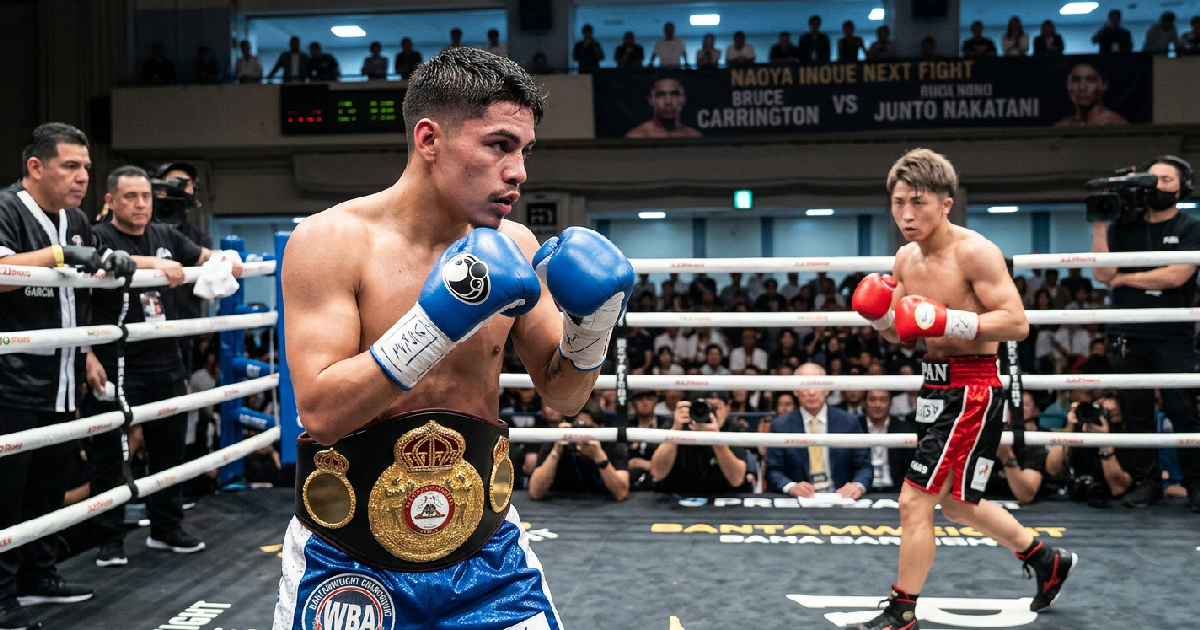
Featherweight contender Bruce Carrington believes Jesse “Bam” Rodriguez is a legitimate threat capable of defeating Naoya Inoue, citing the San Antonio native’s unique “flow state” as a decisive factor. Rodriguez, the newly crowned WBA bantamweight champion, recently secured a sixth-round knockout victory over Antonio Vargas on June 13, 2026.
This victory has reignited discussions about a potential superfight with Inoue, the undisputed super bantamweight champion, who is coming off a unanimous decision win against Junto Nakatani in May.
Carrington argued that most opponents approach Naoya Inoue with excessive reverence, a psychological trap he believes Rodriguez would avoid. According to Carrington, Junto Nakatani fought as if he were simply sharing the ring with an all-time great, whereas Jesse James Rodriguez Franco would enter with the intent to take such a legend out.
This lack of “worship” is, in Carrington’s view, essential for any fighter hoping to “put him down” and claim greatness for themselves.
The rise of Jesse Rodriguez has been defined by his ability to dismantle champions across multiple weight classes. While some contenders struggle with transitions, Rodriguez has maintained his power, as seen in his recent 10th-round knockouts of Fernando Martinez and Phumelele Cafu in late 2025. Unlike Shakur Stevenson’s dismissal of immediate weight moves, Rodriguez’s trajectory suggests a relentless climb toward the sport’s biggest names.
Carrington analyzes the movement of Jesse ‘Bam’ Rodriguez
Bruce Carrington highlighted Rodriguez’s fluidity and relaxation under pressure as his most significant advantages. He noted that while Naoya Inoue is “so intense” and thinks constantly during a fight, Rodriguez operates in a “flow state” where his punches are free-flowing. This ease in the ring often prevents the tension that typically plagues Inoue’s opponents, allowing Rodriguez to maintain his rhythm even in high-stakes exchanges.
In addition to his composure, Carrington pointed to Rodriguez’s sophisticated use of footwork and upper body movement. He explained that these tools are used to offset an opponent’s timing and create openings for counters. By manipulating a rival’s rhythm through feints, Rodriguez makes himself a difficult target to pin down.
Carrington believes these technical nuances make the 26-year-old Texan a dangerous challenge for anyone in the lower weight divisions.
Physical adjustments and areas for improvement
Despite his praise, Carrington observed “little spells” in the Antonio Vargas fight where the opponent found success. He cautioned that Rodriguez cannot afford to get caught with certain shots if he intends to “shoot up” to face an elite puncher like Inoue.
Carrington suggested that as Rodriguez continues to move through different weight classes, he may need to tighten up certain aspects of his game and grow physically stronger to compete with the 122-pound king.
The physical demands of moving up to super bantamweight are considerable. Arturo Cárdenas’s defense of regional titles underscores the depth of talent currently occupying those ranks. Carrington believes that while Rodriguez has a “true chance” at victory, the time spent growing into these higher weight classes will be critical in determining whether he can withstand the power of “The Monster.”
Potential roadmap for the Naoya Inoue showdown
While no official bout has been scheduled, interest in an Inoue-Rodriguez clash remains high among fans and peers. Rodriguez’s trainer, Robert Garcia, has expressed a desire for a defensive outing against a “solid 118-pounder” in late 2026 before pursuing Inoue. One potential name mentioned is Mexico’s WBO bantamweight champion Christian Medina for a possible date in Saudi Arabia this September.
Naoya Inoue remains the undisputed benchmark of the lower weight classes, holding a professional record of 33 wins with 27 knockouts. His May 2, 2026, victory over Junto Nakatani demonstrated his ability to handle technical challengers over the distance.
However, Carrington remains firm in his belief that Rodriguez, an undefeated champion with 17 knockouts of his own, possesses the mentality required to dethrone the Japanese icon.
The contrast in styles provides a fascinating narrative for boxing purists. Naoya Inoue’s orthodox intensity against Rodriguez’s southpaw fluidity creates a tactical puzzle that few have been able to solve. As both fighters continue to dominate their respective divisions, the momentum toward a pound-for-pound collision appears inevitable.
Carrington’s analysis suggests that the “smartest” fighters—much like those Roberto Duran encountered throughout his career—are the ones most likely to give Inoue the fight of his life.