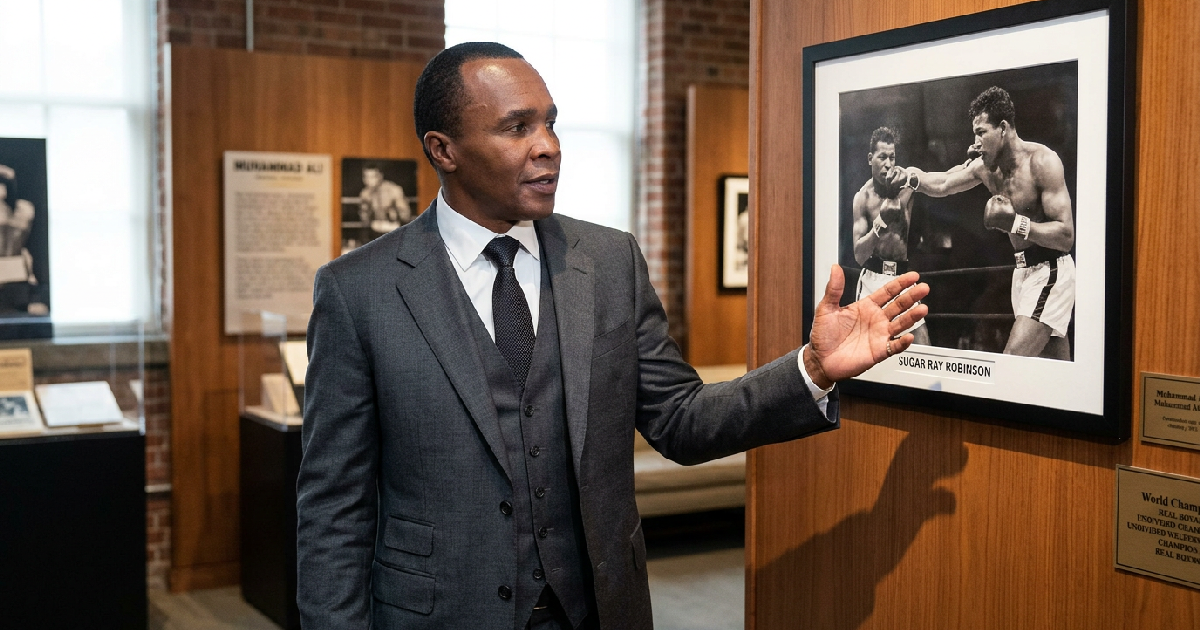
Sugar Ray Leonard has declared that Sugar Ray Robinson stands alone as the greatest fighter in history, ranking the mid-century icon above heavyweight legend Muhammad Ali. In a resurfaced interview with ESPN, Leonard dismissed comparisons between his own storied career and Robinson’s, stating there is \”no comparison\” between the two.
The legendary fighter, who became a global icon in the 1980s, clarified that Robinson remains the ultimate benchmark for boxing excellence. While Leonard himself is often mentioned in discussions regarding the greatest of all time, he insisted that Robinson’s accomplishments set him apart from every other athlete.
Leonard identifies Robinson as the ultimate benchmark
Leonard’s assessment of the all-time rankings is rooted in a deep respect for the technical mastery Robinson displayed during his tenure in the ring. While many fans and analysts reflexively name Muhammad Ali as the premier figure in the sport, Leonard pointed toward Robinson as the superior combatant.
\”Someone once said there was a comparison between Sugar Ray Leonard and Sugar Ray Robinson,\” Leonard noted during the ESPN interview. \”Believe me, there’s no comparison. Sugar Ray Robinson was the greatest.\”
This endorsement carries immense weight coming from a man who navigated the highest levels of the sport. Leonard’s own career was defined by his ability to overcome elite opposition and adapt his style to different weight categories.
The professional legacy of Sugar Ray Leonard
The career of Sugar Ray Leonard spanned several decades, during which he became a world champion in five different weight classes. His journey to the top was marked by his participation in the famous \”Four Kings\” era of the 1980s.
Alongside rivals such as Marvin Hagler, Roberto Duran, and Thomas Hearns, Leonard participated in some of the most significant bouts in boxing history. These matchups helped define a generation and solidified Leonard’s status as a superstar.
During this period, the mental and physical demands on elite fighters were immense. For example, Duran identifying smart opponents during his own career illustrates the high level of competition Leonard faced.
In September 1981, Leonard reached a pinnacle of his career by becoming the undisputed welterweight champion. This achievement remains a cornerstone of his legacy, representing his dominance in one of boxing’s most competitive divisions.
Robinsons dominance across two weight divisions
Sugar Ray Robinson’s professional career is often cited by purists as the gold standard for pound-for-pound greatness. Throughout his memorable 201-fight career, he became a world champion six times across two of the sport’s most prestigious divisions.
Robinson held the undisputed welterweight championship for a five-year period between 1946 and 1951. His ability to maintain control of the 147-pound division for such an extended timeframe demonstrated a level of consistency that few have matched.
After his reign as a welterweight, Robinson made the move up to the 160-pound middleweight division. In this new weight class, he captured world honors on five separate occasions, proving his versatility against naturally larger opponents.
During his middleweight tenure, Robinson faced a series of legendary challengers who tested his resolve and skill. His resume includes bouts against high-caliber opposition such as Rocky Graziano, Carmen Basilio, and Jake LaMotta.
These matchups were essential in building the aura of invincibility that Leonard so admires. Facing such diverse styles allowed Robinson to showcase a complete toolkit that combined speed, power, and defensive brilliance.
Muhammad Ali and the heavyweight standard
While Leonard places Robinson at the top, he acknowledges the outstanding career of Muhammad Ali. The Kentucky native won the world heavyweight championship on three separate occasions, a feat that cemented his place in the history books.
Ali’s career was defined by his victories over some of the most formidable heavyweights to ever compete. His resume includes legacy-defining wins against Joe Frazier, George Foreman, and Sonny Liston.
These victories were not just athletic achievements but cultural moments that resonated far beyond the world of boxing. Ali’s ability to overcome the raw power of Foreman and the tenacity of Frazier established him as a premier heavyweight.
However, Leonard’s preference for Robinson suggests a distinction between heavyweight dominance and total boxing mastery. He views Robinson’s ability to transcend multiple weight classes as the deciding factor in the greatest of all time debate.
Evaluating the impact of the Four Kings era
The perspective Leonard holds is shaped by his own experiences during the 1980s. This era saw the \”Four Kings\” consistently test one another in bouts that required near-perfect execution and durability.
Leonard’s battles with Marvin Hagler and Thomas Hearns forced him to reach levels of performance that are rarely seen today. These encounters were essential for establishing a hierarchy in a sport where the best often avoided the best.
The technical challenges posed by these rivals were a constant theme of the era. Modern greats often reflect on similar challenges, as seen in Pacquiao’s rankings of his most skilled rivals which highlight the complexities of elite competition.
By comparing Robinson to Ali, Leonard is essentially comparing two different philosophies of greatness. One is built on the sheer presence and heavyweight impact of Ali, while the other is built on the technical perfection of Robinson.
The enduring standard of the Sugar moniker
The fact that Leonard adopted the \”Sugar\” nickname is a testament to the influence Robinson had on subsequent generations. It served as a tribute to the man who Leonard believes perfected the art of prize fighting.
Robinson’s career ended with a staggering 201 professional fights, a number that seems nearly impossible in the modern era of infrequent scheduling. This level of activity allowed him to refine his craft to a degree that Leonard finds incomparable.
For Leonard, the choice between Robinson and Ali is not a slight against the heavyweight king. Instead, it is an acknowledgment of a fighter who he believe operated on a different plane of technical skill.
As the sport continues to evolve, these debates remain central to the identity of boxing. Leonard’s ranking serves as a bridge between the legendary past and the champions of the modern era, ensuring Robinson’s legacy remains secure.
The discussion regarding who sits atop the mountain will likely never reach a final consensus among fans. However, the opinion of a five-weight world champion like Leonard provides a definitive answer from within the ring’s highest echelons.