
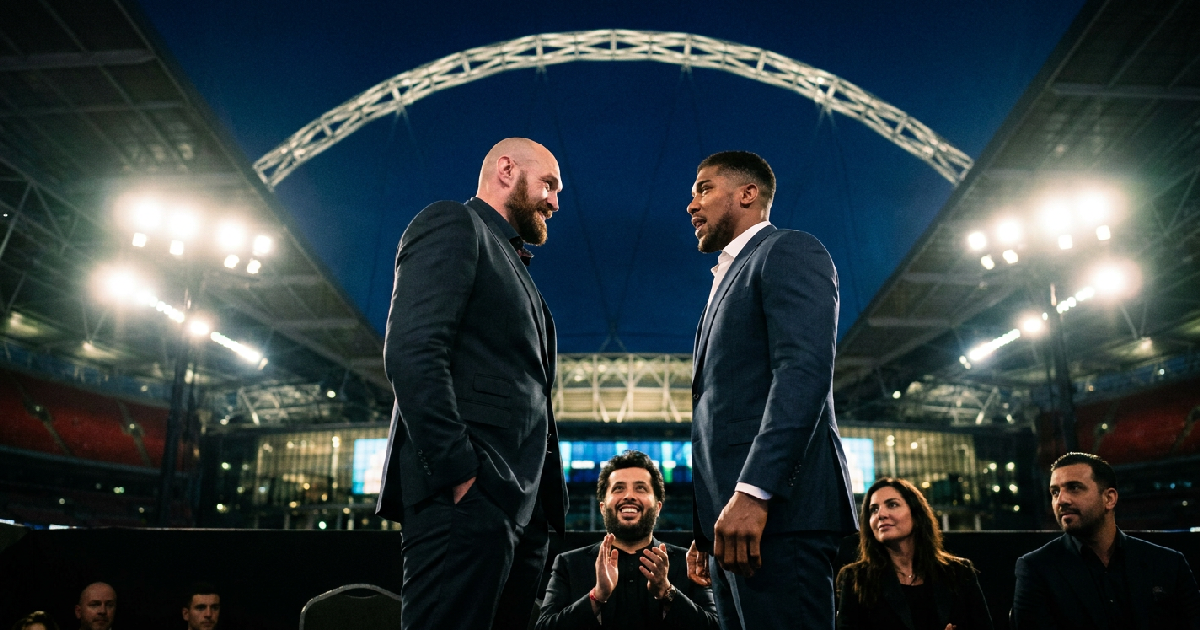
Turki Alalshikh, the chairman of Saudi Arabia’s General Entertainment Authority, has confirmed that the long-awaited heavyweight showdown between Tyson Fury and Anthony Joshua could be staged at Wembley Stadium provided local authorities approve a significantly later start time.
Speaking on July 6, 2026, the influential organiser revealed his intention to enter formal negotiations with London Mayor Sadiq Khan to secure the necessary permissions for a late-night main event designed to capture a global television audience.
Wembley Stadium emerges as a serious contender for Tyson Fury vs Anthony Joshua
While the bout has long been expected to take place in the Middle East, this development marks the first serious push to bring the all-British spectacle back to UK soil under the “Riyadh Season” banner.
The proposal hinges on a departure from traditional British curfew regulations, which typically see major stadium events conclude by 11:00 PM. Turki Alalshikh argued that for a fight of this magnitude to achieve its commercial potential in North American and Asian markets, the ring walks must occur much later than the standard UK slot.
This logistical hurdle has been the primary reason many of the recent undisputed and high-profile heavyweight matchups have gravitated toward Riyadh.
However, the appetite for a homecoming fight at the national stadium remains high among both the fighters and the British public, who have waited years for the rivals to settle their differences in the ring.
A potential Wembley date would represent a massive pivot in the current heavyweight calendar. It follows a period of intense speculation regarding the status of the two fighters, who are widely expected to meet later this year if current scheduling holds.
Despite the optimism surrounding these talks, the complexity of staging a 90,000-capacity event in London during the early hours of the morning cannot be understated. Transport links, policing, and local noise ordinances are all expected to be significant sticking points as the General Entertainment Authority begins its dialogue with the Greater London Authority.
For months, the conventional wisdom in boxing circles was that Tyson Fury and Anthony Joshua would inevitably meet in Saudi Arabia, where the financial backing of the Public Investment Fund has redefined the sport’s economy.
But the news that Wembley Stadium is back on the table suggests a desire to honour the domestic roots of this rivalry. The venue has previously hosted massive nights for both men, including Anthony Joshua’s career-defining victory over Wladimir Klitschko in 2017 and Tyson Fury’s homecoming knockout of Dillian Whyte in 2022.
Staging the bout in London would satisfy a vocal contingent of British fans who feel the biggest fight in UK history belongs in the capital.
Key details
The challenge lies in the “Riyadh Season” model, which prioritises global reach. Turki Alalshikh has been clear that he views these events as international products, not just local gatherings. To make a London fight viable for his team, the 11:00 PM “Cinderella” curfew must be extended.
This is a tall order for any stadium, especially one situated in a densely populated residential area like Brent.
Mayor Sadiq Khan has historically been a supporter of major sporting events in London, but he must balance the economic benefits of a global broadcast with the statutory requirements of the local council and the Metropolitan Police.
Negotiations are expected to focus on the economic windfall such an event would bring to the city. A fight of this scale generates millions of pounds in tourism, hospitality, and transport revenue. However, without a later start time, the lucrative US pay-per-view market is compromised.
In the United States, an 11:00 PM UK finish means the main event begins as early as 3:00 PM on the West Coast, which is far from the prime-time slot needed to maximise revenue. If the London authorities refuse to budge, the fight will almost certainly remain in the Middle East.
The role of Sadiq Khan and the London Mayor’s office
Sadiq Khan’s role in these discussions will be pivotal. The Mayor’s office has the power to facilitate high-level talks between the organisers, Transport for London (TfL), and the police. For a 1:00 AM or 2:00 AM main event, the infrastructure of the entire city would need to stay “awake” much longer than usual.
This includes running the Jubilee Line and Metropolitan Line throughout the night and ensuring that crowd control measures are sufficient for a 90,000-strong audience leaving a stadium in the middle of the night. It is a logistical nightmare, but one that Turki Alalshikh believes is solvable with enough political will.
Critics of the plan point to the potential for significant disruption to residents in the Wembley Park area. Past attempts to extend licensing hours for major concerts or sporting events have often met with fierce local opposition.
However, the unique status of the Tyson Fury and Anthony Joshua matchup might provide the leverage needed for a one-off exception.
If the authorities agree, it would set a massive precedent for the future of British sports broadcasting, potentially allowing other major UK events to align with international time zones to remain competitive on the world stage.
Navigating the commercial hurdles of a global boxing broadcast
The primary driver behind the push for a later start time is the commercial reality of modern boxing. To fund the eye-watering purses demanded by heavyweights of this calibre, organisers rely heavily on the American pay-per-view market.
Historically, UK fans have often stayed up until the early hours to watch fights in Las Vegas or New York. Turki Alalshikh is essentially asking London to reverse that dynamic.
If the fight starts at 2:00 AM in London, it hits the 9:00 PM Eastern and 6:00 PM Pacific windows in the US, which are the “sweet spots” for digital sales.
Key details
This commercial pressure has often led to friction between traditional fans and broadcasters. Many feel that moving the start time to satisfy international viewers alienates the fans who are actually attending the event in person. However, with Fury-Joshua contracts still pending final signatures on the logistical details, all options remain on the table.
The fighters themselves are understood to be open to the idea, as a Wembley atmosphere is famously difficult to replicate in the more sterile indoor arenas of the Middle East.
The “Riyadh Season” brand has already demonstrated its ability to take over world-famous venues, most recently with its successful card at the BMO Stadium in Los Angeles. Bringing that same level of production value to Wembley would involve a level of showmanship rarely seen in British boxing.
From pyrotechnics to musical performances, a later start time would allow for a longer, more elaborate broadcast that treats the main event like a Super Bowl-style entertainment property. Turki Alalshikh’s vision is to make the event a 24-hour festival of sport, rather than just a two-man contest.
Status of the Tyson Fury and Anthony Joshua rivalry in 2026
As of July 2026, both men find themselves at a crossroads. Tyson Fury has spent the last year navigating a complicated landscape of rematches and mandatory challenges, while Anthony Joshua has undergone a significant career resurgence. The narrative between them remains the strongest draw in the division, transcending the belts themselves.
While other matchups have occasionally taken precedence, such as the Usyk-Verhoeven Giza bout, the all-British clash is the one the mainstream public continues to demand. It is the definitive fight to decide who is the ultimate king of the UK scene.
The technical aspects of the fight have also evolved. Both men are now seasoned veterans, with Tyson Fury recently reflecting on their past, including Fury’s accounts of Joshua sparring sessions from over a decade ago. These deep-seated histories add a layer of personal animosity that isn’t present in Joshua’s other bouts.
Key details
For Joshua, a win over Tyson Fury would be the final piece of the puzzle in his quest for a legacy that rivals the all-time greats. For Tyson Fury, it is the opportunity to finally silence the one domestic rival he has constantly belittled throughout his career.
While the Wembley news provides a spark of hope for UK fans, the reality of the fight’s timing remains subject to the results of their prior commitments. Tyson Fury is reportedly looking at a busy summer and autumn, with some suggesting a Fury warm-up fight in August could serve as the final tune-up.
If both emerge unscathed from their respective dates later this year, the path to a late-night Wembley spectacle becomes much clearer. The stakes are higher than ever, and neither man can afford a slip-up if they want to reach the 90,000-seat finale.
Potential logistical solutions for a 2:00 AM main event
Should the London authorities agree to the proposal, the logistical planning will be unprecedented for a sporting event in the UK. One possible solution being discussed is the “lock-in” model, where the stadium becomes a self-contained entertainment hub for the duration of the evening.
This would involve a much deeper undercard with world-class talent to keep the crowd engaged from the early evening until the midnight hour. Under this plan, the undercard would start at 7:00 PM, with the “Riyadh Season” entertainment segments bridging the gap between the traditional boxing schedule and the late-night main event window.
Transport for London would be a critical partner in this endeavour. The Night Tube, which currently runs on Fridays and Saturdays across certain lines, would need to be bolstered with additional security and high-frequency trains at 3:00 AM and 4:00 AM. There is also the question of policing.
Key details
Brent Council and the Metropolitan Police would likely demand significant payment from the promoters to cover the cost of the extended shifts required. Given the financial power of the Saudi organisers, these costs are likely manageable, though the social impact remains a secondary concern for the local community.
Furthermore, the environmental impact of such a massive operation will be scrutinised. Lighting up Wembley Stadium and moving 90,000 people across the city in the early hours carries a heavy carbon and noise footprint.
Turki Alalshikh has signaled he is willing to negotiate on all fronts to make the fight happen in London, but he has also subtly reminded the public that Riyadh is waiting with open arms and no curfew restrictions if the London deal falls through. It is a high-stakes game of chicken with the city’s regulators.
Future implications for the UK boxing scene
The outcome of these talks with Sadiq Khan will resonate far beyond the Tyson Fury and Anthony Joshua fight. If a precedent is set for later start times, it could fundamentally change how the UK hosts major international events.
For too long, British boxing has been hampered by its time zone in relation to the lucrative US market.
If the authorities can find a way to accommodate late-night broadcasts, it opens the door for other stars like Ben Whittaker or Moses Itauma to headline global events on home soil without the financial penalty of a poorly timed broadcast.
However, the move toward late-night stadium shows also risks alienating the core of the sport. Younger fans and families may find it impossible to attend a fight that ends at 3:00 AM, potentially turning the arena into an exclusive venue for those with the endurance (and the wallet) for an all-night affair.
Key details
The balance between being a “global product” and a local sport is delicate. As Turki Alalshikh continues his dialogue with London officials over the coming weeks, the boxing world will be watching to see if the “Big Smoke” can finally align with the “Riyadh Season” vision.
For now, the focus remains on the meeting between Turki Alalshikh and Sadiq Khan. The boxing public is used to hearing “more to follow” in the saga of Tyson Fury vs Anthony Joshua, but this specific detail—the start time—might be the final piece of the puzzle that brings the heavyweights home.
Whether it happens at Wembley or in the more familiar surroundings of the Kingdom Arena in Riyadh, the clash is destined to be the defining moment of the 2026 boxing calendar.
Both fighters are reportedly in training, and with the venue discussion now in the public eye, the countdown to the official announcement has truly begun.