
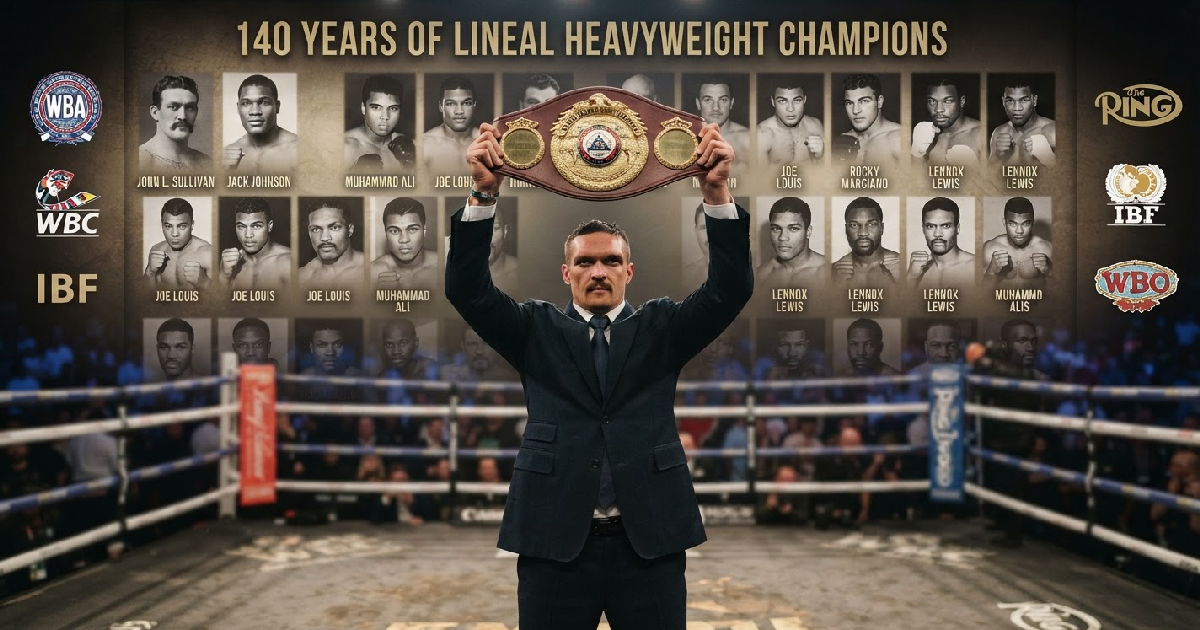
In the venerable annals of boxing, a mere 40 men have etched their names into history as lineal heavyweight champions over the past 140 years. This exclusive club, stretching from the bare-knuckle era’s John L. Sullivan to today’s reigning Oleksandr Usyk, represents the sport’s most enduring and prestigious prize.
Unlike the modern proliferation of belts from various sanctioning bodies, the lineal title adheres to a singular, uncompromising principle: to become the champion, you must defeat the recognized champion in the ring. This “man who beat the man” ethos elevates it above rankings or organizational decisions, cementing its unique status in professional boxing.
The enduring prestige of the lineal title
The lineal heavyweight championship stands apart from the titles issued by the World Boxing Council (WBC), World Boxing Association (WBA), International Boxing Federation (IBF), and World Boxing Organization (WBO). These organizational belts can often be won through rankings, mandatory challenges, or even against opponents not universally considered the best in the division.
But the lineal crown is different. It’s a direct, unbroken chain of supremacy, symbolizing who truly reigns as the division’s undisputed king. This unyielding tradition is a major reason why the heavyweight division continues to captivate fans and remains boxing’s glamor weight class.
How the lineal title differs from sanctioning body belts
Sanctioning bodies, which emerged later in boxing history, each crown their own champions, sometimes leading to multiple “world champions” in the same weight class. For instance, the WBA, founded in 1921 as the National Boxing Association (NBA), has at times recognized up to four champions simultaneously, though it’s tried to consolidate recently.
The WBC, established in 1963 in Mexico City, and the IBF, formed in 1983, both play significant roles in structuring the sport. Yet, despite their influence and strict defense requirements, their belts don’t inherently carry the historical weight of the lineal designation.
The WBO, created in 1988, also contributes to this fragmented landscape of titles, where a major IBF heavyweight clash might occur without the lineal title being on the line.
A rich history of heavyweight kings
The lineage officially began with John L. Sullivan, the final bare-knuckle champion who transitioned to gloved boxing. He held the title from 1885 to 1892, laying the groundwork for a tradition that would include some of the sport’s most legendary figures. His reign marked the true beginning of heavyweight boxing as we know it, attracting widespread public and media attention.
Throughout the 20th century, icons like Joe Louis, Rocky Marciano, and Muhammad Ali claimed this ultimate prize. Louis, “the Brown Bomber,” famously held the world heavyweight title for nearly 12 years, from 1937 to 1949, making a record 25 consecutive defenses. His cultural impact transcended boxing, making him a national hero during World War II.
Key figures in the lineal chain
The list of 40 includes a who’s who of boxing greatness. Jack Johnson broke racial barriers, holding the title from 1908 to 1915. Later, the dynamic Jack Dempsey dominated the 1920s, captivating audiences with his aggressive style. George Foreman, a two-time lineal champion, exemplified raw power, with George Foreman’s powerful performances cementing his legacy.
Muhammad Ali, initially fighting as Cassius Clay, first became lineal champion in 1964. Cassius Clay’s early reign saw him defeat Sonny Liston, ushering in a new era of boxing. Ali would later reclaim the title twice, solidifying his status as “The Greatest.” Mike Tyson, Evander Holyfield, and Lennox Lewis carried the mantle into the modern era, each adding their chapter to this storied lineage.
Vacancies and reinstatements
A crucial distinction of the lineal title is how it becomes vacant. It only happens when a champion retires or leaves the heavyweight division without suffering defeat. In these rare instances, the lineage is temporarily shelved, lying dormant until a new champion emerges through a consensus “box-off” or a clear top-contender clash.
This happened most recently when Vitali Klitschko retired in 2012, leaving the lineal title in abeyance. His younger brother, Wladimir Klitschko, later filled that void, becoming the recognized lineal heavyweight champion. However, Wladimir’s impressive reign was eventually brought to an end by the enigmatic Tyson Fury three years later.
The role of The Ring magazine
While no official body sanctions the lineal title, The Ring magazine has historically played a significant role in identifying the lineal champion. Established in 1922, The Ring awards its own championship belt, which often aligns with the lineal succession. The magazine reintroduced its belt in 2002 after a hiatus, striving to bring clarity to a sport often muddled by multiple organizational titles.
The Ring’s criteria for awarding a vacant title can involve top-ranked contenders fighting each other, aiming to designate the truly best fighter in a division. This editorial oversight lends additional weight and recognition to the lineal champion, particularly in times of uncertainty following a champion’s retirement.
Oleksandr Usyk: The current lineal king
Today, the lineal torch rests with Oleksandr Usyk, who ascended to this esteemed position by defeating Tyson Fury on May 18, 2024. The Ukrainian star further cemented his claim with a second victory over Fury seven months later, solidifying his place as the division’s undisputed and lineal champion.
Usyk’s journey highlights the purity of the lineal concept. He faced and conquered the man who held the crown, leaving no doubt about his supremacy. This is a stark contrast to fighters who collect organizational belts without truly facing the division’s top dog.
The future of the lineal heavyweight championship
As Oleksandr Usyk continues his reign, the question of the lineal title