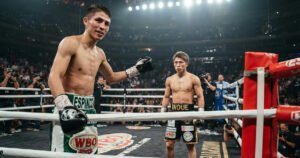
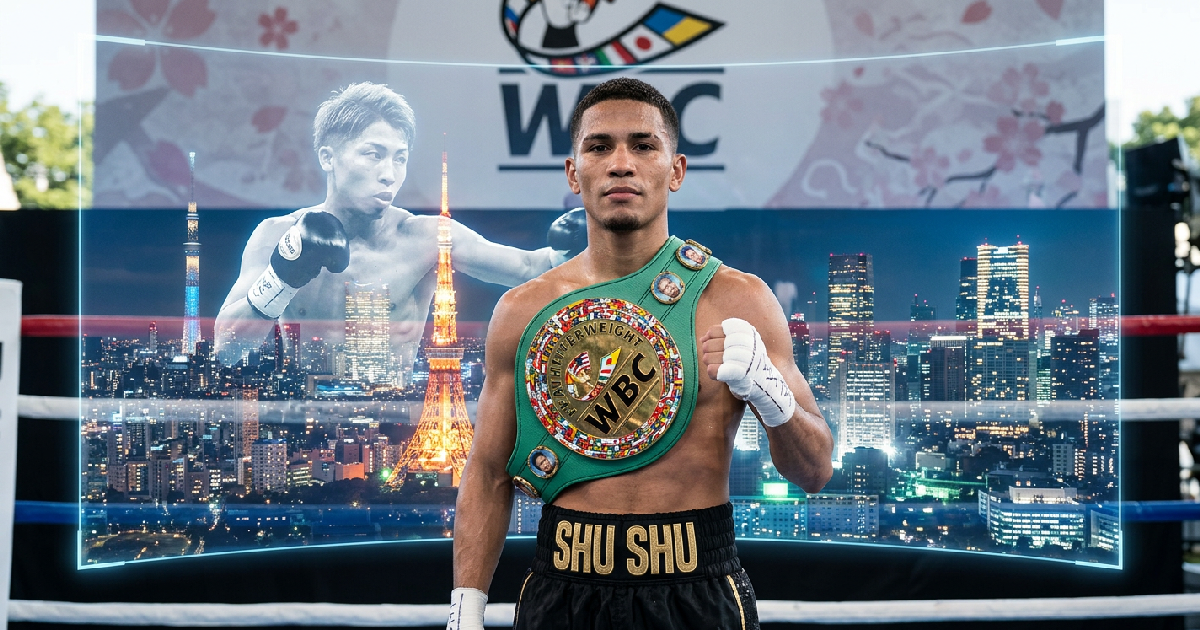
Undefeated World Boxing Council (WBC) featherweight champion Bruce Carrington has declared his readiness to travel to Tokyo to face Japanese superstar Naoya Inoue, provided the financial incentives and logistical leverage align with his standing as a titleholder. Speaking on the InsideRingShow on July 9, 2026, the Brooklyn-born fighter told host Max Kellerman that he would “love” the opportunity to compete in Japan, a country he has wanted to visit since his days as a standout amateur.
Bruce Carrington, widely known by his nickname “Shu Shu,” currently holds a perfect 18-0 professional record with 10 knockouts, securing a 55.5% KO ratio. The 29-year-old captured the vacant WBC featherweight title in January 2026 and recently defended it on July 4 against Rene Osvaldo Palacios in Cleveland. Meanwhile, Naoya Inoue remains the undisputed king of the super bantamweight division, but he has frequently expressed his intention to move up to the 126-pound featherweight limit before retiring.
Bruce Carrington on the Naoya Inoue fight and Tokyo
The crux of a potential showdown rests on where the fight takes place and who holds the commercial upper hand. Bruce Carrington argued that if Naoya Inoue moves up in weight, he will be entering a division where he does not currently hold a title. “To be honest, if he moves up in weight, he won’t have a belt,” Bruce Carrington noted during the broadcast. “This will not be his weight class. I will have the leverage.” This emphasis on leverage underscores Carrington’s strategic approach to top-tier boxing, valuing his championship status within the featherweight division.
But Max Kellerman countered this view by highlighting Naoya Inoue’s immense commercial gravity. The Japanese star, known as “The Monster,” draws crowds and television revenue at a scale rarely seen in the lower weight classes. Kellerman pointed out that Inoue’s ability to attract massive audiences provides him with significant leverage, regardless of his divisional status.
Bruce Carrington admitted his opponent is “undoubtedly top three, top two pound-for-pound,” but he suggested that a fight in New York City could be equally lucrative if Naoya Inoue wants to cement his legacy in the United States.
Financial leverage and boxing economics
With top-level boxing increasingly driven by pay-per-view numbers and gate receipts, the negotiation around a potential fight between these two champions will intensely focus on the financial split. Bruce Carrington’s insistence on the “financial aspect” making sense is a direct acknowledgement of the high stakes involved. Both fighters command significant purses, and agreeing on terms that satisfy both camps, including location and revenue share, will be crucial. This financial consideration often becomes a primary hurdle in making superfights a reality.
Olympic ambitions and a missed trip to Tokyo
A bout in Japan would hold personal significance for Bruce Carrington beyond the championship hardware. The Brooklynite was supposed to travel to Japan to qualify for the 2020 Tokyo Olympics before the global pandemic altered those plans. “I’ve been dying to go to Japan anyway ever since I was supposed to qualify for the 2020 Olympics in Tokyo,” he said.
This unfulfilled ambition adds a deeper, more personal layer to his expressed willingness to fight in Tokyo. He expressed a genuine desire to experience the culture, though he maintained that a New York fight at the “mecca of boxing” remains a viable alternative.
The statistical bridge between super bantamweight and featherweight
For Naoya Inoue to face Bruce Carrington, he must successfully transition his power to a fifth weight class. 82% KO ratio. While his power has translated across four divisions already, the featherweight division presents a different physical challenge.
Bruce Carrington possesses a significant size advantage, standing 5’8″ compared to the 5’5″ frame of the Japanese champion. This height and reach disparity could play a crucial role if the fight materializes, forcing Inoue to adapt to a physically larger opponent.
Matchups of this magnitude often face delays due to the complexities of modern boxing politics. Much like how a boxing match delayed by contract talks can frustrate fans, the negotiation between an American champion and a Japanese undisputed king would require immense coordination. Both fighters are managed by high-profile teams that would need to balance the revenue of a Tokyo stadium gate against the pay-per-view potential of a New York event, illustrating the intricate ballet of boxing promotion.
Legacy and the future of the 126-pound division
The featherweight division is becoming a primary focus for the sport’s elite, as fighters seek the prestige historically associated with the 126-pound limit. Bruce Carrington, who debuted on the undercard of the third Tyson Fury vs. Deontay Wilder bout in 2021, has quickly ascended to the top of the WBC rankings. His style, rooted in the boxing traditions of Brownsville, Brooklyn, relies on technical precision and defensive fundamentals. This foundation has allowed him to build an undefeated record and capture a world title early in his professional career.
Adding a fighter of Naoya Inoue’s caliber to the featherweight mix would arguably create the most significant fight in the division’s history. com/terence-crawford-canelo-alvarez-retirement-outlook-2026/”>Terence Crawford has commented that Canelo Alvarez may not quit boxing yet, the sport is constantly looking for the next generational clash. A Carrington-Inoue fight fits that description perfectly, pitting a naturally larger, technical champion against an explosive, multi-division icon.
Such a bout would undoubtedly generate massive global interest and could define the careers of both men.
For now, the boxing world must wait to see if Naoya Inoue will vacate his titles at 122 pounds to pursue the WBC strap held by Bruce Carrington. If the “financial aspect” makes sense, as Bruce Carrington demanded, the fight could take place in early 2027, fulfilling a long-held ambition for the Brooklyn champion to finally step foot on Japanese soil.