
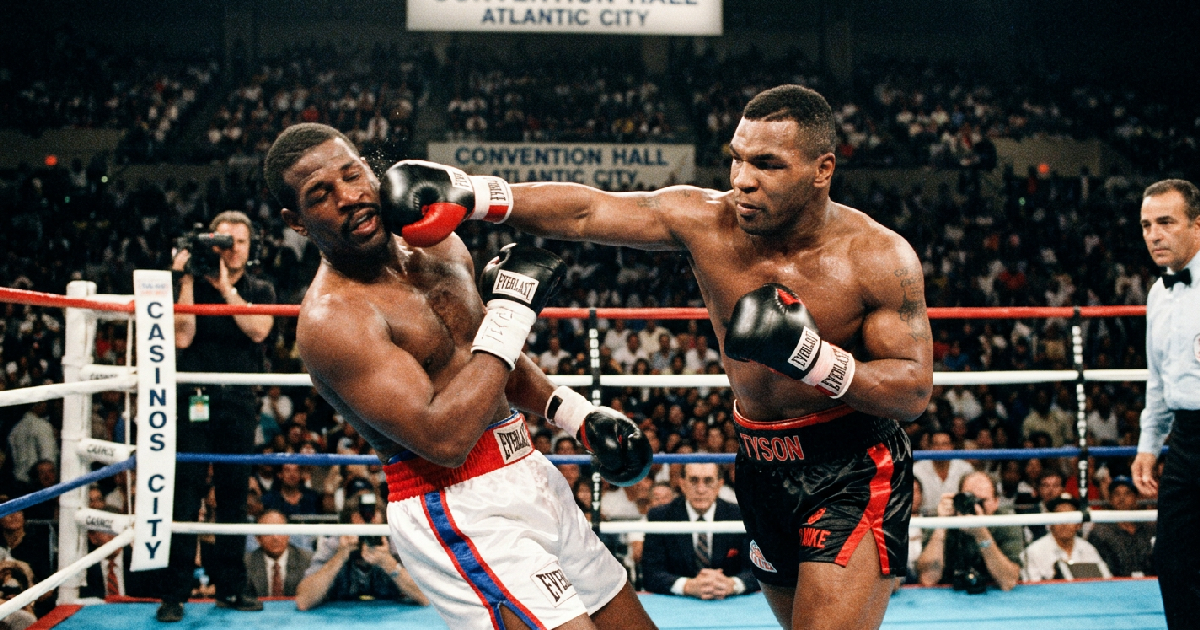
On June 27, 1988, Mike Tyson cemented his legacy as the most fearsome force in heavyweight history by knocking out the previously unbeaten Michael Spinks in just 91 seconds at the Convention Hall in Atlantic City.
The victory allowed Mike Tyson to unify the WBC, WBA, and IBF titles with the lineal and Ring Magazine championships, effectively ending all debate regarding the true king of the division.
The Mike Tyson vs Michael Spinks fight negotiations
Under the bright lights of New Jersey, Mike Tyson needed only eight landed punches to dismantle a man who had never before been stopped or defeated as a professional.
The bout, famously promoted by Don King under the tagline “Once and For All,” represented the absolute zenith of the “Iron Mike” era. Michael Spinks entered the ring with a stellar reputation, having twice defeated the legendary Larry Holmes and carrying a perfect 31-0 record.
However, the psychological and physical chasm between the two men became apparent the moment the first bell rang. While Michael Spinks appeared visibly apprehensive during his ring walk, Mike Tyson exuded a sense of cold, calculated aggression that had become his trademark under the tutelage of the late Cus D’Amato.
For boxing historians, this 91-second demolition remains the definitive Exhibit A when discussing Mike Tyson’s prime. It wasn’t just a win; it was a total erasure of a top-tier opponent’s capabilities.
Michael Spinks was no “bum” or “gatekeeper”—he was a Hall of Fame talent who had dominated the light heavyweight division before moving up to conquer the heavyweights. Yet, against Mike Tyson, he looked like an amateur caught in a hurricane.
This performance served as the ultimate proof that the “Peek-a-Boo” style, when executed with Mike Tyson’s unique blend of speed and power, was virtually unsolveable at the highest level.
Key details
The road to Atlantic City was paved with complex mirrors and massive financial stakes. Before the opening bell even rang, the Tyson-Spinks showdown had already broken records as the richest fight in the history of the sport at that time.
Reports indicated that Mike Tyson walked away with approximately $22 million, an astronomical sum for 1988, while Michael Spinks secured a career-high payday of $13.5 million. The deal took months to finalize, largely due to the protective maneuvering of Michael Spinks’ long-time manager, Butch Lewis.
Butch Lewis was known for his flamboyant style and fierce loyalty to his fighters. He had carefully guided Michael Spinks through the treacherous waters of the heavyweight division, ensuring his fighter maintained his lineal claim to the throne even after the IBF stripped him of their belt in 1987.
The promoter, Don King, eventually brought the parties together for a deal that transcended the sport, attracting celebrities and high rollers from across the globe to the New Jersey Shore. The fight was the premier “must-see” event of the decade, overshadowing almost every other cultural moment that year.
Even in modern terms, the financial scale of this event remains impressive. For comparison, while current heavyweights sometimes wait years for unification, the urgency in 1988 was driven by a public desire to see a singular, undisputed champion.
Just as modern fans monitor contract disputes and stalling negotiations in the current era, the 1980s boxing public was held in suspense until the ink was finally dry on the Tyson-Spinks posters. When the doors of the Convention Hall opened, it felt like the entire world was watching.
Mental warfare and the pre-fight glove controversy
The tension didn’t dissipate once the fighters arrived at the venue; if anything, it reached a fever pitch in the dressing rooms. In a classic piece of psychological gamesmanship, Butch Lewis visited Mike Tyson’s locker room and raised a formal objection regarding the padding in Mike Tyson’s gloves.
He demanded that officials inspect the equipment, a move clearly intended to rattle the young champion and delay his entrance to the ring. This strategy had worked for others in the past, distracting fighters and cooling their muscles during the wait.
However, the tactic backfired spectacularly. Rather than losing his composure, Mike Tyson reportedly became more incensed, channelled his anger into a terrifying focus. By the time the officials cleared the equipment and Mike Tyson began his walk, he was a pressure cooker of kinetic energy.
Key details
Michael Spinks, meanwhile, looked like a man heading toward a grim fate. Observers noted that Michael Spinks appeared shaken by the sheer noise. He would later admit that the atmosphere was unlike anything he had experienced in his storied career.
The psychological edge is often what separates great fighters from legends. Much like how astute fighters use their intellect to navigate difficult matchups, Mike Tyson used his intimidating persona to win half the battle before a punch was thrown.
By the time referee Frank Cappuccino brought the men to the center of the ring for instructions, Michael Spinks was already fighting a losing battle against his own nerves. The “Peak Terror” era was in full effect.
The 91-second demolition at Convention Hall
When the bell finally rang, the action was short, brutal, and entirely one-sided. Mike Tyson did not spend time “finding his range” or feeling out his opponent. He exploded from his corner using the bob-and-weave movement that made his 5-foot-11 frame so difficult to hit.
Within the first ten seconds, a heavy left hook caught Michael Spinks, forcing the taller man to immediately seek a clinch. It was the survival instinct of a veteran, but it offered no respite against the relentless engine in front of him.
About one minute into the round, the end began. Mike Tyson unleashed a vicious left uppercut followed by a right hand to the ribcage. The body shot was so powerful it forced Michael Spinks to one knee, marking the first time in his professional life he had ever been officially knocked down.
Though he managed to beat the count of Frank Cappuccino, the look in his eyes told a story of total disorientation. He was on “wobbly legs,” a state from which few fighters ever recover when facing a finisher of Mike Tyson’s caliber.
Key details
The final sequence remains one of the most replayed clips in sports history. As Michael Spinks tried to reset, Mike Tyson slipped a desperate right hand and countered with a thunderous left hook and a short, percussive right hand that landed flush on the chin.
Michael Spinks fell backward, his arms outstretched, as if he had been struck by a lightning bolt. He attempted to crawl toward the ropes, but his equilibrium was gone. Referee Frank Cappuccino reached the count of ten at the 1:31 mark, ending the fight and Michael Spinks’ career in under two minutes.
Statistical dominance of Iron Mike
The numbers from the fight provide a stark look at the efficiency of Mike Tyson’s performance. In just 91 seconds, he proved that volume is secondary to impact. His accuracy was nearly surgical, focusing on areas that would maximize damage while minimizing the risk of a counter-attack.
- Total Punches Landed (Tyson): 8
- Total Punches Landed (Spinks): 2
- Total Knockdowns: 2
- Total Match Duration: 1 minute and 31 seconds
This level of efficiency is rare in heavyweight championship history. Usually, a fight of this magnitude involves a period of tactical sparring, but Mike Tyson’s strategy was built on the “intimidation factor” and the immediate application of power. He didn’t want to win a decision; he wanted to end the argument “Once and For All.”
Legacy of the performance and Spinks’ retirement
The aftermath of the fight was as definitive as the knockout itself. Michael Spinks, recognizing that he had encountered a level of violence he could no longer compete with, announced his retirement from boxing shortly after the bout.
He left the sport with his dignity intact, despite the loss, having been a two-division champion and an Olympic gold medalist. He remains the only man to win the heavyweight crown from Larry Holmes, a feat that ensures his place in the International Boxing Hall of Fame regardless of the Tyson result.
For Mike Tyson, the 91-second win was the peak of his mountain. While he would continue to fight for decades, many analysts believe he was never better than he was on that June night in Atlantic City.
Key details
He possessed the perfect combination of youth, discipline under trainer Kevin Rooney, and the devastating power that had been nurtured since his childhood in Brooklyn. He had successfully unified the WBA, WBC, and IBF titles with the lineal crown, becoming the undisputed king in every sense of the word.
In the years since, boxing has searched for a similar era of dominance. While fighters like Oleksandr Usyk seek historic matchups to define their own legacies, the Tyson-Spinks fight remains the gold standard for a “superfight” that actually delivers on its promise of a definitive ending.
It was a moment where the hype was matched—and perhaps exceeded—by the reality of the performance. Mike Tyson didn’t just win a fight; he captured the imagination of the world, creating an image of invincibility that would endure for years to come.
Historical significance in the heavyweight timeline
To understand why this 91-second fight carries such weight nearly four decades later, one must look at the state of the heavyweight division in the late 1980s.
The “Golden Era” of the 1970s featuring Muhammad Ali, Joe Frazier, and George Foreman had passed, leaving a fragmented landscape where various organizations held different versions of the title. Mike Tyson’s rise was the force that pulled these fragments back together, restoring the prestige of the “Undisputed” tag.
The victory over Michael Spinks was the final piece of that puzzle. By defeating the lineal champion, Mike Tyson removed the last “asterisk” next to his name. He wasn’t just the man with the belts; he was the man who beat the man.
Key details
This distinction is vital in boxing, where politics often prevent the best from fighting the best. In 1988, there were no excuses, no “wrong side of the street” promotional hurdles, and no disputes. There was only one champion.
Modern boxing often struggles to produce such clear resolutions. Today, fans frequently have to wait years for similar unifications, with many bouts falling through due to purse splits or mandatory obligations.
The Tyson-Spinks fight serves as a reminder of what the sport looks like when the biggest stars are willing to risk their “0” to prove who is number one. It was a brief, violent masterpiece that proved Mike Tyson was not just a puncher, but a generational phenomenon whose “Peak Terror” would never be forgotten.