When Mike Tyson speaks, the boxing world usually stops to listen. It isn’t just about the legend he built in the eighties and nineties; it’s about his perspective as an elder statesman who actually watches the tape. While many retired greats distance themselves from the modern era, Tyson remains a vocal, if sometimes unpredictable, student of the current game.
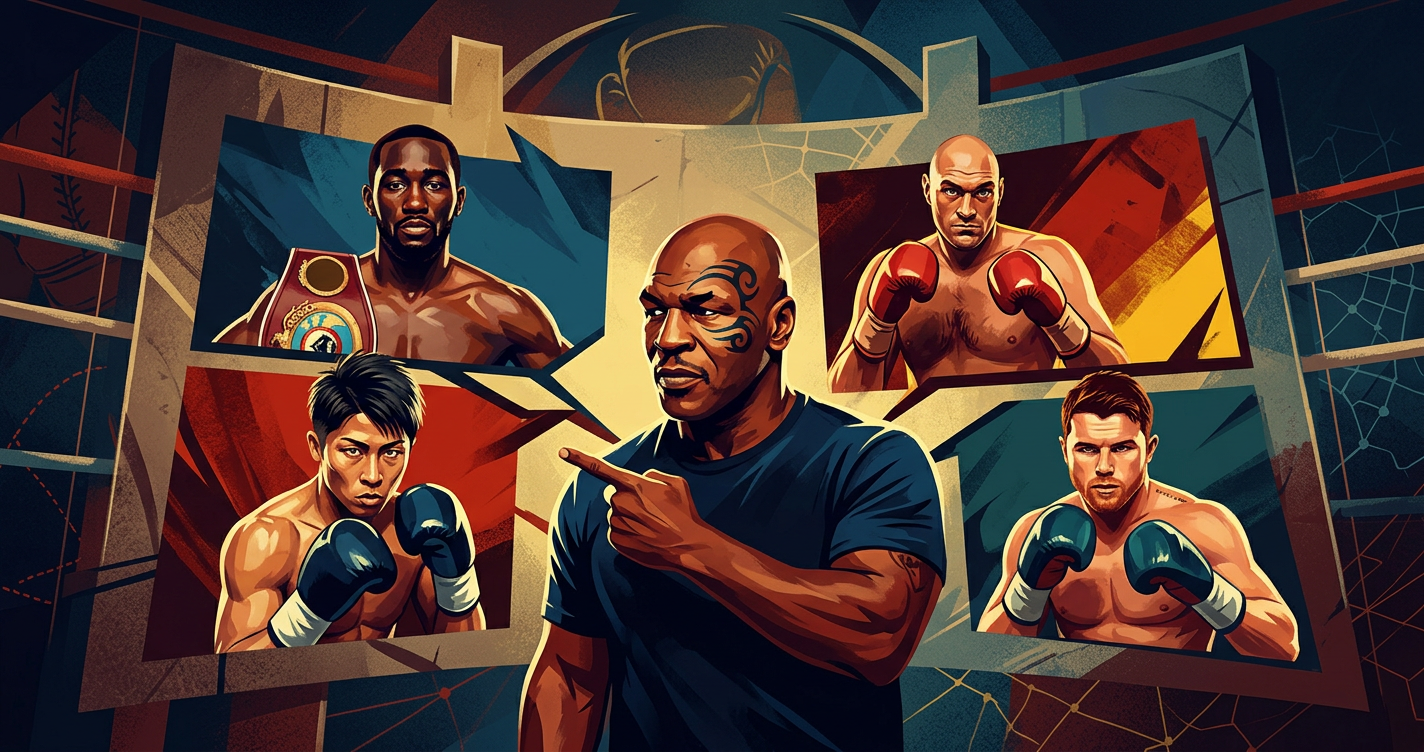
The former undisputed heavyweight champion recently sat down to identify the five active fighters he believes are carrying the sport. His list ignores the standard promotional divides and politics that usually bog down these conversations. Instead, Tyson focused on raw intent, technical mastery, and that specific “mean streak” he knows better than anyone else.
The Heavyweight Kingpin: Tyson Fury
It’s no surprise that “The Gypsy King” sits high on Tyson’s list. Beyond sharing a name, the two have developed a mutual respect that transcends generations. Tyson has often pointed to Fury’s ability to survive the darkest moments of a fight as his defining trait. “You can’t teach what he has,” Tyson remarked during a recent podcast appearance, noting that Fury’s agility for a man of his size is an anomaly in boxing history.
But it isn’t just the size. Tyson appreciates the psychological warfare Fury brings to the ring. In a heavyweight division often criticized for its slow pace of matchmaking, Fury remains the most significant draw and the most technically confusing puzzle for his peers to solve.
The Purity of Terence Crawford
Terence “Bud” Crawford has long been a favorite of the purists, and “Iron Mike” is firmly in that camp. Tyson has repeatedly praised Crawford’s “mean spirit”—a compliment coming from a man who once defined intimidation. To Tyson, Crawford represents the closest thing to the old-school mentality: a fighter who can switch stances seamlessly and looks to finish opponents with clinical precision.
Crawford’s recent dominance in the welterweight and super-welterweight divisions has cemented his status in Tyson’s top five. For Tyson, the intrigue lies in Crawford’s adaptability. Whether he’s counter-punching or leading the dance, Crawford exhibits a level of ring generalship that Tyson believes is rare in the modern era.
Naoya Inoue: The Monster from the East
Perhaps the most telling inclusion in Tyson’s list is the Japanese sensation Naoya Inoue. The four-weight world champion, known as “The Monster,” creates the kind of visceral destruction that Tyson himself used to dispense at 200-plus pounds. Despite fighting in the lower weight classes, Inoue’s power-to-weight ratio has clearly impressed the heavyweight legend.
Tyson has noted that Inoue doesn’t just win; he breaks people. That specific brand of dominance—where an opponent’s confidence evaporates within three rounds—is the hallmark of a Tyson favorite. In a sport where many fighters look to do just enough to win on the cards, Inoue’s hunt for the knockout resonates with Tyson’s own philosophy of the “sweet science.”
The Inclusion of Canelo Alvarez and David Benavidez
The final spots on Tyson’s shortlist focus on the drama at 168 pounds. Saúl “Canelo” Alvarez remains an obvious choice. Despite some critics suggesting Canelo has slowed down, Tyson respects the Mexican icon’s work rate and his willingness to take on the biggest names for over a decade. Tyson views Canelo as the ultimate professional, a fighter who has mastered the business of boxing while maintaining a high level of technical output.
However, Tyson has also been incredibly vocal about David Benavidez. In fact, Tyson has gone as far as to call Benavidez “The Mexican Monster.” He sees in Benavidez a relentless pressure that reminds him of the fighters from his own era. The fact that Tyson includes both Canelo and Benavidez highlights his desire to see the best fight the best—a sentiment often echoed by fans frustrated by the current state of elite matchmaking.
What Tyson’s Picks Say About Modern Boxing
Looking at this list, a clear theme emerges. Mike Tyson doesn’t care about “influencer boxing” or the social media metrics that dominate much of the current conversation. He values durability, punch selection, and the willingness to take risks. He is also acutely aware of the shifting power dynamics in the sport, such as the potential impact of new promotional ventures. For example, Dana White’s planned launch of Zuffa Boxing could change how these elite fighters are moved and marketed in the coming years.
Tyson’s top five serves as a reminder that while the business side of the sport is often messy, the talent in the ring is as high as it has ever been. Whether it is the technical wizardry of Crawford or the terrifying power of Inoue, the “Iron Mike” seal of approval still carries immense weight in the gym and the boardroom alike.
Frequently Asked Questions
Does Mike Tyson think these fighters could compete in his era?
Tyson is surprisingly humble about this. Unlike some former champions who claim they would “spark out” everyone today, Tyson often says that greatness is relative to the era. He believes guys like Crawford and Inoue have the discipline and the chin to have survived in any decade of boxing history.
Why didn’t Tyson include any of the younger prospects?
Tyson tends to wait until a fighter has “gone through the fire” before labeling them as a top-five talent. While he has praised younger fighters in the past, his current list is reserved for those who have consistently beaten world-class opposition and held major titles over several years.
Is Tyson’s opinion influenced by his business ties?
While Tyson is a promoter and a personality with many interests, his boxing takes are generally viewed as authentic. He often criticizes the very people he works with if he feels their performance in the ring isn’t up to par. He remains one of the few figures in the sport who says exactly what he thinks, regardless of the fallout.