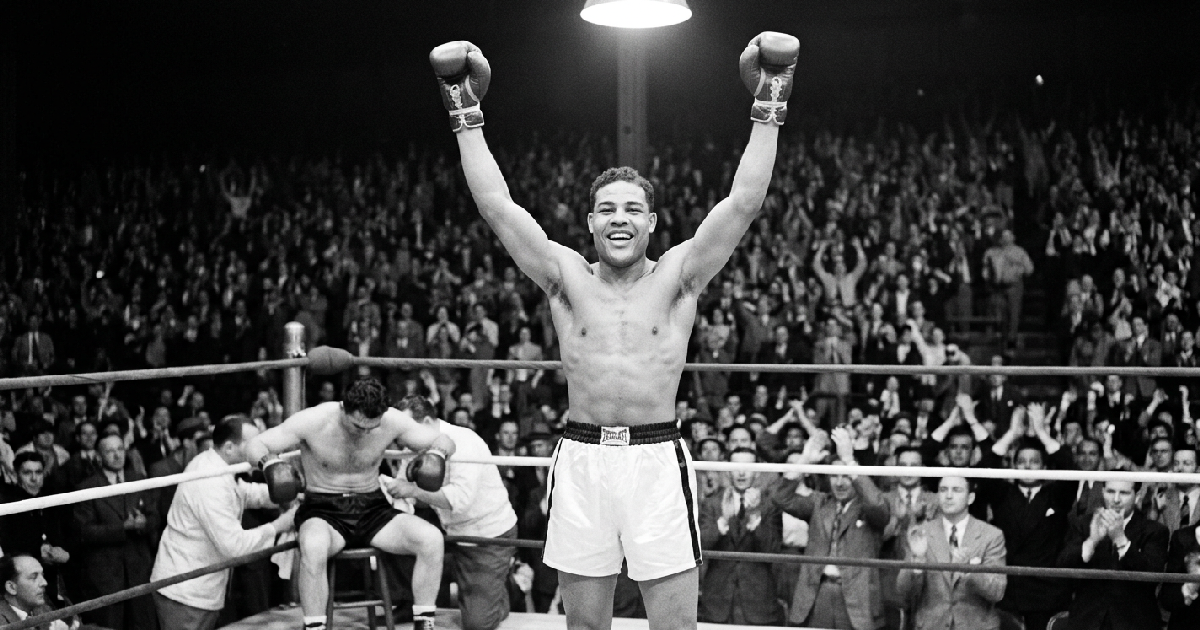
On June 22, 1938, Joe Louis defended his undisputed heavyweight championship by stopping Max Schmeling in just 124 seconds at Yankee Stadium in New York City. The rematch, which took place exactly 88 years ago today, saw Joe Louis avenge the only defeat of his professional career. In front of more than 70,000 spectators, the “Brown Bomber” delivered a performance that remains one of the most significant in sports history.
The bout was far more than a standard title defense. It occurred during a period of intense geopolitical tension between democracy and fascism. While Max Schmeling had won their first encounter in 1936 with a 12th-round knockout, Joe Louis entered the 1938 rematch with a record of 35-1 and the determination to prove his status as the true world champion.
Political stakes behind Joe Louis and Max Schmeling II
The fight carried a symbolic weight that extended across the Atlantic. Nazi Germany had recently annexed Austria, and the German government used Max Schmeling’s previous success to promote ideas of racial superiority. Despite being used as a propaganda figure, Max Schmeling never joined the Nazi party and notably provided sanctuary for Jewish families later that year.
Joe Louis felt the pressure of representing the United States. A few weeks before the contest, he visited the White House where President Franklin D. Roosevelt told him, “Joe, we need muscles like yours to beat Germany.” In a private moment with a friend before the fight, Joe Louis admitted to being uneasy, stating, “Yeah, I’m scared. I’m scared I might kill Schmeling.”
This level of individual burden is a rarity in the sport, though modern fans often seek similar high-stakes narratives, such as when Fury and Joshua are discussed for a future undisputed clash.
Financial and global impact of the Yankee Stadium rematch
The event was a massive commercial success, generating a gate of $1,015,012. This sum is equivalent to more than $23 million in today’s currency. Yankee Stadium was packed with celebrities, including Gary Cooper, Clark Gable, and J. Edgar Hoover. Beyond the stadium walls, the reach of the NBC network broadcast was unprecedented for the era.
An estimated 70 million people listened in the United States, while the global audience exceeded 100 million. Commentator Clem McCarthy described the broadcast as “the greatest fight of our generation.” The fight used 8-ounce Everlast gloves with horsehair padding, ensuring that every punch from the heavyweights carried maximum impact.
A 124-second demolition in New York
Joe Louis did not wait to find his rhythm. From the opening bell, he attacked the German challenger with a relentless barrage. During the brief contest, Joe Louis threw 41 punches and landed 31 of them. In contrast, Max Schmeling was only credited with throwing two punches as he struggled to cope with the champion’s speed and power.
A hard body shot visibly crippled Max Schmeling early in the round. Joe Louis then scored three consecutive knockdowns. Referee Arthur Donovan Sr. eventually stopped the fight at 2:04 of the first round. Although Max Schmeling’s cornerman, Max Machon, attempted to stop the punishment by throwing a towel into the ring, the fight was officially recorded as a technical knockout for Joe Louis.
Clinical aftermath and the physical toll on Max Schmeling
The power displayed by Joe Louis had immediate medical consequences. Max Schmeling was taken to a hospital following the defeat, where doctors confirmed he had suffered several cracked vertebrae in his back. Despite the short duration, the intensity of the exchange left lasting damage. Physical welfare remains a priority for modern heavyweights, as seen when Usyk raised brain health concerns after recent high-impact bouts.
Friendship forged in the wake of rivalry
Though they represented opposing national ideologies in 1938, the two fighters developed a deep personal bond in later years. Max Schmeling visited Joe Louis regularly in Las Vegas and provided financial support when the former champion faced personal hardships. Their relationship endured until Joe Louis’s death in 1981, at which point Max Schmeling traveled to the United States to serve as a pallbearer at the funeral.
The enduring legacy of the undisputed champion
Joe Louis went on to hold the heavyweight championship for nearly 12 years, completing a record 25 consecutive title defenses. The 1938 rematch remains the defining moment of his career, marking the point where he was universally embraced as a national hero. His ability to handle immense psychological and political pressure set a standard for technical excellence in the ring.
This pursuit of perfection continues to influence the sport today, as younger fighters like Shakur Stevenson focus on technical dominance to build their own legacies. The anniversary of Joe Louis vs Max Schmeling II serves as a reminder of when boxing stood at the very center of the global cultural conversation. At just 24 years old, the “Brown Bomber” changed the trajectory of the sport in just over two minutes.