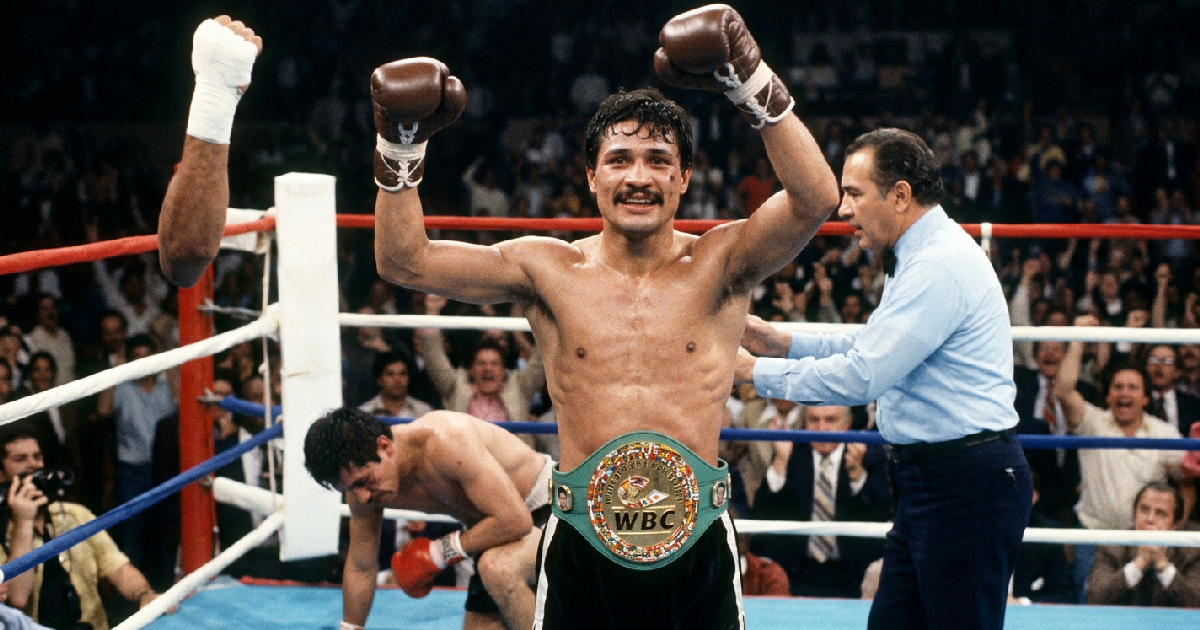
On Sunday, July 8, 1979, Alexis Argüello successfully defended his WBC super featherweight world title for the fifth time, defeating top contender Rafael Limón at the Felt Forum in New York City.
The Nicaraguan champion, known by the nicknames “El Flaco Explosivo” and “The Explosive Thin Man,” secured victory when referee Tony Perez stopped the contest at 1:40 of the 11th round. The technical knockout followed a systematic performance by the champion against a challenger widely respected for his toughness and punching power.
Argüello’s methodical dismantling of Limón
Facing the WBC’s No. 1-ranked contender, Alexis Argüello controlled the distance throughout the scheduled 15-round bout using his jab and a powerful straight right hand. Rafael Limón, a Mexican southpaw nicknamed “Bazooka,” remained aggressive despite suffering a cut over his right eye before the end of the opening round.
By the middle rounds, blood was pouring from beneath both Limón’s left and right eyes, yet the challenger continued moving forward in an attempt to engage at close range. However, he struggled to bridge the gap against the taller champion’s reach advantage.
Argüello, employing precision and patience, systematically broke down his opponent. His orthodox stance complemented his long jab, which consistently prevented Limón from launching his signature offensive flurries. This strategy kept the gritty Mexican fighter at a disadvantage, showcasing Argüello’s mastery of ring generalship.
The champion’s physical and tactical advantage
Alexis Argüello entered the ring at age 27, standing 5’10” with a reach of 72 inches, giving him a physical edge over the 5’8″ Rafael Limón. The champion relied heavily on his straight right hand, a weapon that consistently found its target as Limón pressed for an inside fight.
Limón, at 24 years old, was known for his relentless pressure, but Argüello’s defensive movements and counter-punching stifled many of his advances. The 20-foot ring size at the Felt Forum further allowed Argüello to dictate the pace and distance, preventing Limón from trapping him against the ropes.
While the Mexican contender remained competitive through the early stanzas, he was unable to produce a knockdown against the disciplined Nicaraguan. The precision of the champion’s accurate combinations led to early damage that defined the trajectory of the encounter.
The evolving scorecard and inevitable stoppage
The officiating crew, including referee Tony Perez and judges Eva Shain and Artie Ayala, oversaw a one-sided points tally as the fight progressed. According to the official scorecards at the time of the stoppage, Alexis Argüello held a commanding lead with scores of 99-93, 98-94, and 98-92.
These numbers reflected the champion’s ability to outscore the durable “Bazooka” while remaining out of range of the challenger’s most dangerous shots. The victory was a demonstration of why Argüello is often regarded alongside figures like Ken Buchanan as one of the most astute technical fighters in the sport’s history.
Referee Tony Perez’s decision
The cut above Limón’s right eye worsened throughout the bout, with blood also streaming from underneath his left eye. As the fight wore on, the accumulation of unanswered punches became too significant for Limón to continue. Referee Tony Perez made the decision to stop the contest in the 11th, prioritizing fighter safety.
The stoppage not only protected the bloodied Rafael Limón from further punishment but also reinforced Argüello’s dominance at 130 pounds. This defense followed his previous TKO win over Alfredo Escalera earlier in 1979 and preceded further successful defenses against Bobby Chacon and Rubén Castillo.
Refining the super featherweight championship legacy
This fight was Argüello’s fifth defense of the WBC super featherweight title, a belt he had won from Alfredo Escalera in their 1978 rematch. His prior defense against Escalera, a 13th-round TKO in February 1979, had set the stage for another dominant performance.
Argüello’s ability to remain calm against high-pressure styles was a hallmark of his reign, a trait occasionally seen in modern greats like Terence Crawford. His control and systematic approach highlighted why many considered him a pound-for-pound elite.
Limón’s perspective on facing an all-time great
In a later “Best I Faced” interview, Rafael Limón offered insight into Argüello’s formidable skills. He specifically praised Argüello’s jab, stating, “He was tall. He was thin. He had fast hands. He was a good fighter and also a good person. The right jab was very powerful because of the movement of his legs.”
Limón also acknowledged Argüello’s footwork, noting, “In the beginning, it was hard for him to adapt to my southpaw stance but he really was the best and soon started moving from side to side.” While Limón initially struggled to adapt to the champion’s lateral movement, the Mexican fighter displayed the grit that would eventually lead him to his own world title once Argüello vacated the division.
The 1979 clash served as a standard for tactical execution, much like how Oleksandr Usyk’s upcoming historic bouts are expected to showcase cross-disciplinary technical skills.
Future paths for Argüello and Limón
Alexis Argüello never lost his world championships in the ring, choosing instead to relinquish them to pursue glory in heavier weight classes. His career was marked by a strategic ascent through divisions, securing multiple world titles without a single in-ring loss of a belt.
After his super featherweight tenure, he captured the WBC lightweight title on June 20, 1981, against Jim Watt, becoming the sixth boxer to win world titles in three divisions. He later added the WBA junior welterweight championship, cementing his legacy as a three-division world champion and securing his place among boxing’s all-time greats.
His impressive professional record lists either 58-5-0 or 61-4-0 at the time of the Limón fight, showcasing a career that would ultimately lead to his induction into the International Boxing Hall of Fame in 1992. Argüello was also named the greatest junior lightweight of all time by The Ring Magazine in 1994 and the best Junior Lightweight of the 20th century by The Associated Press in 1999.
Rafael Limón eventually fulfilled his own championship ambitions by winning the WBC super featherweight title on December 11, 1980, after Argüello had moved up in weight. His professional debut in 1972 involved a first-round knockout over José García, and he won the NABF super featherweight title by 1978.
His career, spanning more than 75 professional fights, became best known for a celebrated four-bout rivalry with Bobby Chacon. Limón’s durability allowed him to share the ring with other era-defining names, including Héctor Camacho and Julio César Chávez, cementing his status as one of Mexico’s most rugged contenders. Currently, boxing fans look to prospects like Richard Torrez Jr. to bring similar levels of top-tier competition to the modern stage.
Legacy of two boxing legends
The bout between Alexis Argüello and Rafael Limón, though a decisive victory for Argüello, highlighted the contrasting styles and unwavering determination of both fighters. Argüello, born in Managua, Nicaragua, on April 19, 1952, overcame humble beginnings to become a global boxing icon. His journey from poverty to multiple world championships, and later to mayor of Managua, speaks volumes about his character and drive.
Limón, born in Tlaxco, Mexico, on January 13, 1954, also forged a remarkable career through sheer tenacity. His willingness to face anyone, irrespective of their reputation, earned him the respect of fans and peers alike. Even in defeat against Argüello, Limón’s performance underscored the toughness that characterized his “Bazooka” persona, a quality often admired in Mexican fighters.
This particular fight might not be the most frequently cited of Argüello