Speculation is mounting regarding Santos Saúl “Canelo” Álvarez Barragán’s perceived decline, particularly as he faces a potential formidable challenge from the undefeated Christian Mbilli. The question isn’t just if Canelo Alvarez is slowing down, but whether this apparent erosion of his signature skills will be too much when confronted by Mbilli’s relentless, high-volume attack.
This looming matchup pits Alvarez’s legendary boxing IQ against a physical onslaught that could exploit his recent vulnerabilities.
The shifting sands of Canelo Alvarez’s performance
Alvarez, with a professional record of 63 wins, 3 losses, 2 draws, and 39 knockouts, is undeniably a future Hall of Famer. However, recent performances against Jaime Munguia, Edgar Berlanga, William Scull, and most notably, Terence Crawford, have highlighted a disturbing trend. These bouts suggest a fighter who has lost a critical edge in speed, activity, and aggression, elements once central to his dominance.
The champion’s recent fights have painted a picture of a boxer who struggles to maintain the frenetic pace he once commanded. His last stoppage victory dates back to November 2021 against Caleb Plant. Since then, even against opponents theoretically suited to his style, he hasn’t managed to force an early finish, often fighting in short bursts and relying on isolated power punches.
Many observers point to the visible deterioration in Canelo Alvarez’s jab. Once a crucial tool that dictated distance and created openings against elite opponents like Gennadiy Golovkin and Callum Smith, it has reportedly transformed into a tentative, “pawing” motion. Opponents now parry it with minimal effort, allowing them to close the distance and negate one of his primary defensive layers.
A fading offensive arsenal
Beyond the jab, Canelo Alvarez’s multi-punch body combinations, a hallmark of his destructive power, have largely vanished. The explosive torque required for his classic downstairs-upstairs hook combinations seems to be a thing of the past. Instead, he often resorts to isolated overhand rights and looping hooks, which are easier for opponents to anticipate and counter before he can reset his guard.
This shift in his offensive approach makes him more predictable. It allows adversaries to brace for single shots, then retaliate effectively. Without the varied attack that once broke down opponents, Alvarez is finding it increasingly difficult to impose his will and create consistent damage, relying instead on moments of singular power.
Ring generalship and retreats
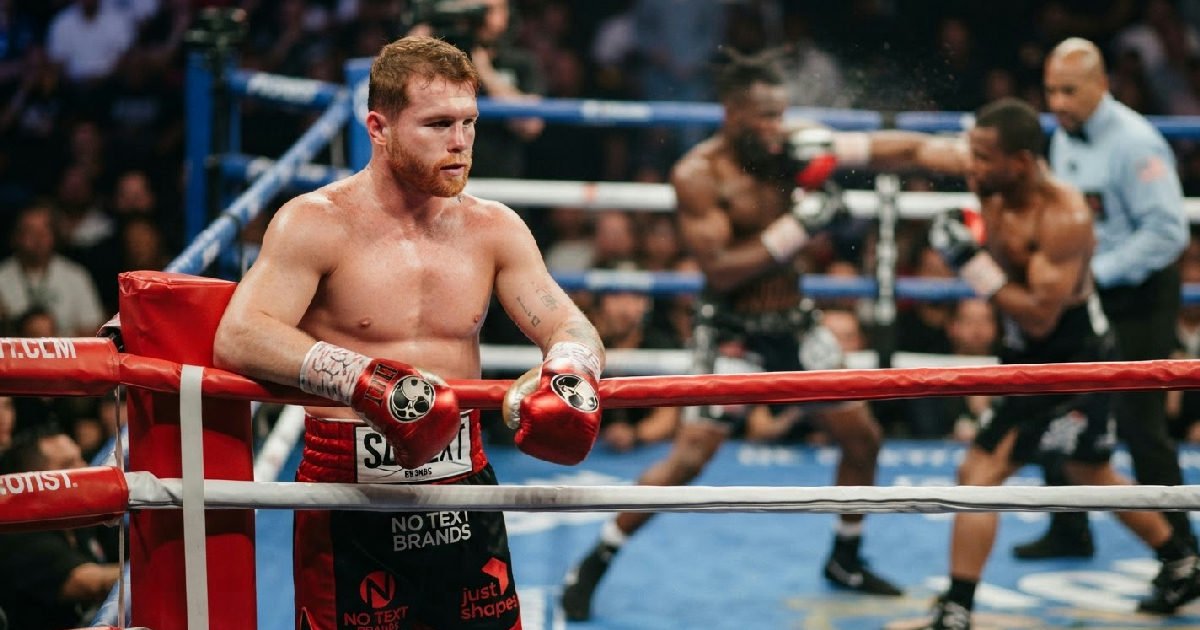
Another troubling pattern emerged in his bout against William Scull, where Alvarez spent significant stretches pinned against the ropes. While a younger Canelo Alvarez could dynamically rest through masterful trunk movement, the current version often retreats straight back, physically leaning on the cables to catch his breath. This passive posture surrenders ring generalship, influences judges, and can lead to him losing rounds due to inactivity.
Terence Crawford reportedly exploited these very tendencies, chasing Alvarez in straight lines and forcing him to load up on telegraphed blows. This inability to sustain output to shift the fight’s momentum is a stark contrast to his prime. While an elbow ailment provided a convenient excuse post-Crawford, analysts suggest this physical issue alone cannot account for the missing aggression seen in previous bouts.
Christian Mbilli’s relentless pressure and volume
Christian Mbilli, currently boasting an impressive 29-0-1 record with 24 knockouts, represents a stark stylistic challenge to the current iteration of Canelo Alvarez. Mbilli is renowned for his relentless tempo and high-volume punching. He attacks in waves, consistently pounding the torso, arms, and shoulders, even when clean head openings aren’t immediately available.
This aggressive, attrition-based style is particularly dangerous for an aging veteran who might be seeking moments to recover between exchanges. Mbilli’s willingness to ignore momentary breaks and continuously push the pace could severely test Alvarez’s stamina and resilience over twelve grueling rounds. He does not possess top-shelf technical defense, but his sheer output makes him a difficult puzzle to solve.
The toll of two decades: physical decline
Canelo Alvarez, who began his professional boxing career as a teenager in 2005, has accumulated over two decades of prize fights, intense gym wars, and brutal training camps. This extensive wear and tear have taken an inevitable toll on his body, impacting his joints, shoulders, knees, and arms. No amount of specialized training can entirely reverse the physical consequences of such a demanding career.
While working with Oleksandr Usyk for training insights has generated considerable buzz, Usyk’s tactical acumen and conditioning drills can’t turn back the clock on Alvarez’s reflexes or the condition of his legs. Furthermore, an extended period on the sidelines following joint surgery, reportedly over twelve months, rarely results in a fighter emerging revitalized.
Instead, it often produces a slower fighter, burdened with ring rust and forced to rely heavily on opportunistic single-shot counters.
Usyk’s influence and limits
Oleksandr Usyk’s presence in Alvarez’s camp brings undeniable prestige and invaluable tactical advice. Usyk is known for his intricate footwork and high-level boxing strategy, qualities that could theoretically benefit Alvarez. However, even the most astute coaching cannot fully compensate for the cumulative physical degradation that comes with more than twenty years in professional combat sports.
The fundamental physical attributes – speed, explosiveness, and sustained energy – are often the first to diminish with age and chronic wear. Usyk might refine Alvarez’s technique or provide new angles, but he cannot restore the youthful elasticity or boundless gas tank that marked Alvarez’s prime.
A clash of styles: brain vs. brawn
Alvarez’s Hall of Fame career was built on his ability to intimidate opponents, drawing them into low-output “chess matches” where his limited gas tank was never exposed. Fighters, wary of his explosive counter-punches, would stay on the outside, throw tentative jabs, and allow him to dictate a slow pace.
Thirty seconds of flashy combinations were often enough to win a round on the scorecards, letting him conserve energy for the rest of the fight.
Christian Mbilli, however, completely shatters this formula. He is a true volume merchant, unafraid to enter the pocket like a “bowling ball” and unleash 70 to 80 punches per round. His objective is to wear down opponents by relentlessly attacking their collarbones, biceps, and ribcage until their guard eventually drops from sheer exhaustion.
This style directly counters the cerebral, pace-controlling approach that defined Alvarez for so long.
The early rounds imperative
For Canelo Alvarez, the opening three rounds against Mbilli will be absolutely critical. If he cannot make Mbilli taste severe, concussive power early on, he faces a potentially horrific night.
Without the blazing hand speed of his younger days, Alvarez’s single-shot counters may simply bounce off Mbilli’s forehead, with the French-Canadian challenger continuing to drive forward relentlessly. This scenario would force Alvarez into a prolonged, high-intensity engagement he appears ill-equipped to handle.
The stakes are high, not just for this fight, but for Alvarez’s legacy. Should he struggle, future title challenges from other top contenders could become even more complicated.
The looming specter of a forced stoppage
Once Canelo Alvarez gets forced onto the ropes by Mbilli’s relentless assault, the fight could quickly devolve from a technical boxing match into a brutal war of attrition.
An aging fighter, carrying twenty years of wear, a surgically repaired elbow, and a visibly shallower engine, is unlikely to survive being battered along the cables for twelve continuous rounds. Mbilli’s style is designed to exploit precisely these vulnerabilities.
Should Alvarez spend the latter half of the fight covering up in a high shell while Mbilli unloads hooks to his sides, a referee or corner stoppage becomes a distinct possibility.
This isn’t merely about winning or losing on points; it’s about his ability to withstand a punishing beating from a younger, stronger, and relentlessly aggressive opponent. The focus shifts from his boxing brain to his physical durability, which is now more questionable than ever.
A decisive loss here could significantly alter perceptions of his longevity at the elite level within the super middleweight division.