
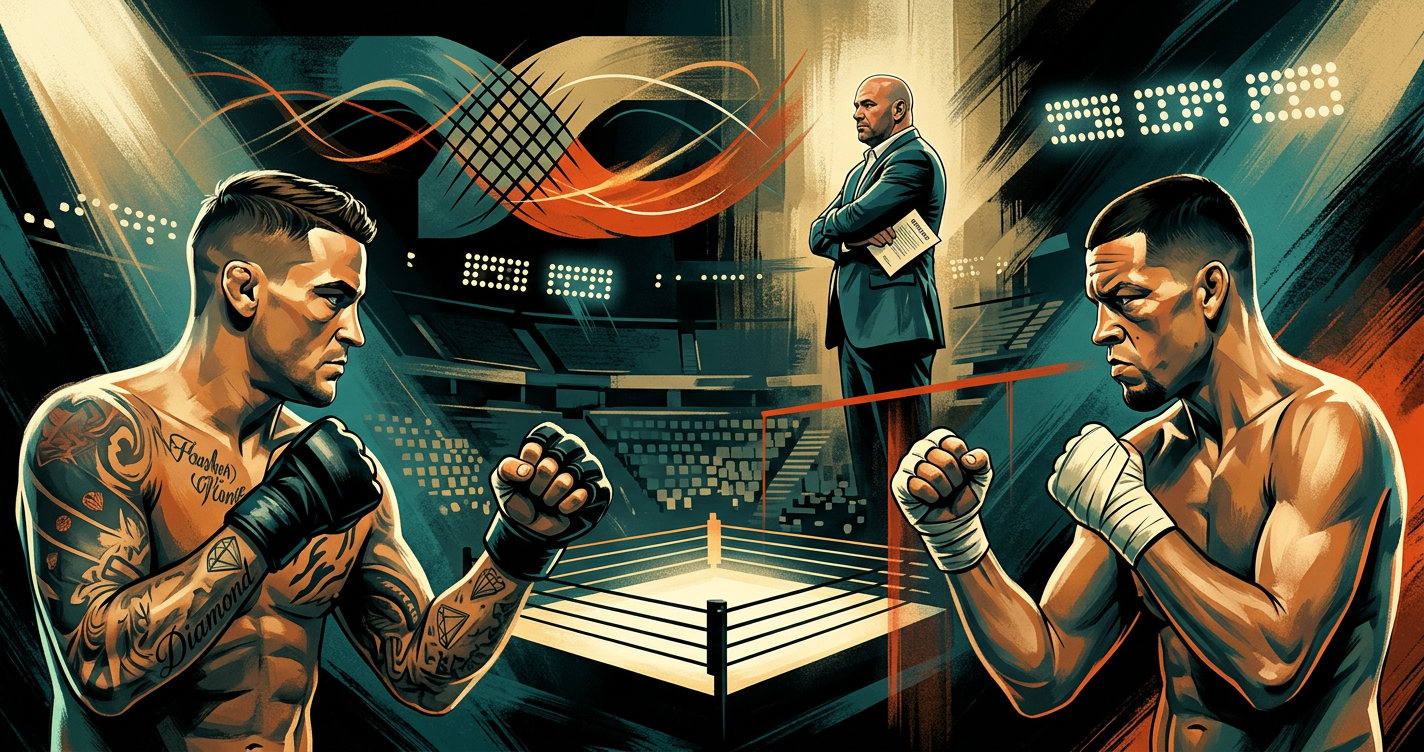
Dustin Poirier has shed light on why the long-rumoured boxing match between himself and Nate Diaz never materialized under the Zuffa Boxing banner. According to the former interim UFC lightweight champion, the venture spearheaded by Dana White ultimately walked away from the matchup because it failed to meet their criteria for a “crossover” spectacle.
The revelation comes at a time when the intersection of MMA and boxing has become a crowded marketplace. While fans have been clamouring for a Poirier-Diaz showdown for years—originally scheduled for the Octagon back at UFC 230 in 2018—the transition to the ring appeared to be the logical next step for two of combat sports’ biggest stars. But logic often bows to the ledgers of promoters.
The Crossover Conundrum
Poirier, speaking on the recent circuit of combat sports media, explained that Dana White’s boxing outfit viewed the fight as “just another match” rather than a unique event capable of bridging disparate audiences. The logic seems to be that because both men are known primarily as MMA fighters, putting them in 10-ounce gloves doesn’t offer the same novelty as a “Boxer vs. MMA” dynamic seen in bouts like Tyson Fury vs. Francis Ngannou.
“They wanted something that felt like a different world,” Poirier noted. “With me and Nate, it’s two guys who fans already know can fight. Zuffa was looking for that ‘crossover’ appeal—something that brings in the people who don’t usually watch us.”
This rejection highlights a shift in how promoters view the “influencer” and “crossover” era. It is no longer enough to have two household names; there has to be a clash of cultures or a perceived “impossible” scenario to drive the pay-per-view numbers Zuffa is chasing. For White, who has teased the launch of Zuffa Boxing for nearly a decade, the entry point needs to be a home run, not a ground-rule double.
The History of a Missed Opportunity
The rivalry between Poirier and Diaz is rooted in frustration and “what ifs.” Their 2018 Madison Square Garden booking fell apart due to a combination of Poirier’s hip injury and Diaz’s notorious contractual disputes. Since then, the two have traded barbs on social media with a frequency that suggested a fight was inevitable.
Diaz, now a free agent after completing his UFC tenure and testing the boxing waters against Jake Paul, has been vocal about his desire to fight at the highest level of prize fighting. But for Zuffa, the concern likely rested on the ceiling of the event. Without a pure boxer involved, or a massive celebrity angle, the risk-to-reward ratio didn’t tip in their favor.
It’s a tough pill for purists to swallow. A boxing match between Poirier and Diaz would undoubtedly be a high-paced, technical slugfest. Both men possess high-level striking and conditioning that puts many professional boxers to shame. But in the current economy of combat sports, “good fights” are often secondary to “big events.”
What This Says About Zuffa Boxing’s Future
The fact that Zuffa passed on this fight suggests that Dana White’s vision for boxing is far more selective than his approach to the UFC. While the UFC operates on a weekly volume-based model, Zuffa Boxing appears to be hunting for “tentpole” events only. They aren’t interested in being another PBC or Top Rank; they want to be the platform for the outliers.
This selective nature might explain why the promotion has been so slow to actually get off the ground. If a Poirier-Diaz fight isn’t big enough to trigger the green light, one wonders what is. Are they waiting for a Conor McGregor return to the ring? Or perhaps a co-promotion with a heavyweight titan? Whatever the case, the bar for entry is remarkably high.
In the meantime, Poirier remains one of the most bankable stars in the UFC, though his window for these massive “legacy” fights is narrowing. He has hinted at retirement several times, and every missed opportunity like this one brings him closer to hanging up the gloves for good. It’s a similar story for Diaz, who continues to march to the beat of his own drum, largely ignoring the traditional promotional structures.
The Landscape of Modern Prize Fighting
We are seeing a divergence in the sport. On one hand, you have the traditional boxing world where fighters like Michael Conlan face Kevin Walsh in regional homecomings, building local legacies. On the other, you have the “mega-fight” or nothing approach. Even seasoned champions are feeling the pressure to treat every outing as a spectacle. Sebastian Fundora recently noted he treats his high-stakes clash with Keith Thurman as just another fight, but the promoters certainly don’t see it that way.
For Poirier and Diaz, the missed Zuffa connection might just mean they look elsewhere. Most Likely, Real Fight Inc. (Diaz’s promotion) or a Middle Eastern suitor will eventually find the funds to make it happen. But the “crossover” tag remains an elusive hurdle for two men who are, quite simply, just very good at fighting.
Frequently Asked Questions
Why didn’t Poirier vs. Diaz happen in the UFC?
The fight was originally scheduled for November 2018 at UFC 230. However, Poirier suffered a hip injury that required surgery. Following that, contract disputes between Diaz and the UFC, combined with both fighters moving in different directions in the rankings, prevented the matchup from being rebooked.
Is Zuffa Boxing a real promotion?
Dana White has trademarked the name and talked about it for years, but it has yet to launch as a consistent, stand-alone boxing promotion. It currently exists more as a concept or a vehicle for specific, high-profile events rather than a traditional stable of fighters.
Can Poirier still box professionally?
Yes. While he is still under contract with the UFC, the promotion has shown a willingness to allow their superstars to compete in boxing if the deal makes sense for all parties—as seen with Conor McGregor and Francis Ngannou (though Ngannou had to leave the UFC to facilitate his boxing career).
” ,focus_keyword: