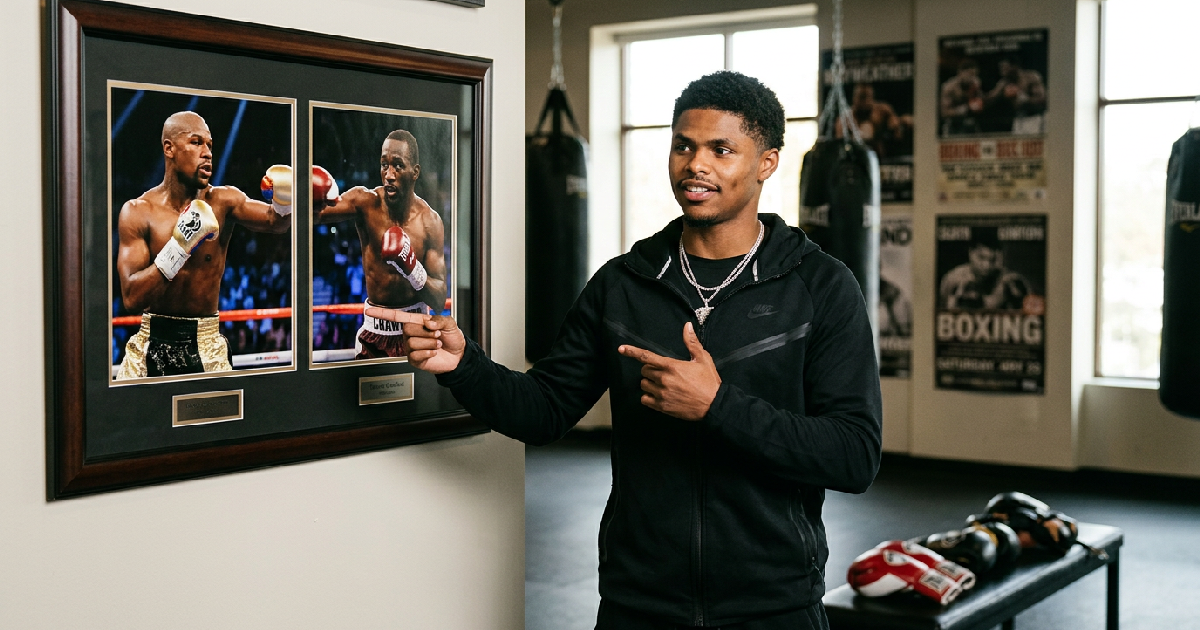
Shakur Stevenson has named Floyd Mayweather Jr. as the only fighter he believes could have defeated Terence Crawford in a prime-for-prime matchup. Speaking on The Agnew Podcast, the Newark-born champion described a hypothetical clash between the two icons as a “50/50” event that is too close to call.
Stevenson, a close friend and long-time training associate of Crawford, admitted that both men possess unique styles that make a definitive prediction nearly impossible.
The assessment comes as the boxing world continues to reflect on the legacy of Terence Crawford following his retirement. Crawford ended his professional career with an undefeated record after 42 fights, cementing his position as one of the sport’s all-time greats.
His final victory, a landmark win against Canelo Alvarez last September, saw him become a five-division world champion and drew immediate comparisons to the records held by Floyd Mayweather Jr.
While Terence Crawford has remained firm in his retirement, Terence Crawford rejected comeback rumors earlier this year during a high-profile fight week in Egypt. This has effectively frozen his professional stats at 42-0, leaving fans and pundits to debate how he would have fared against the defensive mastery of a prime “Money” Mayweather.
For Stevenson, the answer lies in the technical vulnerabilities each man occasionally showed during their respective reigns.
Shakur Stevenson breaks down the Mayweather vs Crawford tactical battle
Stevenson focused on stance and style when explaining why the fight would be so competitive. He pointed out that Floyd Mayweather Jr. occasionally struggled with southpaws during the earlier stages of his legendary career. Because Crawford often operates as a world-class southpaw, Stevenson believes he would have presented the most dangerous left-handed challenge Mayweather ever encountered, even considering his 2015 win over Manny Pacquiao.
“I think that Floyd, early on in his career, he struggled with southpaws; I feel like ‘Bud’ is probably going to be a southpaw and be the southpaw that he has ever been against,” Stevenson explained.
This specific tactical hurdle for Mayweather forms the basis of Stevenson’s belief that Crawford could have ended the Grand Rapids native’s famous winning streak. But the analysis was far from one-sided, as Stevenson also noted Crawford’s own career hurdles.
Vulnerabilities against orthodox opponents and past struggles
To balance his view, Stevenson recalled times when Crawford looked human in the ring. He cited the fighter’s bouts with Egidijus Kavaliauskas, known as “Mean Machine,” and Yuriorkis Gamboa as examples where Crawford faced early difficulties. Both opponents were orthodox fighters who managed to win rounds or catch Crawford cleanly before he adjusted his timing to secure the wins.
These minor lapses against right-handed specialists suggest that a tactician as precise as Floyd Mayweather Jr. would have found openings. Stevenson emphasized that the outcome would ultimately depend on which legend arrived in better condition and executed their game plan without error. “You just never know who would come in on point and win that fight,” Stevenson remarked, refusing to name a winner.
The legacy of two undefeated five-division world champions
The comparison between the two is natural given their shared achievements. Both men successfully navigated five different weight classes and retired without a professional defeat. Mayweather’s 50-0 record remains the gold standard for modern boxing, though his professional status could change if a mooted September rematch with Manny Pacquiao is sanctioned as a competitive bout rather than an exhibition.
Crawford’s rise to five-division supremacy was capped by his victory over Canelo Alvarez, a feat that mirrored the way Mayweather moved through weight classes to take on the biggest names of his era. While fans roast Shakur Stevenson at times for his social media presence, his technical understanding of what happens at the highest level of the sport remains highly respected by his peers.
Stevenson himself is currently navigating the same path toward multi-division greatness. He has been vocal about his own career choices, recently deciding to dismiss an immediate Devin Haney fight while focusing on his development. Observing the careers of Mayweather and Crawford has clearly influenced his perspective on how legacy is built through a combination of skill and strategic matchmaking.
How the southpaw factor defines the fantasy matchup
The core of the “50/50” argument rests on Crawford’s ability to switch stances. While Stevenson highlighted Crawford as a southpaw, “Bud” is famously comfortable in any position. This would force Mayweather—the most disciplined defensive fighter in history—to constantly reset his feet and shoulder roll. Mayweather’s ability to survive such a versatile attack is what makes the debate so enduring.
Ultimately, Stevenson’s comments serve to elevate both fighters rather than diminish either one. By labeling Mayweather as the only man capable of beating Crawford, he acknowledge’s Mayweather’s genius while simultaneously suggesting that Crawford was on a level above his contemporaries.
Without a time machine to pit their primes against each other, Stevenson’s analysis is likely as close to a definitive answer as the boxing world will get.
What happens next for the welterweight legends
As of June 2026, the paths of these two legends remain distinct. Crawford appears settled in his post-fight life, having secured his place in history with the Alvarez victory.
Mayweather continues to tease the boxing world with potential returns and exhibition matches, keeping his name in the headlines despite being decades removed from his physical peak. The Pacquiao rumors suggest the “Money” brand is far from finished.
For current stars like Stevenson, the focus remains on capturing the same aura of invincibility. Whether he can match the 50-0 standard or Crawford’s multi-belt dominance is a question for the coming years. For now, he remains the primary narrator of a rivalry that never happened in the ring but continues to dominate the conversation in the gym and on the airwaves.