
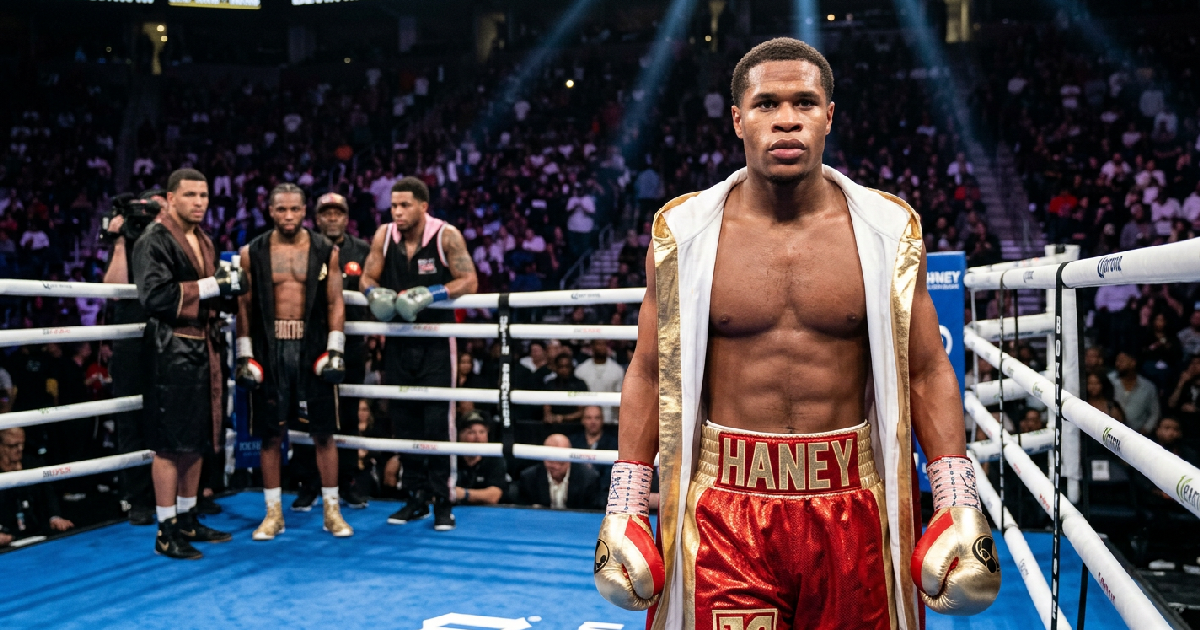
Veteran boxing trainer Stephen Edwards argues that Devin Haney is exerting a psychological grip over his contemporaries by demonstrating a consistent willingness to face dangerous opponents in the ring. In a recent analysis shared within the boxing community, the coach suggested that the fearlessness shown by the former undisputed champion creates a sense of unease among potential rivals, who are often left questioning what perceived weaknesses he sees in them to accept such risky assignments.
Stephen Edwards, known widely as “Breadman,” noted that in an era where top-tier athletes are frequently accused of over-protecting their undefeated records, the approach taken by Devin Haney stands out. By reportedly moving toward difficult challenges rather than away from them, he disrupts the typical leverage-based negotiations that have come to define modern matchmaking. This proactive stance is seen by some as a way to shift the mental advantage toward Devin Haney before a punch is ever thrown.
The sentiment from Stephen Edwards reflects a career path built on stern tests. While many young stars are criticized for “marinating” major events, Devin Haney has shared the ring with a gauntlet of elite talent including Vasiliy Lomachenko and George Kambosos Jr. Even after facing setbacks in high-profile encounters, the narrative around his competitive spirit remains a talking point, reinforcing his reputation as a fighter who does not shy away from the sport’s most dangerous boxers even when the odds are tight.
The Psychological Weight of Constant Risk
The assessment by Stephen Edwards focuses heavily on the mental state within the professional boxing fraternity. He suggested that when a champion actively seeks out the toughest threats, it forces those opponents to second-guess their own standing. In most high-level sports, athletes are accustomed to a dance of avoidance and tactical delays. When that pattern is broken by someone who demonstrates a genuine desire to fight anyone, it creates a unique kind of pressure.
Critics of Stephen Edwards’ view have pointed to recent results and the complexities of finalizing major bouts as potential hurdles in the “fight anyone” theory. However, the trainer’s core point remains that Devin Haney has consistently traveled to hostile territory or accepted high-risk scenarios that others might avoid. This trait is becoming a defining characteristic of his career, mirroring the legacy-focused paths of legendary figures who prioritized competition over protective management.
Building a Legacy Through Adversity
This willingness to face elite competition is seen by many as a direct challenge to the modern culture in boxing, where a single loss is often treated as a career-ending catastrophe. By disregarding the stigma of defeat in favor of meaningful competition, Devin Haney is carving out a niche that earns the respect of peers and trainers alike. This approach is increasingly rare in divisions where stars can make substantial money against lesser opposition.
The boxing world is currently navigating a period where veteran voices like Oscar De La Hoya have criticized the stalling of major matchups. In this context, the behavior of Devin Haney serves as a counter-narrative. Stephen Edwards emphasizes that while fans may focus primarily on results, fighters focus on the intent of their peers. When a rival appears leery of an opponent, it is often because that opponent lacks the usual hesitation associated with protecting a brand.
A Contrast to Defensive Matchmaking
In contrast to other rising stars who are currently navigating a patient path to world titles, Devin Haney has often accelerated his timeline. Whether it was traveling overseas to silence a boisterous crowd or facing legendary figures in Las Vegas, his resume serves as a primary psychological tool. Stephen Edwards believes this history of taking on all comers leaves opponents questioning where their own advantages lie.
Looking Toward Future Challenges
As Devin Haney considers his next steps in the sport, the question remains whether this psychological edge will continue to benefit him in the higher weight classes. His management has recently hinted at potential deals that would keep him at the forefront of the sport’s biggest events. If the analysis provided by Stephen Edwards holds true, the biggest hurdle for future opponents may not be the physical skill of Devin Haney, but the mental stress of facing a man who appears uniquely unafraid of risks.
The boxing community remains divided on his true standing at the top of the pound-for-pound lists, but his impact on the culture of matchmaking is frequently discussed. In an industry often characterized by caution, a fighter who is perceived to actively seek out danger is an anomaly that competitors find difficult to reconcile. His future trajectory is expected to continue following this high-stakes pattern.