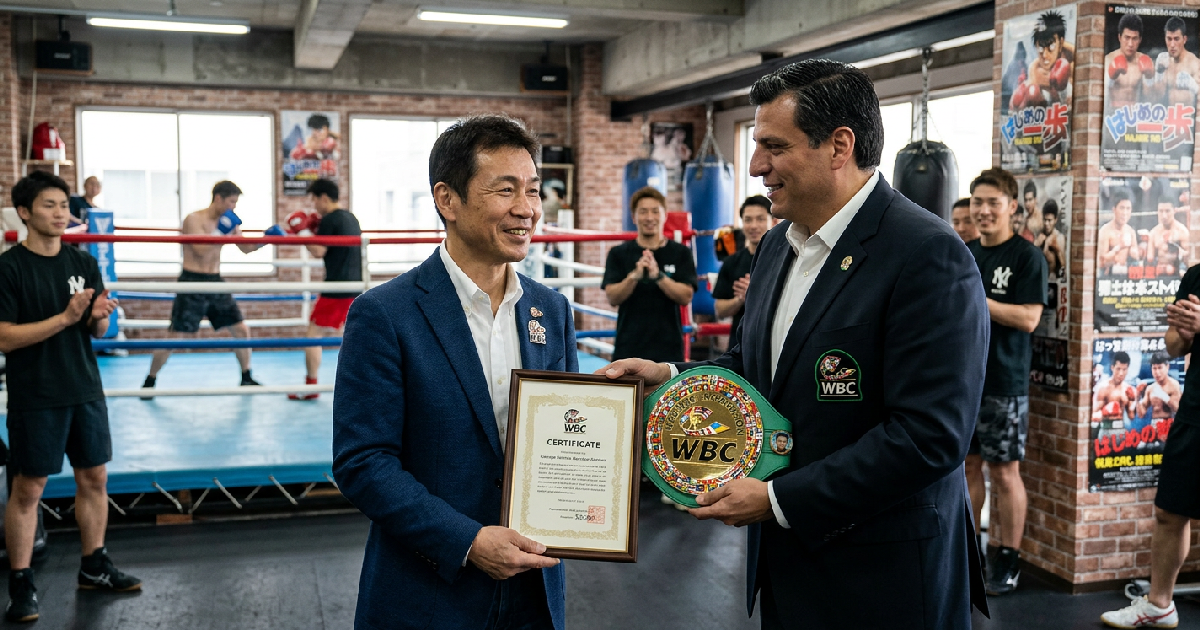
The World Boxing Council has moved to honor George Morikawa, the acclaimed creator of the boxing manga Hajime no Ippo, following reports of his recent discharge from the hospital. WBC leadership indicated that the tribute serves as a recognition of Morikawa’s lifelong dedication to the sport, bridging the world of illustrated fiction with the harsh realities of the professional ring.
Morikawa is a unique figure in the combat sports community. Beyond his work as an artist, he is a long-time gym owner and trainer, providing him with a technical perspective that few other creators possess. To celebrate his recovery and return to health, the WBC is reportedly commissioning a bespoke “Green and Gold” mini-belt. This symbolic gesture is usually reserved for the sport’s highest-achieving athletes, underscoring the respect Morikawa commands among the boxing elite.
A Symbolic Honor from the WBC Family
The commemorative belt is said to feature the signatures of several prominent figures within the WBC infrastructure. Among those mentioned in reports are Hall of Fame ring announcer Jimmy Lennon Jr. and former bantamweight world champion Shinsuke Yamanaka. The inclusion of Yamanaka is particularly meaningful given his status as one of Japan’s most respected former champions, reflecting the “warrior spirit” that Morikawa has spent decades depicting through his protagonists.
WBC President Mauricio Sulaimán has characterized the gift as a token of affection from the global boxing community. He noted that while boxing is a physical confrontation, its cultural footprint is often expanded by those who can translate the struggle of the gym into a narrative form. The WBC has increasingly looked to bridge the gap between traditional prize-fighting and modern media, much like how UFC owners defend massive investment in high-profile boxing crossovers to reach new audiences.
Technical Mastery on the Page
What distinguishes Morikawa’s work within the genre is an almost obsessive focus on technical accuracy. Drawing from his experiences at his own JB Sports Gym in Japan, he has spent his career studying the biomechanics of punching and footwork. His work is credited with reintroducing historical techniques to a modern audience, making maneuvers like the “Dempsey Roll” or the “Gazelle Punch” household names for a new generation of fight fans.
The story of Ippo Makunouchi—a shy youth who discovers self-worth through the discipline of boxing—has reportedly served as a significant recruitment tool for boxing clubs worldwide. By focusing on the grueling nature of weight cutting, the nuances of head movement, and the psychological burden of competition, Morikawa provides a realistic look at the grit required for the professional ranks. This dedication to the “sweet science” is a primary reason why his recovery has resonated so deeply with sanctioning body officials.
This tribute arrives at a time when the boxing world is navigating a transition between eras. While veteran stars like Manny Pacquiao signal a return for multi-fight comeback campaigns, the influence of Morikawa’s storytelling continues to act as a bridge between the sport’s storied history and its future prospects.
Commercial Longevity and Cultural Impact
Morikawa’s primary work stands as one of the longest-running serialized stories in the history of the medium. Its endurance is often attributed to the author’s ability to mirror the evolution of the sport itself. He does not solely focus on the triumphs of champions; he frequently explores the motivations of rivals and the quiet dignity of journeymen. This layered perspective reflects the complexities often found in the modern heavyweight rankings and schedules, where the narrative outside the ring is often as compelling as the action inside it.
With Morikawa now expected to continue his work following his medical release, the boxing world remains attentive to the next chapter of his journey. The “Green and Gold” mini-belt is a rare acknowledgment for a non-competitor, suggesting that for the WBC, promoting the values of the sport—discipline, respect, and perseverance—is worthy of the highest praise regardless of whether those values are demonstrated in a title fight or on the printed page.
The presentation is expected to take place in Japan through the WBC’s regional representatives, marking a quiet but significant moment in the intersection of sports and cultural arts.