
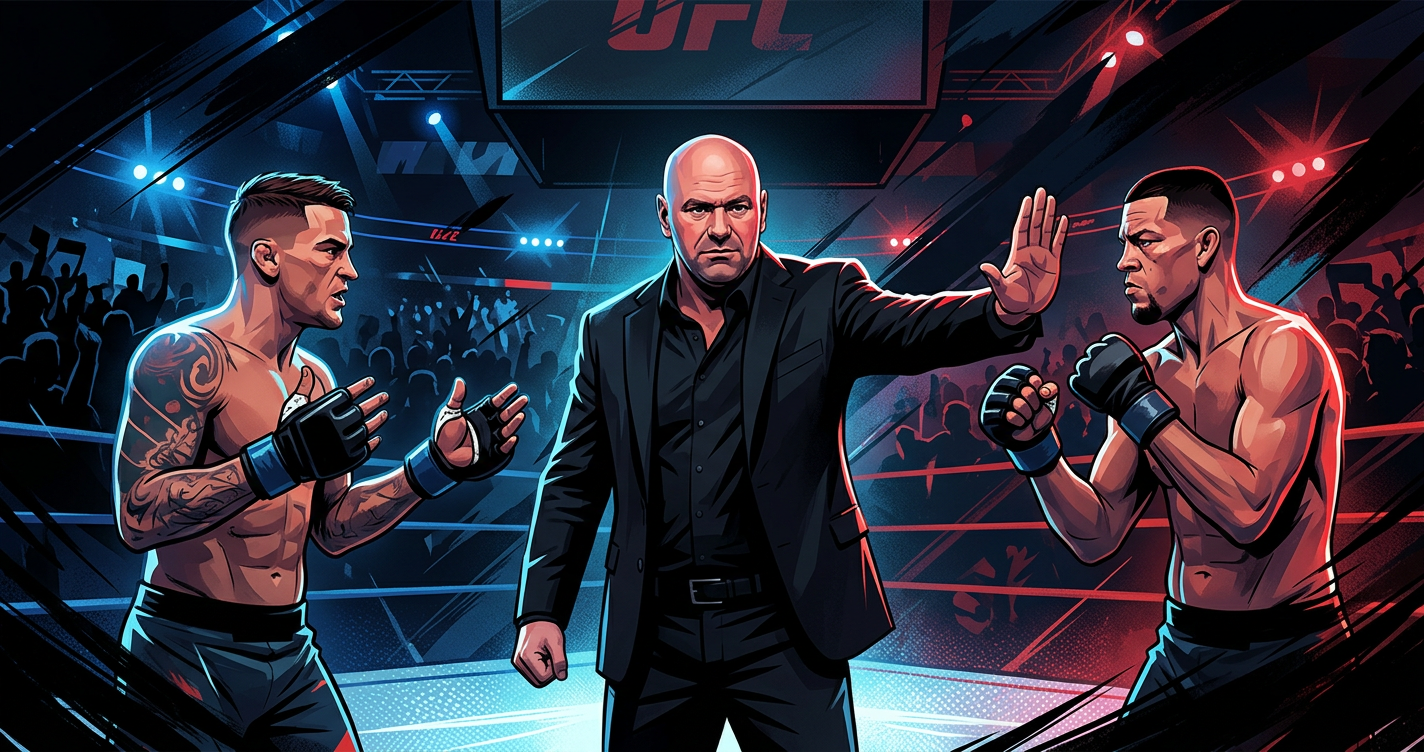
Dana White has built an empire on the philosophy that the best should fight the best, or at least that the fights he promotes should serve a long-term strategic purpose. This week, we saw that philosophy in action as the UFC CEO reportedly pulled the plug on a potential boxing match between former interim lightweight champion Dustin Poirier and fan-favorite Nate Diaz.
The decision wasn’t about missing out on a gate or a few hundred thousand pay-per-view buys. It was a calculated move by White, who is currently building the foundation for Zuffa Boxing. As he steps back into the squared circle, White seems determined to avoid the “celebrity circus” trap that has defined the influencer era of the sport. He isn’t interested in nostalgia for the sake of it, especially if it doesn’t translate to his specific vision for cross-sport promotion.
The logic behind the Poirier-Diaz rejection
For years, Poirier and Diaz have been linked to a clash. They were originally scheduled to meet at UFC 230 in 2018, a fight that fell apart due to injuries and contract disputes. Since Diaz left the UFC to pursue high-profile boxing matches—most notably his 2023 bout with Jake Paul—fans assumed a boxing ring would be the natural venue for their unfinished business.
However, reports indicate that when the proposal reached White’s desk, it was met with a firm “no.” The reasoning was simple: there was no “crossover” value. Unlike the spectacle of Conor McGregor vs. Floyd Mayweather, or even the recent heavyweight experiments featuring Francis Ngannou, Poirier and Diaz are fundamentally MMA fighters. Putting them in a boxing ring doesn’t create a new narrative; it just creates a lower-quality version of an MMA fight.
White’s rejection highlights a shift in how Zuffa Boxing intends to operate. Earlier this year, Dana White confirmed Zuffa Boxing launch plans, signaling that he wants to be a serious player in the traditional boxing space rather than just a promoter of “weird” events. Passing on Poirier vs. Diaz suggests he wants his brand associated with high-level pugilism, not just recycled UFC rivalries.
A different vision for the boxing ring
The modern boxing market is crowded. While the boxing broadcast landscape shifts as new players enter the market, White is looking for longevity. He has seen the diminishing returns of the “legends” circuit. While these names carry weight, the actual boxing frequently fails to live up to the price tag.
By passing on Poirier against Diaz, White is essentially saying that the “name value” isn’t enough to justify the brand dilution. Diaz’s performance against Jake Paul showed his limitations in a pure boxing environment, and Poirier, despite his elite striking in the Octagon, would be starting from scratch in a 10-ounce glove world. White apparently feels that if fans want to see these two fight, they should see them do what they are best at—mixed martial arts.
This disciplined approach is what the UFC boss thinks will set his boxing venture apart. He isn’t just looking for a quick cash grab. He’s looking for the next generation of stars who can compete at the championship level under the Zuffa banner. If he fills his early cards with aging UFC stars, he risks being viewed as another version of Triller or Gamebred Bare Knuckle—promotions that rely on name recognition over competitive relevance.
What this means for Poirier and the lightweight elite
Dustin Poirier remains one of the most respected figures in the fight game. But at this stage of his career, he is looking for massive events. If Zuffa Boxing isn’t the home for those events, Poirier might have to look toward independent promoters or simply return to the UFC for a final run at the gold.
The rejection also serves as a warning to other UFC veterans thinking about an easy transition to boxing under White’s wing. If you don’t bring a unique “crossover” appeal that expands the audience, you aren’t getting the call. Even high-profile names like Zuffa Boxing passed on Poirier against Diaz citing no crossover because the numbers simply didn’t justify the effort for a company trying to be taken seriously by the boxing establishment.
The wider boxing scene in 2026
While White is being selective, other promoters are leaning into the spectacle. We are still seeing major marquee events that prioritize star power over rankings. For instance, Tyson and Mayweather agree to April exhibition in Las Vegas, an event that will undoubtedly draw massive eyes but does little to move the sport’s competitive needle.
White is betting that fans will eventually tire of the gimmick fights. He wants to position Zuffa Boxing alongside the likes of PBC and Matchroom. We already see PBC stacking their cards, as PBC announces undercard for Benavidez vs Ramirez PPV, focusing on deep talent pools rather than celebrity matchups. White wants to occupy that same space, but with the marketing machine of the UFC behind it.
Looking ahead to a busy spring
The rejection of Poirier-Diaz doesn’t mean Zuffa Boxing will be quiet. White is reportedly looking at several “genuine” boxers to anchor his first few shows. He isn’t the only one making moves, either. The featherweight division is heating up, with Conlan nearing a WBC title shot against Carrington, and domestic scenes in the UK remain vibrant with fighters like Michael Conlan facing Kevin Walsh in Belfast.
Dana White is playing a long game. By saying no to a fight that would have surely been a financial success in the short term, he is attempting to protect the prestige of his new brand. Whether boxing fans will embrace him as a serious promoter—or if they will miss the fun of seeing UFC legends trade leather—remains to be seen.
Boxing Strategy FAQ
Why did Dana White reject the Poirier vs. Diaz boxing match?
White felt the fight lacked “crossover appeal.” Since both are primarily MMA fighters, he didn’t believe there was a compelling narrative for them to meet in a boxing ring rather than the Octagon. He’s trying to keep Zuffa Boxing focused on high-level, traditional boxing rather than gimmick matches.
Is Dana White done with “spectacle” fights entirely?
Not necessarily, but the bar is much higher now. Unless it’s an event on the scale of McGregor-Mayweather that brings in a massive new audience, White seems more interested in building a sustainable boxing promotion that can compete with established giants like PBC or Top Rank.
What will Dustin Poirier do next if he can’t box Diaz?
Poirier is in a tough spot. He’s an elite lightweight who doesn’t have much left to prove. He might take one more big UFC fight—perhaps a trilogy or a title eliminator—or wait for an independent boxing promoter to make an offer that doesn’t require UFC/Zuffa involvement, though his contract status usually makes that difficult.