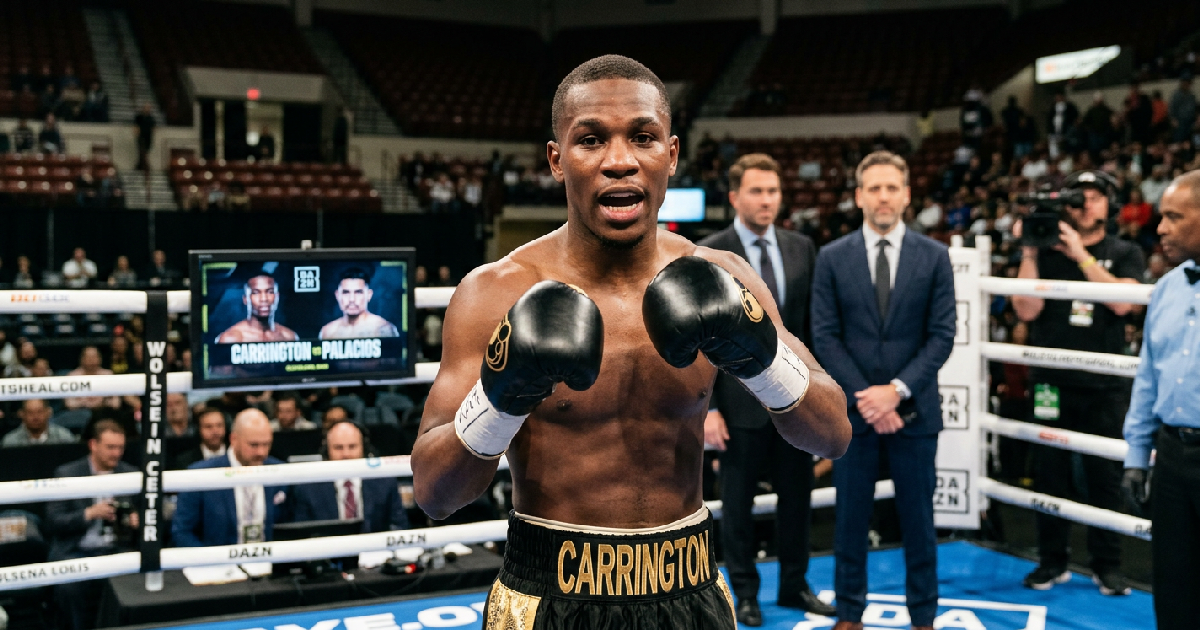
Undefeated WBC Featherweight Champion Bruce Carrington has responded to sharp criticism from the DAZN commentary team following his unanimous decision victory over Rene Palacios on Saturday, July 4, 2026. Speaking on Max Kellerman’s “Inside Ring” show, the 18-0 titleholder argued that former fighters serving as broadcasters should have a more nuanced understanding of the sport’s tactical demands.
The Brooklyn native defended his performance at the Wolstein Center in Cleveland, Ohio, where he secured scorecards of 118-110, 117-111, and 116-112. Despite the wide margins, the broadcast team focused on what they described as a “cautious pace” and “lack of urgency.” Carrington expressed frustration that those who have competed professionally would judge a world title defense solely on its entertainment value or knockout potential.
Bruce Carrington challenges former fighters on the DAZN broadcast
The tension following the bout highlights the frequent disconnect between a champion’s strategic goals and the broadcast’s demand for action. While Carrington controlled much of the ring with his jab, the commentary underscored several moments where the champion appeared vulnerable, including a disputed knockdown sequence in the eighth round and heavy body shots in the penultimate frame.
During his appearance on Max Kellerman’s “Inside Ring,” Bruce Carrington was asked directly if he felt the television coverage was fair. He was quick to point out the background of the analysts, noting that their personal experience in the ring should inform a more balanced perspective of his defensive work.
“No, I don’t think so, especially being that these guys are fighters in their own right,” Carrington stated. He argued that the complexities of high-level boxing mean that not every contest will result in a spectacular finish.
While he acknowledged the “entertainment aspect” for fans, he reiterated that his priority remains finishing the job and securing the win, regardless of the crowd’s reaction or the analysts’ desire for a demonstration of boxing that prioritizes offense.
Carrington’s philosophy rests on the idea of the “Shu Shu show,” a moniker he uses to describe his calculated approach. “Remember what a Shu Shu show is, bro. It’s just as simple as that,” he told Kellerman.
This incident mirrors other high-pressure situations in the sport where external expectations clash with tactical reality, much like when a contract dispute stalls negotiations and shifts focus away from the competitive merits of a matchup.
Dissecting the controversial eighth round and referee Harvey Dock’s ruling
A central point of the DAZN team’s critique involved an incident in round eight where Carrington went to one knee. Referee Harvey Dock ruled the moment a slip, even as Carrington protested that he had been hit behind the head.
However, television replays appeared to show the punch landing legally on the side of the head, sparking a debate about whether a knockdown should have been credited to Rene Palacios.
The commentary team noted that Carrington remained on the canvas for a significant duration, raising questions about whether he would have beaten a ten-count had Dock ruled it a knockdown. This moment of uncertainty provided the narrative hook for critics who argued Carrington was fighting too safely against an opponent many expected him to dominate more convincingly.
Carrington remained steadfast that the blow was illegal. Nevertheless, the highlight reinforced the broadcast’s focus on his safety-first approach. For the champion, the fixation on one disputed sequence ignored the technical mastery he felt he displayed over the course of the twelve rounds in Cleveland.
Statistical dominance versus the eleventh round body shots
Despite the negative reception from the booth, the official scorecards reflected a clear victory for the champion. Carrington utilized his 72-inch reach to keep Palacios at distance, a strategy that led to audible boos from sections of the crowd at the Wolstein Center. Carrington admitted he heard the crowd but insisted he remained focused on “getting the dub.”
The fight’s most precarious moment for the titleholder arrived in the eleventh round. Palacios landed a hard left hand to the body that visibly troubled Carrington, forcing him to bend over and clinch to recover.
The broadcast team used this as evidence that Carrington may struggle when pressured by elite-tier punchers in a division that is increasingly viewed as entering a new golden era of competition.
Carrington notably offered a candid self-assessment after the fight, grading his performance as a “C.” He admitted he should have utilized more angles and thrown more combinations. However, he maintained that winning a world title defense while not at one’s best is a sign of a high-level operator, even if the “Shu Shu show” didn’t deliver the fireworks the network’s former-fighter commentators desired.
Future unification plans for the WBC champion
With a record of 18-0 and 10 knockouts, Bruce Carrington is now looking toward the other champions at 126 pounds. He expressed a clear desire for unification bouts to solidify his standing as the best in the featherweight class. Names mentioned for potential clashes include IBF champion Angelo Leo, WBA titleholder Brandon Figueroa, and WBO champion Rafael Espinoza.
The champion’s path forward will likely involve addressing the criticisms of his offensive output while maintaining the defensive shell that has kept him undefeated. Every world-class fighter faces a performance that draws scrutiny, but Carrington’s firm response suggests he has no intention of changing his tactical identity to appease broadcasters.
As he targets a return later in the year, the “Shu Shu” brand will remain under the microscope. Whether the Cleveland performance was a one-off struggle or a blueprint for future opponents to exploit the champion’s body remains the primary question for the featherweight elite.
For now, Carrington retains his green belt and his conviction that victory is the only statistic that truly matters in a boxing ring.